QUESTION IMAGE
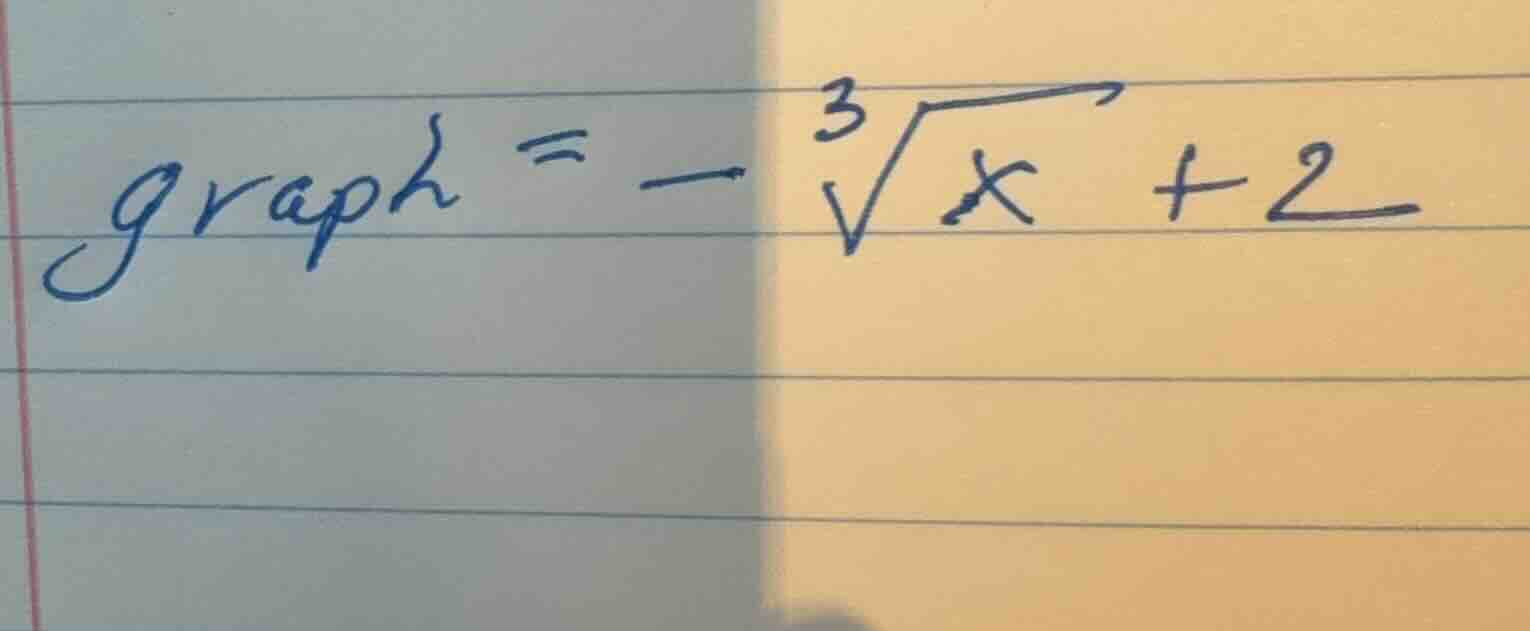
Question
graph \\( = -\sqrt3{x} + 2 \\)
⚡ Using: combining transformations · 🆕 New: graphing radical functions
How to sketch and shift root curves
Step 1: Identify the parent function
The base function (parent function) is:
$$ y = \sqrt[3]{x} $$
This is a cube root function, which has an "S-shape" (or propeller shape) passing through key points:
- \( (-8, -2) \)
- \( (-1, -1) \)
- \( (0, 0) \)
- \( (1, 1) \)
- \( (8, 2) \)
Step 2: Apply transformations
We apply two transformations to the parent function \( y = \sqrt[3]{x} \) to get \( y = -\sqrt[3]{x} + 2 \):
- Reflection over the x-axis: The negative sign in front, \( -\sqrt[3]{x} \), flips the graph vertically.
- Positive \( y \)-values become negative, and negative \( y \)-values become positive.
- Vertical shift up by 2 units: Adding 2 at the end, \( + 2 \), shifts the entire flipped graph upward by 2 units.
Step 3: Find key points for the new graph
We apply these transformations to our key \( x \)-values:
- For \( x = -8 \):
$$ y = -\sqrt[3]{-8} + 2 = -(-2) + 2 = 4 \implies (-8, 4) $$
- For \( x = -1 \):
$$ y = -\sqrt[3]{-1} + 2 = -(-1) + 2 = 3 \implies (-1, 3) $$
- For \( x = 0 \) (the inflection point):
$$ y = -\sqrt[3]{0} + 2 = 0 + 2 = 2 \implies (0, 2) $$
- For \( x = 1 \):
$$ y = -\sqrt[3]{1} + 2 = -1 + 2 = 1 \implies (1, 1) $$
- For \( x = 8 \):
$$ y = -\sqrt[3]{8} + 2 = -2 + 2 = 0 \implies (8, 0) $$
Step 4: Sketch the graph
- Plot the calculated points: \( (-8, 4) \), \( (-1, 3) \), \( (0, 2) \), \( (1, 1) \), and \( (8, 0) \).
- Draw a smooth, continuous curve through these points.
- The curve should be nearly vertical as it passes through the inflection point at \( (0, 2) \), flattening out as it goes far to the left and right.

Snap & solve any problem in the app
Get step-by-step solutions on Sovi AI
Photo-based solutions with guided steps
Explore more problems and detailed explanations
To graph \( y = -\sqrt[3]{x} + 2 \):
- Start with the standard cube root curve \( y = \sqrt[3]{x} \).
- Flip it vertically across the x-axis (so it goes down from left to right instead of up).
- Shift the entire curve up by 2 units.
Key points to plot:
- \( (-8, 4) \)
- \( (-1, 3) \)
- \( (0, 2) \) (the center inflection point)
- \( (1, 1) \)
- \( (8, 0) \) (the x-intercept)