QUESTION IMAGE
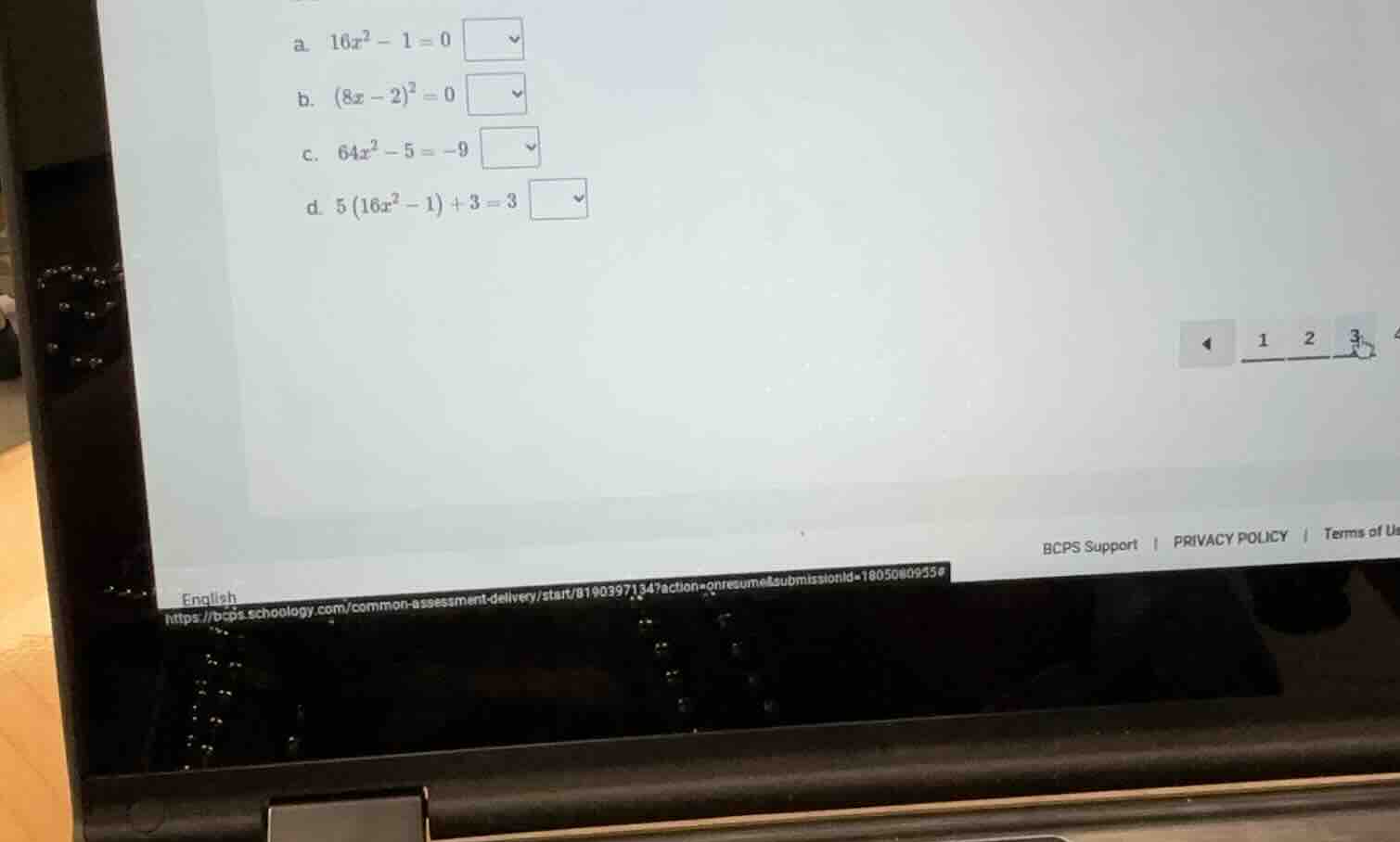
Question
a. $16x^2 - 1 = 0$
b. $(8x - 2)^2 = 0$
c. $64x^2 - 5 = -9$
d. $5(16x^2 - 1) + 3 = 3$
To determine which equations are equivalent to \(16x^2 - 1 = 0\), we analyze each option:
Option a: \(16x^2 - 1 = 0\)
This is the original equation, so it is equivalent.
Option b: \((8x - 2)^2 = 0\)
Expand \((8x - 2)^2\):
\((8x - 2)^2 = 64x^2 - 32x + 4 = 0\)
Divide by 4: \(16x^2 - 8x + 1 = 0\), which is \((4x - 1)^2 = 0\), not equivalent to \(16x^2 - 1 = 0\).
Option c: \(64x^2 - 5 = -9\)
Add 9 to both sides: \(64x^2 + 4 = 0\)
Divide by 4: \(16x^2 + 1 = 0\), not equivalent to \(16x^2 - 1 = 0\).
Option d: \(5(16x^2 - 1) + 3 = 3\)
Subtract 3 from both sides: \(5(16x^2 - 1) = 0\)
Divide by 5: \(16x^2 - 1 = 0\), which matches the original equation. Thus, it is equivalent.
- Option a is the original equation.
- Option d simplifies to \(16x^2 - 1 = 0\) (subtract 3, divide by 5).
- Options b and c do not simplify to \(16x^2 - 1 = 0\).

Snap & solve any problem in the app
Get step-by-step solutions on Sovi AI
Photo-based solutions with guided steps
Explore more problems and detailed explanations
a. \(16x^2 - 1 = 0\)
d. \(5(16x^2 - 1) + 3 = 3\)