QUESTION IMAGE
Question
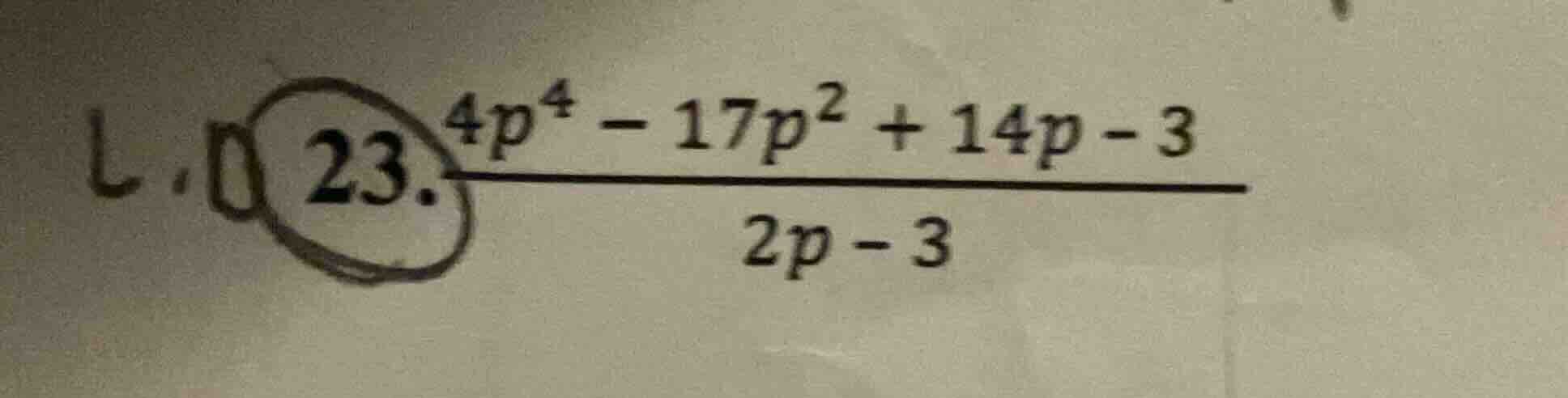
- \\(\dfrac{4p^4 - 17p^2 + 14p - 3}{2p - 3}\\)
Step1: Divide the leading term
Divide the leading term of the numerator \(4p^4\) by the leading term of the denominator \(2p\) to get \(2p^3\). Multiply the denominator \(2p - 3\) by \(2p^3\) to get \(4p^4 - 6p^3\). Subtract this from the numerator:
Step2: Divide the new leading term
Divide the leading term \(6p^3\) by \(2p\) to get \(3p^2\). Multiply the denominator by \(3p^2\) to get \(6p^3 - 9p^2\). Subtract this from the previous result:
Step3: Divide the new leading term
Divide the leading term \(-8p^2\) by \(2p\) to get \(-4p\). Multiply the denominator by \(-4p\) to get \(-8p^2 + 12p\). Subtract this from the previous result:
Step4: Divide the new leading term
Divide the leading term \(2p\) by \(2p\) to get \(1\). Multiply the denominator by \(1\) to get \(2p - 3\). Subtract this from the previous result:
Step5: Combine the results
The quotient is the sum of the terms we found: \(2p^3 + 3p^2 - 4p + 1\) and the remainder is \(0\).

Snap & solve any problem in the app
Get step-by-step solutions on Sovi AI
Photo-based solutions with guided steps
Explore more problems and detailed explanations
\(2p^3 + 3p^2 - 4p + 1\)