QUESTION IMAGE
Question
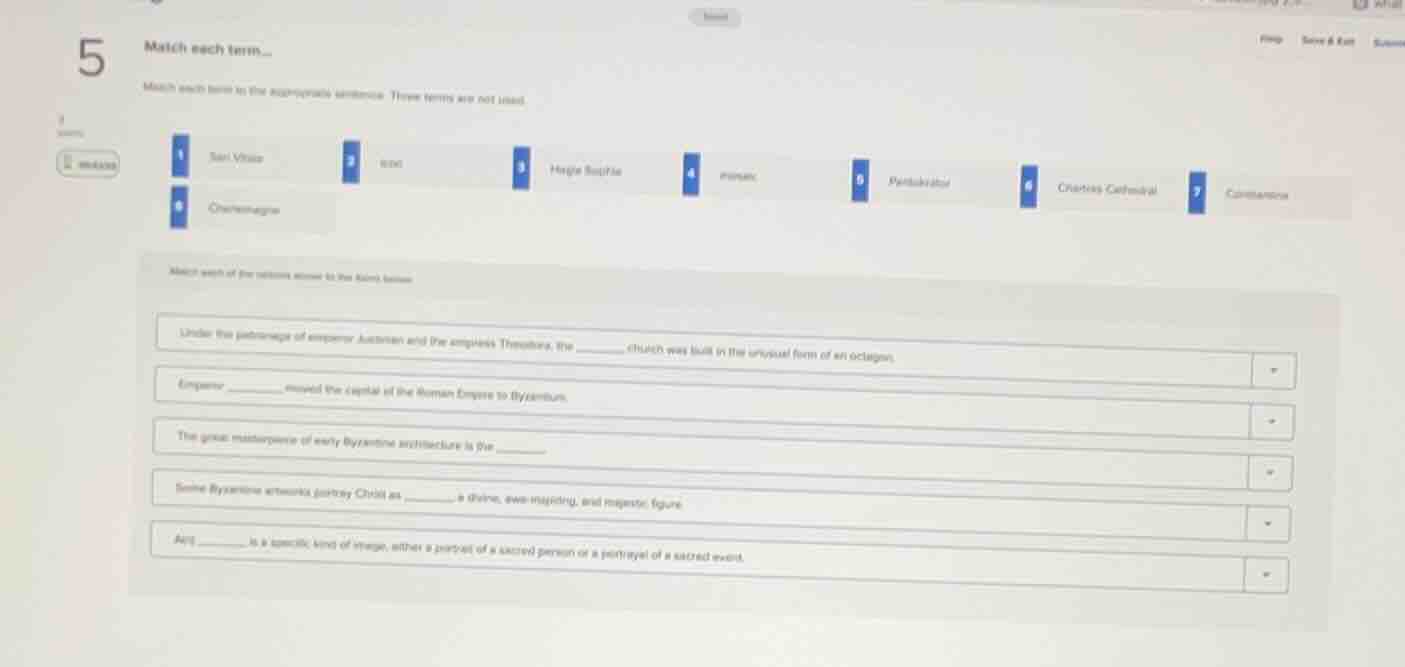
match each term...
match each term to the appropriate sentence. three terms are not used.
- san vitale
- icon
- hagia sophia
- mosaic
- pantokrator
- chartres cathedral
- constantine
- charlemagne
match each of the options above to the items below.
- under the patronage of emperor justinian and the empress theodora, the ______ church was built in the unusual form of an octagon.
- emperor ______ moved the capital of the roman empire to byzantium.
- the great masterpiece of early byzantine architecture is the ______.
- some byzantine artworks portray christ as ______, a divine, awe-inspiring, and majestic figure.
- an ______ is a specific kind of image, either a portrait of a sacred person or a portrayal of a sacred event.
Identify the octagonal church
The first sentence mentions a church built in the unusual form of an octagon under the patronage of Emperor Justinian and Empress Theodora. This refers to the church of San Vitale in Ravenna, which is famous for its octagonal plan and its mosaics.
We apply the San Vitale Mosaics concept here.
Identify the emperor who moved the capital
The second sentence asks for the emperor who moved the capital of the Roman Empire to Byzantium. This historical figure is Constantine the Great, who renamed the city Constantinople.
We apply the Byzantine Art Characteristics concept here.
Identify the early Byzantine masterpiece
The third sentence asks for the great masterpiece of early Byzantine architecture. This is the Hagia Sophia in Constantinople (modern-day Istanbul), built under Justinian.
We apply the Byzantine Art Characteristics concept here.
Identify the portrayal of Christ
The fourth sentence describes Byzantine artworks portraying Christ as a divine, awe-inspiring, and majestic figure. This specific representation is known as the Pantokrator (Christ Pantokrator, meaning "Ruler of All").
We apply the Byzantine Art Characteristics concept here.
Identify the specific kind of image
The fifth sentence defines a specific kind of image, either a portrait of a sacred person or a portrayal of a sacred event. This is the definition of an icon.
We apply the Byzantine Art Characteristics concept here.

Snap & solve any problem in the app
Get step-by-step solutions on Sovi AI
Photo-based solutions with guided steps
Explore more problems and detailed explanations
Question 1
Under the patronage of emperor Justinian and the empress Theodora, the <blank>San Vitale</blank> church was built in the unusual form of an octagon.
Question 2
Emperor <blank>Constantine</blank> moved the capital of the Roman Empire to Byzantium.
Question 3
The great masterpiece of early Byzantine architecture is the <blank>Hagia Sophia</blank>.
Question 4
Some Byzantine artworks portray Christ as <blank>Pantokrator</blank>, a divine, awe-inspiring, and majestic figure.
Question 5
An <blank>icon</blank> is a specific kind of image, either a portrait of a sacred person or a portrayal of a sacred event.