QUESTION IMAGE
Question
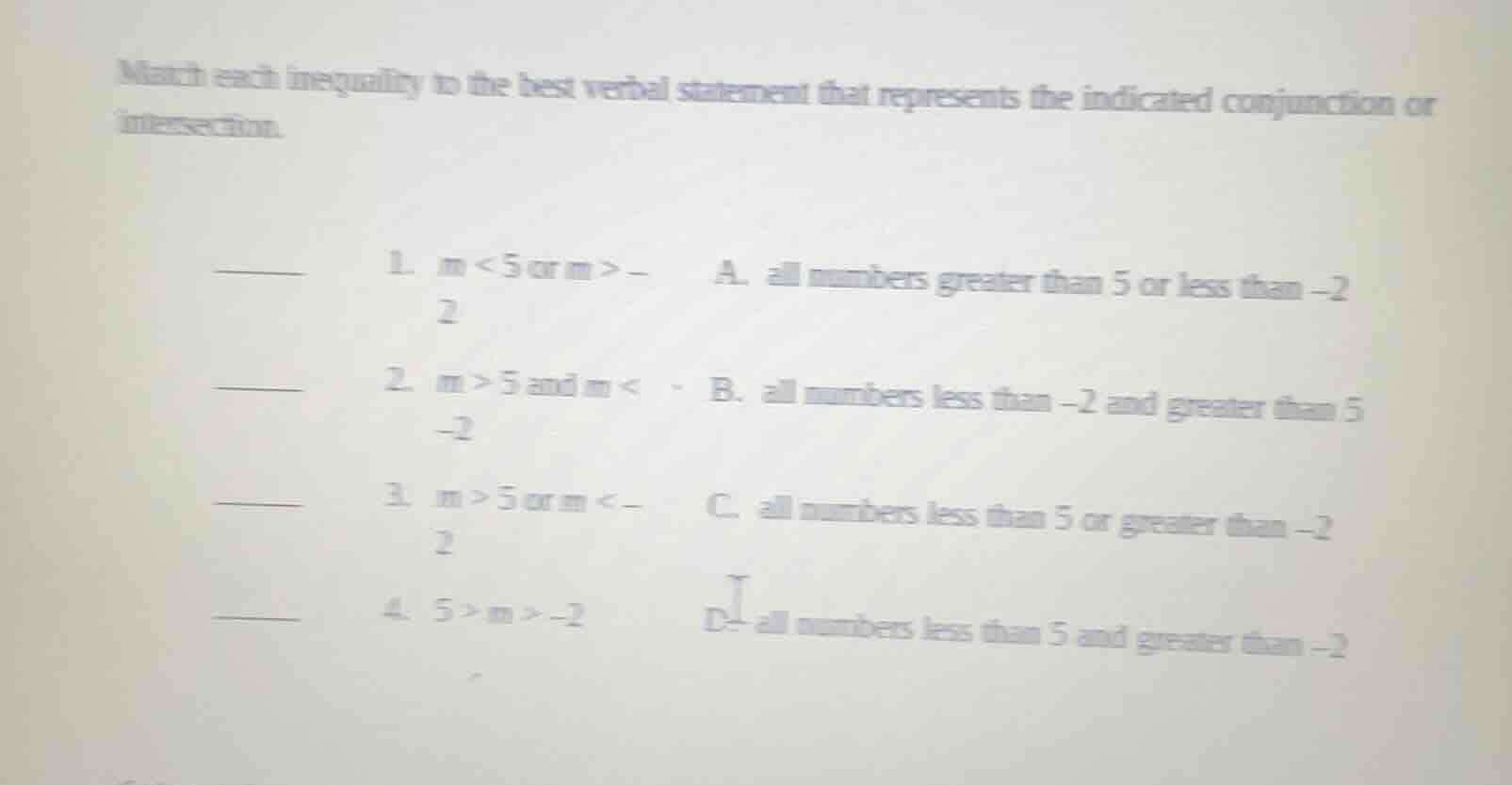
match each inequality to the best verbal statement that represents the indicated conjunction or intersection.
- $m < 5$ or $m > -2$ a. all numbers greater than 5 or less than -2
- $m > 5$ and $m < -2$ b. all numbers less than -2 and greater than 5
- $m > 5$ or $m < -2$ c. all numbers less than 5 or greater than -2
- $5 > m > -2$ d. all numbers less than 5 and greater than -2
for each match:
1. Analyze \( m < 5 \) or \( m > -2 \)
The inequality \( m < 5 \) or \( m > -2 \) means we are looking for numbers that are either less than 5 or greater than -2. This matches option C.
2. Analyze \( m > 5 \) and \( m < -2 \)
The inequality \( m > 5 \) and \( m < -2 \) means we need numbers that are both greater than 5 and less than -2. But since a number can't be both greater than 5 and less than -2 at the same time, the verbal statement is "all numbers less than -2 and greater than 5" (even though there are no such real numbers, the verbal description matches the structure), which is option B.
3. Analyze \( m > 5 \) or \( m < -2 \)
The inequality \( m > 5 \) or \( m < -2 \) means numbers that are either greater than 5 or less than -2, which is option A.
4. Analyze \( 5>m>-2 \)
The inequality \( 5 > m > -2 \) means \( m \) is greater than -2 and less than 5, which is "all numbers less than 5 and greater than -2", option D.

Snap & solve any problem in the app
Get step-by-step solutions on Sovi AI
Photo-based solutions with guided steps
Explore more problems and detailed explanations
- C
- B
- A
- D