QUESTION IMAGE
Question
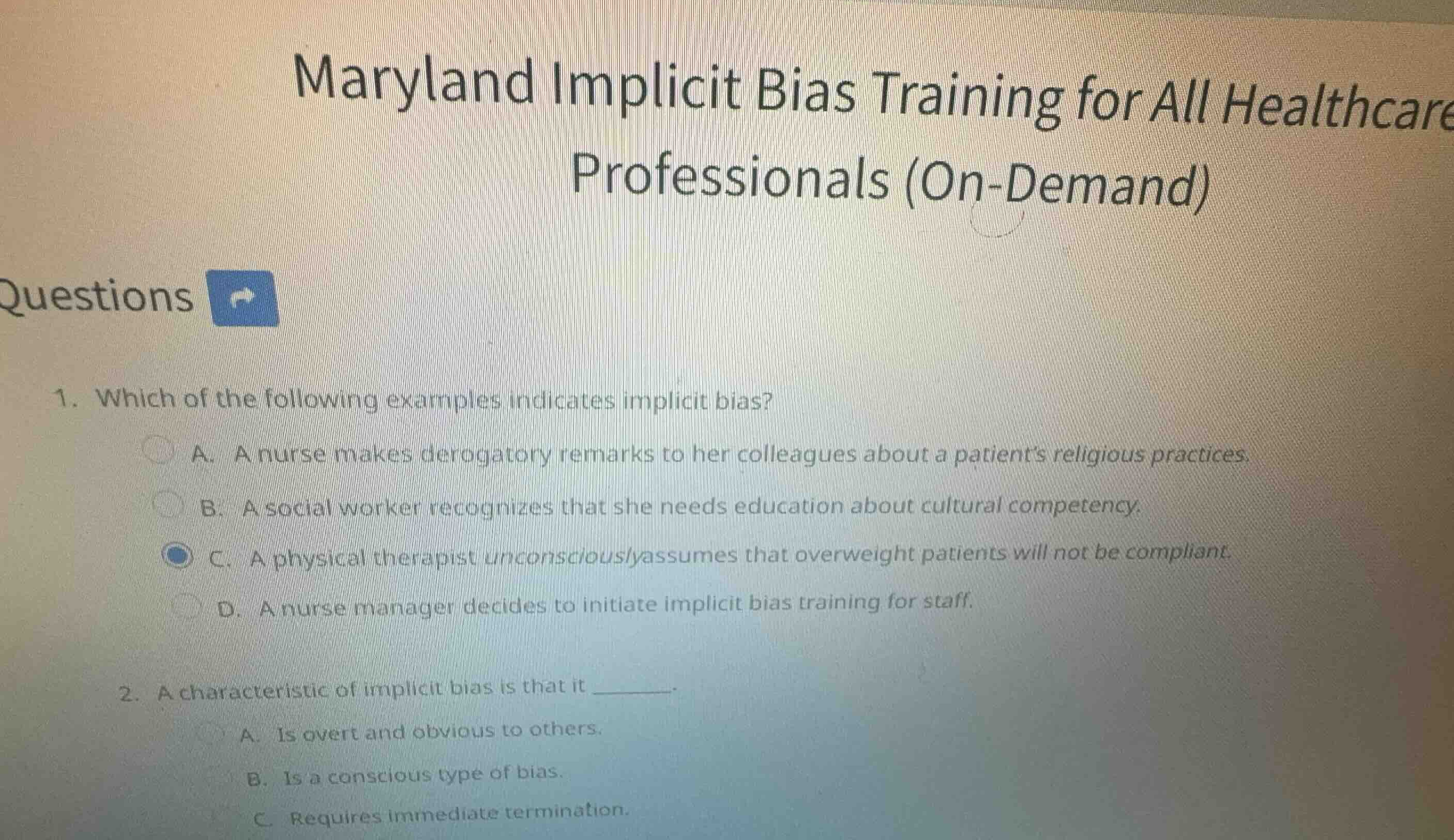
maryland implicit bias training for all healthcare professionals (on-demand)
questions
- which of the following examples indicates implicit bias?
a. a nurse makes derogatory remarks to her colleagues about a patients religious practices.
b. a social worker recognizes that she needs education about cultural competency.
c. a physical therapist unconsciously assumes that overweight patients will not be compliant.
d. a nurse manager decides to initiate implicit bias training for staff.
- a characteristic of implicit bias is that it ______.
a. is overt and obvious to others.
b. is a conscious type of bias.
c. requires immediate termination.
Analyze Question 1
This question asks for an example that indicates implicit bias. Implicit bias refers to unconscious attitudes or stereotypes that affect our understanding, actions, and decisions.
- Option A describes a nurse making derogatory remarks, which is a conscious, explicit action (explicit bias).
- Option B describes a social worker recognizing a need for education, which is conscious self-awareness.
- Option C describes a physical therapist unconsciously assuming overweight patients will not be compliant. The word "unconsciously" directly aligns with the definition of implicit bias.
- Option D describes an administrative decision to start training, which is a deliberate, conscious action.
Therefore, Option C is the correct example of implicit bias.
Analyze Question 2
This question asks for a characteristic of implicit bias.
- Option A states it is overt and obvious, which describes explicit bias.
- Option B states it is a conscious type of bias, which is incorrect because implicit bias operates unconsciously.
- Option C states it requires immediate termination, which is not a defining characteristic of the psychological concept of implicit bias.
- Although the bottom of the image is slightly cut off, implicit bias is characterized by operating unconsciously, automatically, and involuntarily. Based on standard definitions and the visible options, implicit bias is unconscious and involuntary, contrasting with conscious (explicit) bias. Let's evaluate the remaining choices. Since Option B ("conscious") and Option A ("overt") are incorrect, the correct characteristic must relate to its unconscious, automatic, or involuntary nature, which typically appears as an option like "operates unconsciously" or "is involuntary." Looking closely at the visible text, Option B is "Is a conscious type of bias" (incorrect) and Option A is "Is overt and obvious to others" (incorrect). The correct answer must be the option that identifies its unconscious nature.

Snap & solve any problem in the app
Get step-by-step solutions on Sovi AI
Photo-based solutions with guided steps
Explore more problems and detailed explanations
Question 1
- (A) A nurse makes derogatory remarks to her colleagues about a patient's religious practices.
- (B) A social worker recognizes that she needs education about cultural competency.
- (C) A physical therapist unconsciously assumes that overweight patients will not be compliant. (Correct answer)
- (D) A nurse manager decides to initiate implicit bias training for staff.
Question 2
- (A) Is overt and obvious to others.
- (B) Is a conscious type of bias.
- (C) Operates unconsciously and automatically. (Correct answer)