QUESTION IMAGE
Question
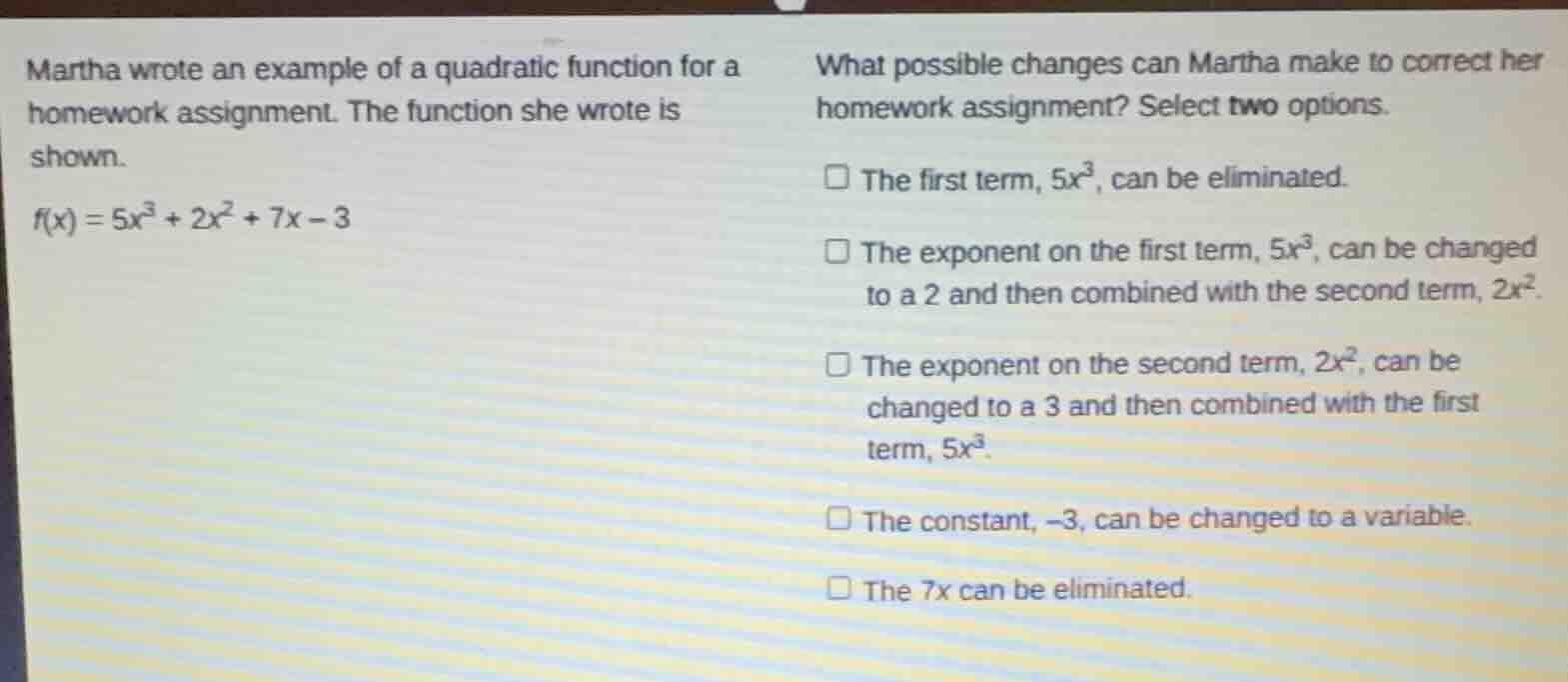
martha wrote an example of a quadratic function for a homework assignment. the function she wrote is shown.
$f(x) = 5x^3 + 2x^2 + 7x - 3$
what possible changes can martha make to correct her homework assignment? select two options.
- the first term, $5x^3$, can be eliminated.
- the exponent on the first term, $5x^3$, can be changed to a 2 and then combined with the second term, $2x^2$.
- the exponent on the second term, $2x^2$, can be changed to a 3 and then combined with the first term, $5x^3$.
- the constant, $-3$, can be changed to a variable.
- the $7x$ can be eliminated.
Brief Explanations
A quadratic function has the form \( f(x)=ax^{2}+bx + c\) (where \(a
eq0\)), meaning the highest degree (exponent) should be 2.
- Option 1: Eliminating \(5x^{3}\) (the cubic term) leaves a quadratic function (\(f(x)=2x^{2}+7x - 3\)), so this works.
- Option 2: Changing the exponent of \(5x^{3}\) to 2 gives \(5x^{2}\), which can be combined with \(2x^{2}\) to form a quadratic term (\(7x^{2}\)), resulting in a quadratic function (\(f(x)=7x^{2}+7x - 3\)), so this works.
- Option 3: Changing the exponent of \(2x^{2}\) to 3 would create a cubic function (highest degree 3), not quadratic, so this is incorrect.
- Option 4: Changing the constant to a variable does not affect the degree (highest exponent) of the function, so it remains cubic, incorrect.
- Option 5: Eliminating \(7x\) still leaves a cubic term (\(5x^{3}\)), so the function is still cubic, incorrect.

Snap & solve any problem in the app
Get step-by-step solutions on Sovi AI
Photo-based solutions with guided steps
Explore more problems and detailed explanations
A. The first term, \(5x^{3}\), can be eliminated.
B. The exponent on the first term, \(5x^{3}\), can be changed to a 2 and then combined with the second term, \(2x^{2}\).