Sovi.AI - AI Math Tutor

Scan to solve math questions

QUESTION IMAGE

marissa researched the cost to have custom t-shirts printed by several …

Question

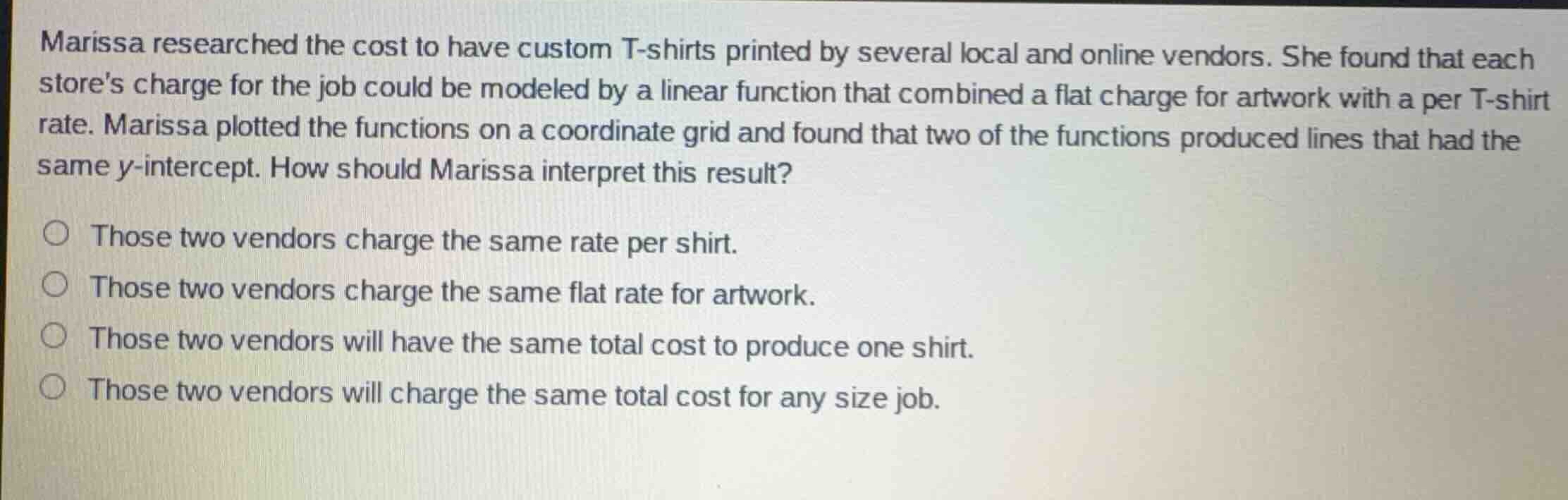
marissa researched the cost to have custom t-shirts printed by several local and online vendors. she found that each stores charge for the job could be modeled by a linear function that combined a flat charge for artwork with a per t-shirt rate. marissa plotted the functions on a coordinate grid and found that two of the functions produced lines that had the same \\(y\\)-intercept. how should marissa interpret this result?

those two vendors charge the same rate per shirt.
those two vendors charge the same flat rate for artwork.
those two vendors will have the same total cost to produce one shirt.
those two vendors will charge the same total cost for any size job.

Explanation:

Response

<pre_analysis>
{
"quality": "clear",
"question_count": 1,
"skills_matched": [
"step_cot",
"multiple_choice_formatter",
"explain_then_answer",
"tutor",
"mastery_adaptive_brevity"
],
"needs_drawing": false,
"concepts_used": [
"Linear Functions",
"Slope Interpretation"
],
"new_concepts": [
"y-intercept Interpretation"
],
"current_concepts": [
"Linear Functions",
"Slope Interpretation",
"y-intercept Interpretation"
]
}
</pre_analysis>

<reasoning>

Define the linear cost model

Using the Linear Functions knowledge point
\[
C(x) = mx + b
\]
where \(C(x)\) is the total cost, \(x\) is the number of T-shirts, \(m\) is the rate per T-shirt, and \(b\) is the flat charge for artwork.

Interpret the y-intercept

Using the Slope Interpretation knowledge point
\[

$$\begin{aligned} &\text{At } x = 0:\\ &C(0) = b \end{aligned}$$

\]
The \(y\)-intercept represents the initial cost when zero shirts are ordered, which is the flat charge for artwork. Therefore, having the same \(y\)-intercept means the two vendors charge the same flat rate for artwork.
</reasoning>

<answer>
<mcq-option>Those two vendors charge the same rate per shirt.</mcq-option>
<mcq-correct>Those two vendors charge the same flat rate for artwork.</mcq-correct>
<mcq-option>Those two vendors will have the same total cost to produce one shirt.</mcq-option>
<mcq-option>Those two vendors will charge the same total cost for any size job.</mcq-option>
</answer>

<post_analysis>
{
"subject": "Mathematics",
"question_type": "Multiple Choice",
"knowledge_point": [
"Mathematics",
"Algebra",
"Linear Functions"
]
}
</post_analysis>

Answer:

<pre_analysis>
{
"quality": "clear",
"question_count": 1,
"skills_matched": [
"step_cot",
"multiple_choice_formatter",
"explain_then_answer",
"tutor",
"mastery_adaptive_brevity"
],
"needs_drawing": false,
"concepts_used": [
"Linear Functions",
"Slope Interpretation"
],
"new_concepts": [
"y-intercept Interpretation"
],
"current_concepts": [
"Linear Functions",
"Slope Interpretation",
"y-intercept Interpretation"
]
}
</pre_analysis>

<reasoning>

Define the linear cost model

Using the Linear Functions knowledge point
\[
C(x) = mx + b
\]
where \(C(x)\) is the total cost, \(x\) is the number of T-shirts, \(m\) is the rate per T-shirt, and \(b\) is the flat charge for artwork.

Interpret the y-intercept

Using the Slope Interpretation knowledge point
\[

$$\begin{aligned} &\text{At } x = 0:\\ &C(0) = b \end{aligned}$$

\]
The \(y\)-intercept represents the initial cost when zero shirts are ordered, which is the flat charge for artwork. Therefore, having the same \(y\)-intercept means the two vendors charge the same flat rate for artwork.
</reasoning>

<answer>
<mcq-option>Those two vendors charge the same rate per shirt.</mcq-option>
<mcq-correct>Those two vendors charge the same flat rate for artwork.</mcq-correct>
<mcq-option>Those two vendors will have the same total cost to produce one shirt.</mcq-option>
<mcq-option>Those two vendors will charge the same total cost for any size job.</mcq-option>
</answer>

<post_analysis>
{
"subject": "Mathematics",
"question_type": "Multiple Choice",
"knowledge_point": [
"Mathematics",
"Algebra",
"Linear Functions"
]
}
</post_analysis>