QUESTION IMAGE
Question
male vs. female skeletal traits
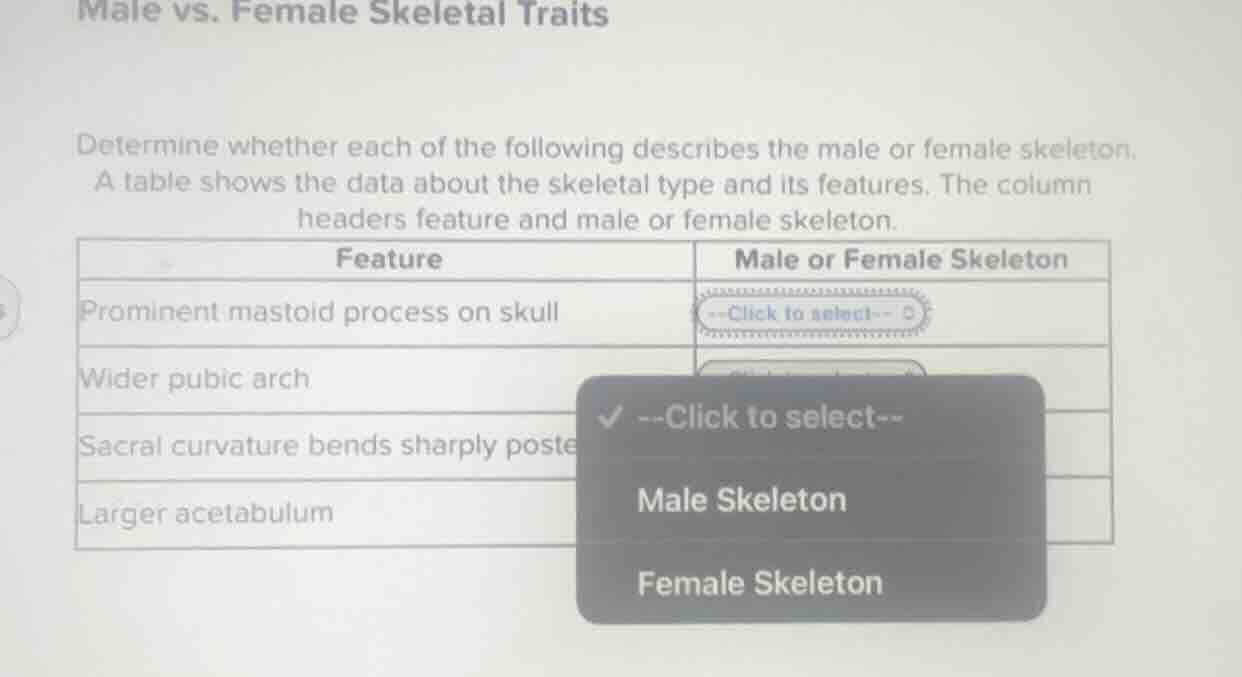
determine whether each of the following describes the male or female skeleton.
\
Analyze cranial sexual dimorphism
Using the Axial Skeleton and Skeletal System Organization knowledge points
The mastoid process is a bony projection located on the temporal bone of the skull. In males, the skull is generally more robust with larger, more prominent muscle attachment sites. Therefore, a prominent mastoid process is characteristic of the Male Skeleton.
Analyze pelvic arch width
Using the Appendicular Skeleton and Skeletal System Organization knowledge points
The female pelvis is adapted for childbirth, requiring a wider pelvic inlet and outlet. This adaptation results in a wider pubic arch (typically greater than \(90^\circ\) in females, compared to less than \(90^\circ\) in males). Thus, a wider pubic arch is characteristic of the Female Skeleton.
Analyze sacral curvature
Using the Axial Skeleton and Skeletal System Organization knowledge points
To maximize the space in the pelvic cavity for childbirth, the female sacrum is shorter, wider, and its curvature bends sharply posteriorly (backward) to stay out of the birth canal. In males, the sacrum is longer, narrower, and curves more evenly anteriorly. Therefore, a sacral curvature that bends sharply posteriorly is characteristic of the Female Skeleton.
Analyze acetabulum size
Using the Appendicular Skeleton and Skeletal System Organization knowledge points
The acetabulum is the socket of the hip bone where the head of the femur articulates. Because males generally have larger bodies, heavier builds, and larger femoral heads to support more weight, they possess a larger acetabulum. Thus, a larger acetabulum is characteristic of the Male Skeleton.

Snap & solve any problem in the app
Get step-by-step solutions on Sovi AI
Photo-based solutions with guided steps
Explore more problems and detailed explanations
| No. | Feature | Answer |
|---|---|---|
| 2 | Wider pubic arch | Female Skeleton |
| 3 | Sacral curvature bends sharply posteriorly | Female Skeleton |
| 4 | Larger acetabulum | Male Skeleton |