QUESTION IMAGE
Question
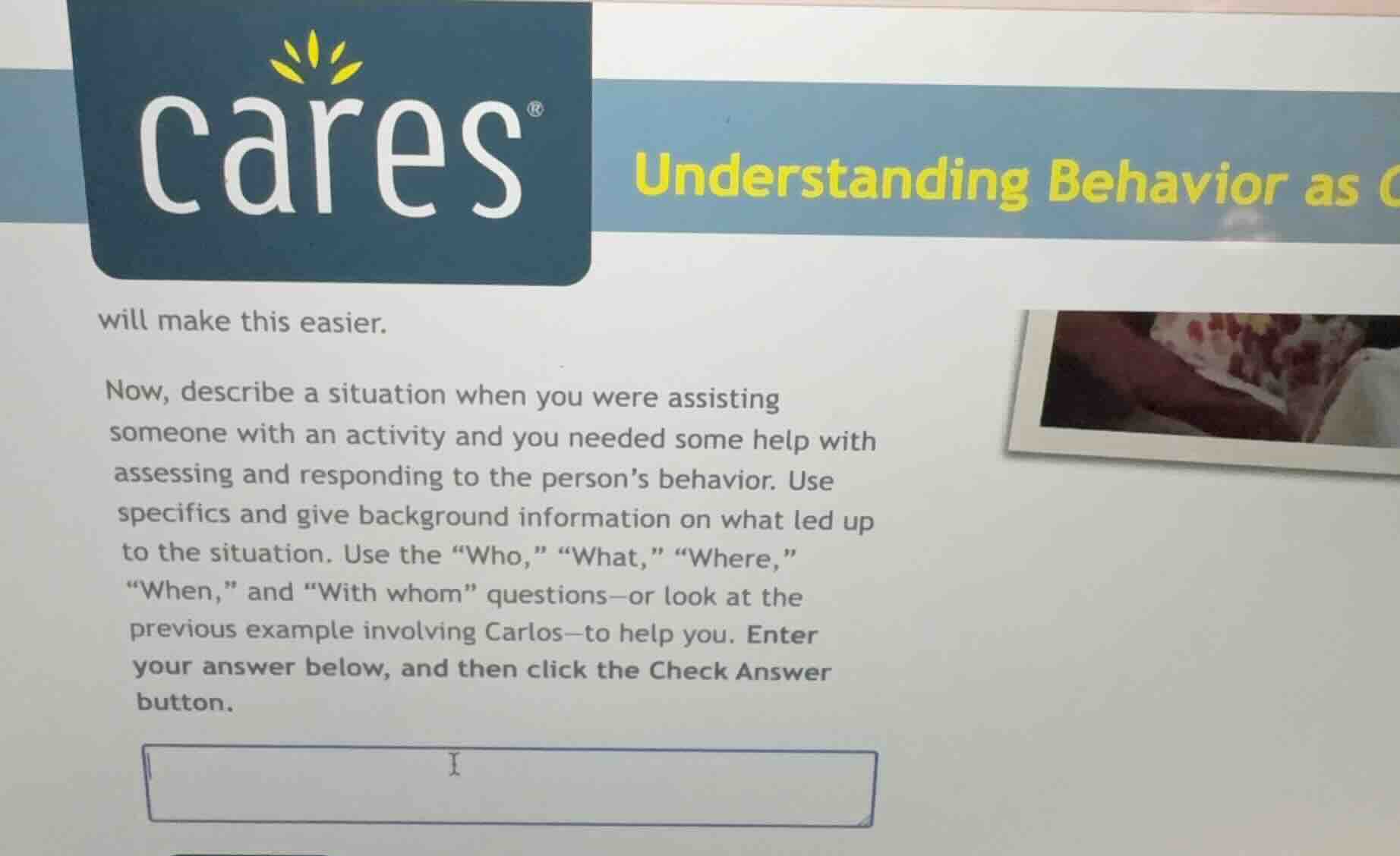
will make this easier.
now, describe a situation when you were assisting someone with an activity and you needed some help with assessing and responding to the persons behavior. use specifics and give background information on what led up to the situation. use the \who,\ \what,\ \where,\ \when,\ and \with whom\ questions-or look at the previous example involving carlos-to help you. enter your answer below, and then click the check answer button.
<pre_analysis>
{
"quality": "clear",
"question_count": 1,
"skills_matched": [
"direct_cot",
"explain_then_answer",
"tutor"
],
"needs_drawing": false,
"concepts_used": [],
"new_concepts": [
"Dementia Caregiving",
"CARES Approach",
"Behavioral Assessment"
],
"current_concepts": [
"Dementia Caregiving",
"CARES Approach",
"Behavioral Assessment"
]
}
</pre_analysis>
<reasoning>
Identify the prompt requirements
The prompt asks to describe a personal caregiving scenario where assistance was needed to assess and respond to a person's behavior. It requires using the "Who," "What," "Where," "When," and "With whom" framework to provide background and context, similar to the CARES® dementia care training model.
Structure the scenario using the 5 Ws
To provide a comprehensive and realistic response, we will construct a scenario involving a caregiver assisting an individual with dementia during a daily activity:
- Who: An elderly resident named Margaret who has moderate-stage Alzheimer's disease.
- What: Margaret became highly agitated, resistive, and started shouting during her afternoon shower.
- Where: In the private bathroom of her memory care facility apartment.
- When: Around 2:00 PM on a Tuesday afternoon.
- With whom: Myself (the primary nursing assistant) and a supervising nurse whom I called for assistance.
Analyze the behavior and the need for help
- The Behavior: Shouting, pushing the water away, and attempting to exit the shower stall unsafely.
- Why help was needed: To ensure Margaret's physical safety, de-escalate her anxiety without physical restraint, and determine if an underlying trigger (such as water temperature, pain, or fear) was causing the distress.
- The Response: The supervising nurse helped by bringing a warm towel, speaking in a calm, low voice, and helping to identify that the shower spray was too strong and frightening to Margaret. We adjusted the spray to a gentle mist and used a handheld wand, which successfully calmed her.
</reasoning>
<answer>
Here is a structured description of a caregiving situation using the requested framework:
- Who: Margaret, an 82-year-old resident diagnosed with moderate Alzheimer's disease.
- What: Margaret became extremely agitated, fearful, and physically resistive during her scheduled shower. She began crying, pushing my hands away, and trying to stand up quickly from the shower chair, which posed an immediate fall risk.
- Where: In the private bathroom of Margaret's apartment within the memory care unit.
- When: During her scheduled afternoon hygiene routine at approximately 2:00 PM.
- With whom: I was assisting Margaret individually, but because of her high level of distress and the physical safety risk, I needed to call my supervising nurse to help de-escalate the situation.
- Background & Response: Margaret is usually cooperative but highly sensitive to sensory changes. The nurse assisted by speaking in a low, soothing tone and wrapping a warm, dry towel around Margaret's shoulders to provide comfort. Together, we assessed that the water pressure from the overhead shower head was too strong and mimicking the sensation of heavy rain, which frightened her. We switched to a gentle, handheld shower wand and washed her slowly, which successfully calmed her down and allowed us to complete the activity safely.
</answer>
<post_analysis>
{
"subject": "Natural Science",
"question_type": "Free Response",
"knowledge_point": [
"Natural Science",…
Snap & solve any problem in the app
Get step-by-step solutions on Sovi AI
Photo-based solutions with guided steps
Explore more problems and detailed explanations
<pre_analysis>
{
"quality": "clear",
"question_count": 1,
"skills_matched": [
"direct_cot",
"explain_then_answer",
"tutor"
],
"needs_drawing": false,
"concepts_used": [],
"new_concepts": [
"Dementia Caregiving",
"CARES Approach",
"Behavioral Assessment"
],
"current_concepts": [
"Dementia Caregiving",
"CARES Approach",
"Behavioral Assessment"
]
}
</pre_analysis>
<reasoning>
Identify the prompt requirements
The prompt asks to describe a personal caregiving scenario where assistance was needed to assess and respond to a person's behavior. It requires using the "Who," "What," "Where," "When," and "With whom" framework to provide background and context, similar to the CARES® dementia care training model.
Structure the scenario using the 5 Ws
To provide a comprehensive and realistic response, we will construct a scenario involving a caregiver assisting an individual with dementia during a daily activity:
- Who: An elderly resident named Margaret who has moderate-stage Alzheimer's disease.
- What: Margaret became highly agitated, resistive, and started shouting during her afternoon shower.
- Where: In the private bathroom of her memory care facility apartment.
- When: Around 2:00 PM on a Tuesday afternoon.
- With whom: Myself (the primary nursing assistant) and a supervising nurse whom I called for assistance.
Analyze the behavior and the need for help
- The Behavior: Shouting, pushing the water away, and attempting to exit the shower stall unsafely.
- Why help was needed: To ensure Margaret's physical safety, de-escalate her anxiety without physical restraint, and determine if an underlying trigger (such as water temperature, pain, or fear) was causing the distress.
- The Response: The supervising nurse helped by bringing a warm towel, speaking in a calm, low voice, and helping to identify that the shower spray was too strong and frightening to Margaret. We adjusted the spray to a gentle mist and used a handheld wand, which successfully calmed her.
</reasoning>
<answer>
Here is a structured description of a caregiving situation using the requested framework:
- Who: Margaret, an 82-year-old resident diagnosed with moderate Alzheimer's disease.
- What: Margaret became extremely agitated, fearful, and physically resistive during her scheduled shower. She began crying, pushing my hands away, and trying to stand up quickly from the shower chair, which posed an immediate fall risk.
- Where: In the private bathroom of Margaret's apartment within the memory care unit.
- When: During her scheduled afternoon hygiene routine at approximately 2:00 PM.
- With whom: I was assisting Margaret individually, but because of her high level of distress and the physical safety risk, I needed to call my supervising nurse to help de-escalate the situation.
- Background & Response: Margaret is usually cooperative but highly sensitive to sensory changes. The nurse assisted by speaking in a low, soothing tone and wrapping a warm, dry towel around Margaret's shoulders to provide comfort. Together, we assessed that the water pressure from the overhead shower head was too strong and mimicking the sensation of heavy rain, which frightened her. We switched to a gentle, handheld shower wand and washed her slowly, which successfully calmed her down and allowed us to complete the activity safely.
</answer>
<post_analysis>
{
"subject": "Natural Science",
"question_type": "Free Response",
"knowledge_point": [
"Natural Science",
"Medicine and Health",
"Dementia Caregiving"
]
}
</post_analysis>