QUESTION IMAGE
Question
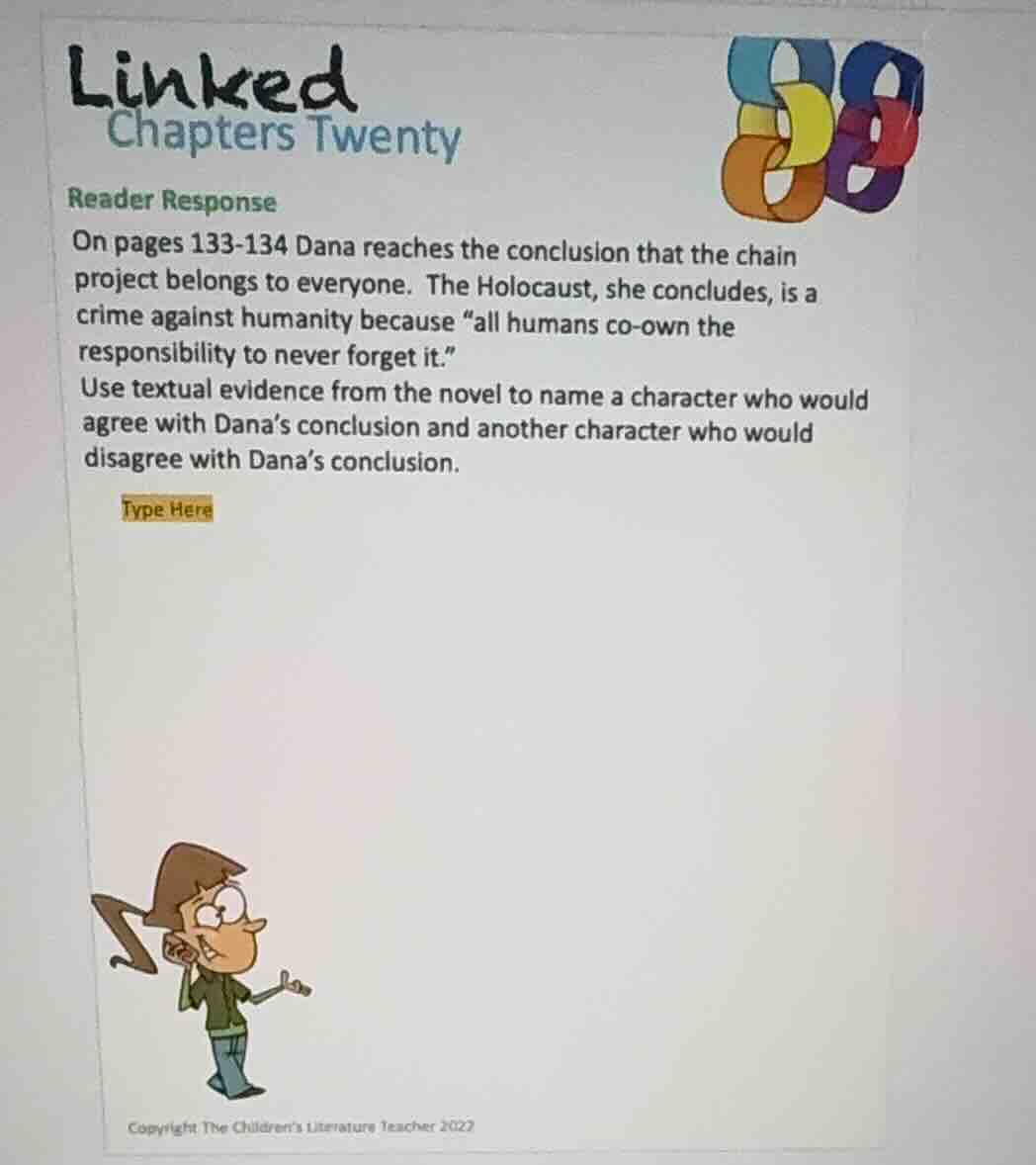
linked
chapters twenty
reader response
on pages 133-134 dana reaches the conclusion that the chain project belongs to everyone. the holocaust, she concludes, is a crime against humanity because \all humans co-own the responsibility to never forget it.\
use textual evidence from the novel to name a character who would agree with danas conclusion and another character who would disagree with danas conclusion.
⚡ Using what you learned: inferential comprehension and textual evidence
Step 1: Analyze Dana's Conclusion
Dana concludes that the paper chain project—which commemorates the victims of the Holocaust—belongs to everyone, not just one group. She believes that because the Holocaust was a crime against humanity, all human beings share the collective responsibility to remember it and ensure it never happens again.
Step 2: Identify a Character Who Agrees
Michael (or Link) would agree with Dana's conclusion.
- Reasoning: Throughout the novel Linked, Michael is deeply invested in the paper chain project from the beginning. He works tirelessly to help it grow and understands that the project is about tolerance, unity, and collective memory. He believes that the entire school and community share the responsibility to stand up against hate.
- Evidence: Michael's dedication to collecting six million paper links shows his belief that everyone must participate in remembering the scale of the tragedy to prevent future hate.
Step 3: Identify a Character Who Disagrees
Reeve (at least initially) or the original vandal (before his identity and growth are revealed) would disagree with Dana's conclusion. Alternatively, characters like some of the townspeople or students who initially viewed the project as a nuisance or "not their problem" would disagree. Let's focus on Reeve in his earlier mindset.
- Reasoning: Early in the book, Reeve does not understand the weight of historical trauma or why everyone should care about the swastikas or the chain project. He views the situation selfishly and does not feel any personal or shared responsibility for historical memory.
- Evidence: Reeve's initial act of drawing the swastikas shows a complete lack of understanding of the collective responsibility to remember and respect the victims of the Holocaust.

Snap & solve any problem in the app
Get step-by-step solutions on Sovi AI
Photo-based solutions with guided steps
Explore more problems and detailed explanations
- Character Who Agrees: Michael
- Evidence/Support: Michael is one of the main driving forces behind the paper chain project. He believes that the entire school community needs to come together to reach the goal of six million links, showing that he agrees that remembering the Holocaust is a shared, collective responsibility for all of humanity.
- Character Who Disagrees: Reeve (in his initial mindset)
- Evidence/Support: At the beginning of the novel, Reeve acts without thinking about the historical weight of his actions. By painting the swastikas, he demonstrates that he does not feel any personal connection or responsibility to respect and remember the victims of the Holocaust, contrasting sharply with Dana's belief in shared human responsibility.