QUESTION IMAGE
Question
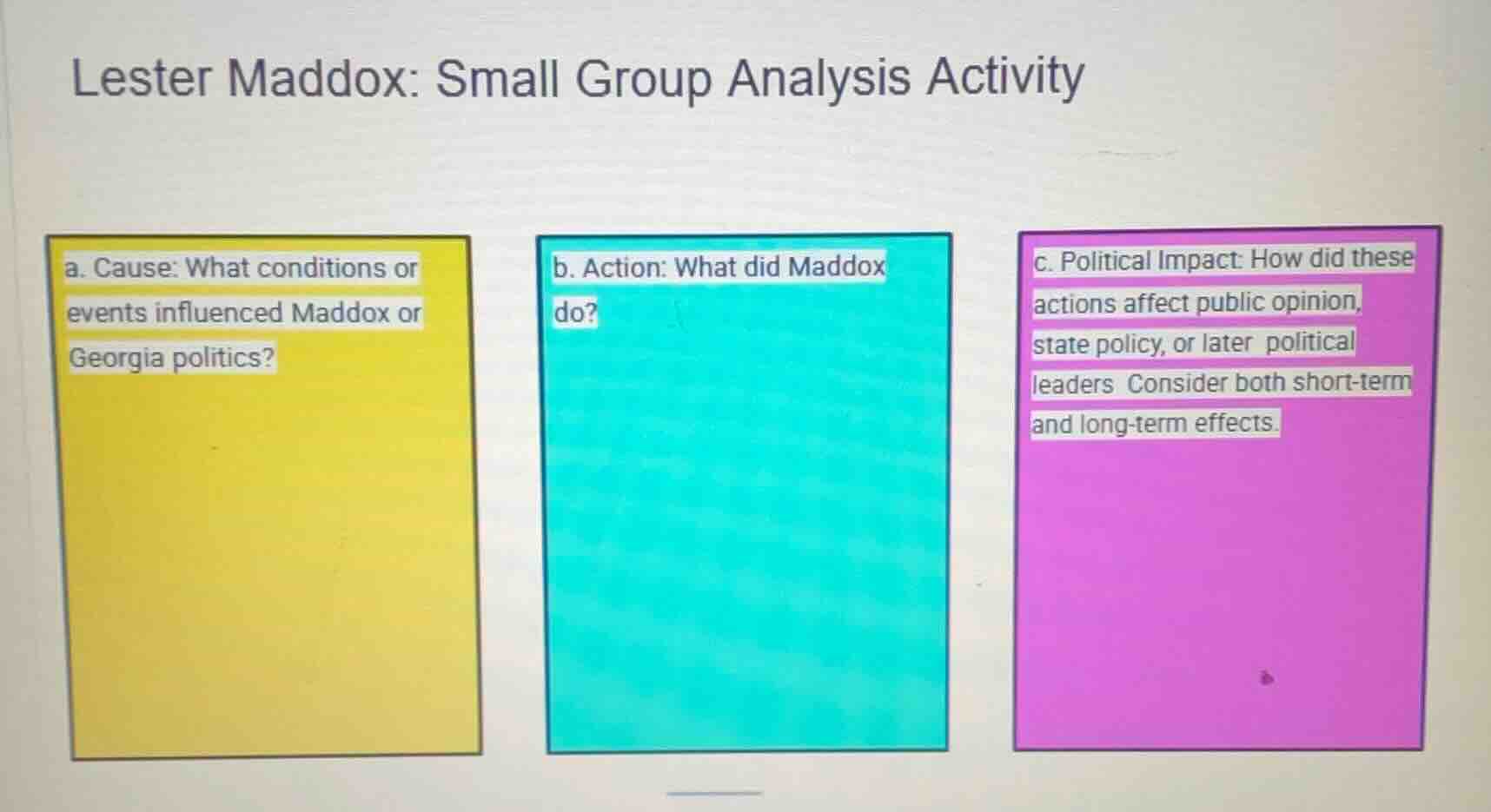
lester maddox: small group analysis activity
a. cause: what conditions or
events influenced maddox or
georgia politics?
b. action: what did maddox
do?
c. political impact: how did these
actions affect public opinion,
state policy, or later political
leaders consider both short - term
and long - term effects.
a. Cause: Post-WWII racial tensions in Georgia, backlash against federal civil rights policies (like desegregation orders), and a white conservative voter base frustrated by changing social norms influenced Maddox and Georgia politics. His views aligned with segregationist sentiment that dominated much of the state's white electorate at the time.
b. Action: Maddox gained fame by refusing to desegregate his Atlanta restaurant, the Pickrick Cafeteria, in defiance of the 1964 Civil Rights Act. He was elected Georgia's governor in 1966, and while in office, he took symbolic segregationist stances, though he also made limited outreach to Black voters later in his career.
c. Political Impact:
- Short-term: His election energized white conservative voters in Georgia, reinforcing the state's reputation as a segregationist stronghold. It also created tensions with the federal government over civil rights compliance.
- Long-term: His career highlighted the lingering power of segregationist politics in the South, but also foreshadowed the shift of white Southern voters to the Republican Party. Later Georgia politicians had to navigate the legacy of his divisive racial rhetoric, as the state gradually became more politically diverse.

Snap & solve any problem in the app
Get step-by-step solutions on Sovi AI
Photo-based solutions with guided steps
Explore more problems and detailed explanations
a. Key influences included post-WWII Georgia racial tensions, federal civil rights backlash, and a conservative white voter base hostile to desegregation.
b. Maddox refused to desegregate his Pickrick Cafeteria, was elected Georgia governor in 1966, and maintained symbolic segregationist positions (with limited later outreach to Black voters).
c. Short-term: Energized white conservative voters, heightened state-federal civil rights tensions, and solidified Georgia's segregationist image. Long-term: Highlighted Southern segregationist political power, foreshadowed white Southern shift to the Republican Party, and created a divisive racial legacy for future Georgia leaders.