QUESTION IMAGE
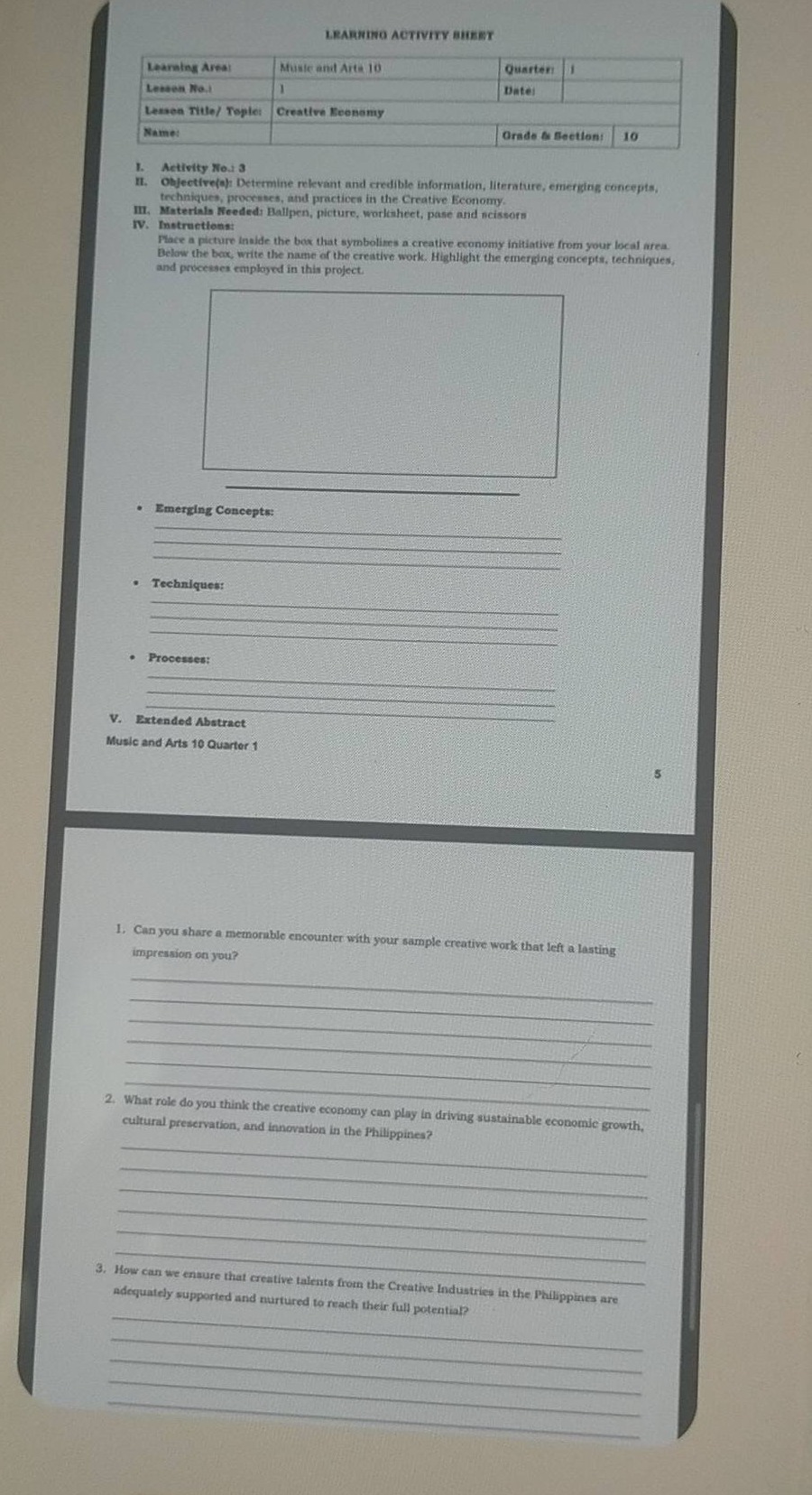
Question
learning activity sheet
learning area: music and arts 10
quarter: 1
lesson no.: 1
date:
lesson title/ topic: creative economy
name:
grade & section: 10
i. activity no.: 3
ii. objective(s): determine relevant and credible information, literature, emerging concepts, techniques, processes, and practices in the creative economy.
iii. materials needed: ballpen, picture, worksheet, paste and scissors
iv. instructions:
place a picture inside the box that symbolizes a creative economy initiative from your local area. below the box, write the name of the creative work. highlight the emerging concepts, techniques, and processes employed in this project.
- emerging concepts:
- techniques:
- processes:
v. extended abstract
music and arts 10 quarter 1
- can you share a memorable encounter with your sample creative work that left a lasting impression on you?
- what role do you think the creative economy can play in driving sustainable economic growth, cultural preservation, and innovation in the philippines?
- how can we ensure that creative talents from the creative industries in the philippines are adequately supported and nurtured to reach their full potential?
🆕 New Concept Discovered: Creative Economy Framework
How local culture and creativity generate economic value.
---
Step 1: Selecting a Local Creative Economy Initiative
To complete the first page of the worksheet, we need to select a highly recognizable and culturally significant creative economy initiative from the Philippines. A perfect example is Abaca Weaving (such as the T'nalak of the T'boli or local Sinamay weaving).
- Name of the Creative Work: Traditional Abaca Weaving (Sinamay / T'nalak)
- Visual Suggestion for the Box: Draw or paste a picture of a colorful, hand-woven abaca textile or a local weaver working on a traditional backstrap loom.
---
Step 2: Detailing Concepts, Techniques, and Processes
Now, we break down the selected creative work into the three required categories:
Emerging Concepts:
- Eco-Fashion and Sustainable Design: Utilizing 100% natural, biodegradable plant fibers (abaca) to create modern fashion, bags, and home decor.
- Cultural Preservation as an Economic Driver: Transforming ancestral weaving heritage into a viable source of income for indigenous and rural communities.
- Fair Trade and Ethical Consumerism: Connecting local weavers directly with global markets to ensure they receive fair wages and recognition.
Techniques:
- Backstrap Loom Weaving: A traditional method where the weaver uses their body weight to keep the warp threads tense.
- Natural Dyeing (Ikats): Using extracts from local leaves, roots, and bark (like indigo and ginger) to color the fibers before weaving.
- Fiber Stripping and Knotting: Hand-stripping the abaca plant stalks to extract fine, strong fibers, which are then knotted end-to-end by hand.
Processes:
- Harvesting and Stripping: Cutting mature abaca stalks, scraping away the pulp to extract the raw fibers, and drying them under the sun.
- Designing and Dyeing: Tying patterns onto the warp threads (resist-dyeing technique) and boiling them in natural dye vats.
- Weaving: Setting up the loom and meticulously weaving the weft threads to create intricate geometric patterns.
- Finishing and Marketing: Softening the finished textile (often using a wooden shell or mallet) and transforming it into consumer goods like bags, footwear, or clothing.
---
Step 3: Answering the Reflection Questions (Page 2)
Here are guided, high-quality answers to the three reflection questions at the bottom of the worksheet:
Question 1: Can you share a memorable encounter with your sample creative work that left a lasting impression on you?
Answer:
During a local cultural festival (or a visit to a regional trade fair), I saw a live demonstration of a traditional weaver working on a backstrap loom. What struck me was the incredible speed, precision, and rhythm of her hands. She did not use a printed pattern or a computer; the complex geometric designs were entirely memorized and passed down through generations. Seeing the raw abaca plant transformed into a beautiful, durable piece of wearable art made me realize how much skill, patience, and cultural identity are woven into every single thread.
Question 2: What role do you think the creative economy can play in driving sustainable economic growth, cultural preservation, and innovation in the Philippines?
Answer:
The creative economy serves as a bridge between our rich heritage and modern industries. First, it drives sustainable economic growth by providing eco-friendly livelihoods to rural and indigenous communities, utilizing renewable l…

Snap & solve any problem in the app
Get step-by-step solutions on Sovi AI
Photo-based solutions with guided steps
Explore more problems and detailed explanations
Use the structured points in Step 1 and Step 2 to fill out the blanks on the first page of your worksheet (drawing or pasting an image of Abaca Weaving in the box). Then, copy the detailed responses from Step 3 onto the corresponding lines for Questions 1, 2, and 3 on the second page.