QUESTION IMAGE
Question
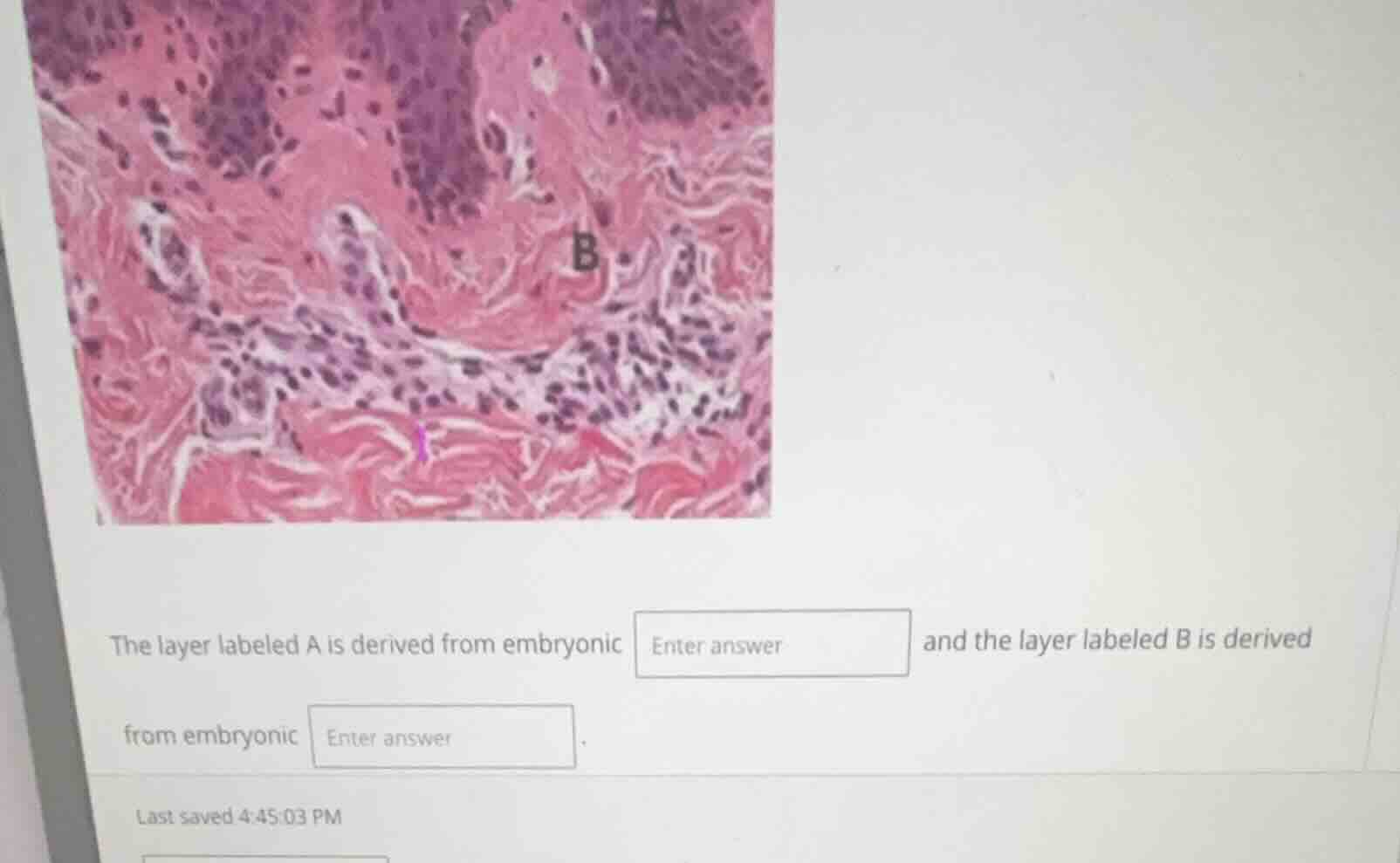
the layer labeled a is derived from embryonic enter answer and the layer labeled b is derived from embryonic enter answer.
🆕 New Concept Discovered: Embryonic Germ Layer Derivatives
How different adult tissues develop from the three primary embryonic layers.
Step 1: Identify the histological layers labeled A and B
Looking at the provided histological image of the skin:
- Layer A represents the outer, cellular layer of the skin, which is the epidermis. It consists of stratified squamous epithelium.
- Layer B represents the deeper, fibrous connective tissue layer beneath the epidermis, which is the dermis. It contains dense irregular connective tissue, collagen fibers, and blood vessels.
Step 2: Determine the embryonic origin of Layer A (Epidermis)
The epidermis (Layer A) is an epithelial tissue covering the outer surface of the body. During embryonic development, the outer protective covering of the embryo is formed by the outermost germ layer:
- Ectoderm gives rise to the epidermis of the skin, as well as the nervous system.
Therefore, Layer A is derived from embryonic ectoderm.
Step 3: Determine the embryonic origin of Layer B (Dermis)
The dermis (Layer B) is a connective tissue layer. Connective tissues, muscle, and the cardiovascular system develop from the middle germ layer of the embryo:
- Mesoderm gives rise to the dermis of the skin, bones, muscles, and blood vessels.
Therefore, Layer B is derived from embryonic mesoderm.

Snap & solve any problem in the app
Get step-by-step solutions on Sovi AI
Photo-based solutions with guided steps
Explore more problems and detailed explanations
- First blank (Layer A): ectoderm
- Second blank (Layer B): mesoderm