Sovi.AI - AI Math Tutor

Scan to solve math questions

QUESTION IMAGE

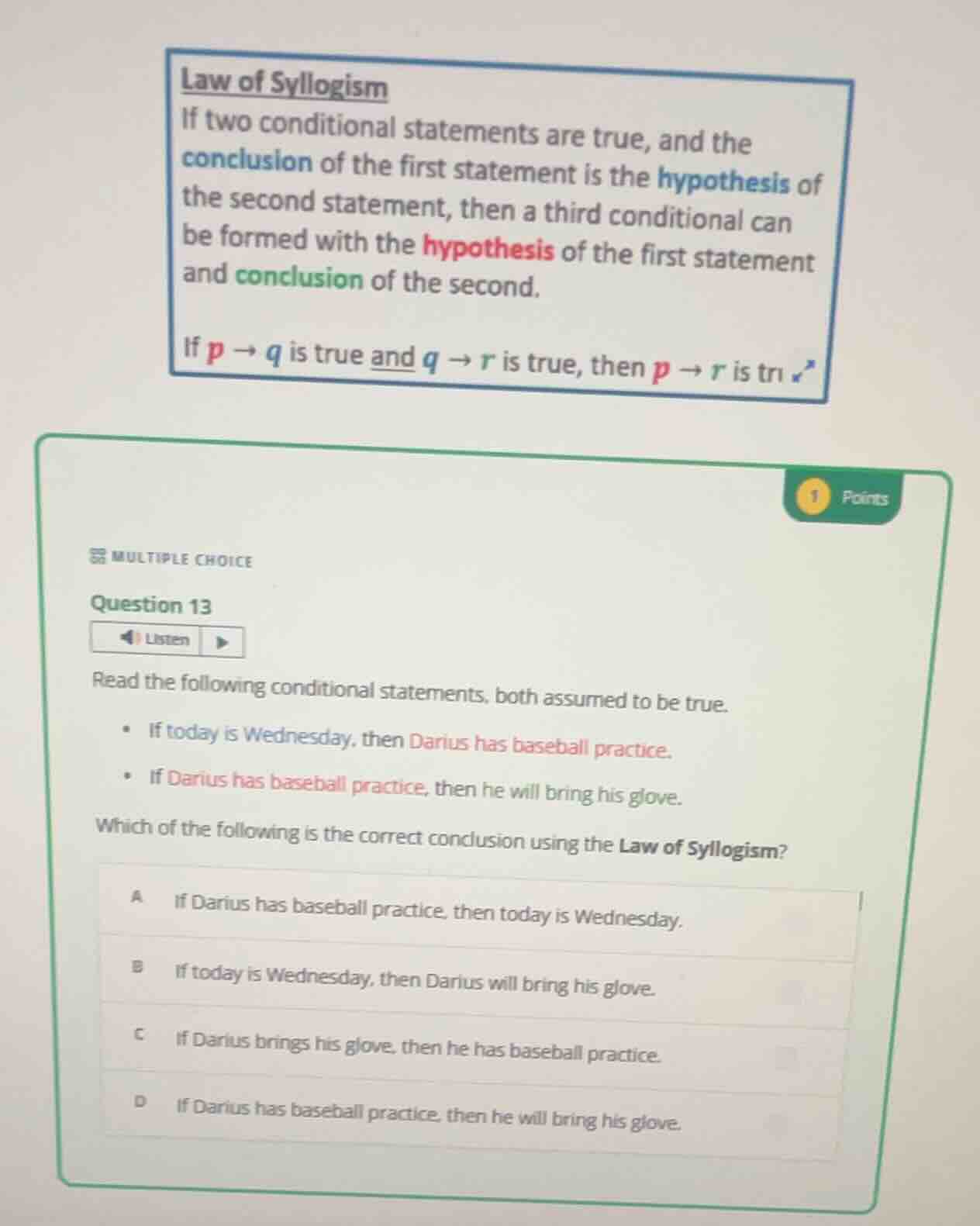
law of syllogism if two conditional statements are true, and the conclu…

Question

law of syllogism
if two conditional statements are true, and the conclusion of the first statement is the hypothesis of the second statement, then a third conditional can be formed with the hypothesis of the first statement and conclusion of the second.

if \\(p \
ightarrow q\\) is true and \\(q \
ightarrow r\\) is true, then \\(p \
ightarrow r\\) is true.

multiple choice
question 13
read the following conditional statements, both assumed to be true.

  • if today is wednesday, then darius has baseball practice.
  • if darius has baseball practice, then he will bring his glove.

which of the following is the correct conclusion using the law of syllogism?

a if darius has baseball practice, then today is wednesday.
b if today is wednesday, then darius will bring his glove.
c if darius brings his glove, then he has baseball practice.
d if darius has baseball practice, then he will bring his glove.

Explanation:

Response

<pre_analysis>
{
"quality": "clear",
"question_count": 1,
"skills_matched": [
"direct_cot",
"multiple_choice_formatter",
"explain_then_answer",
"quick"
],
"needs_drawing": false,
"concepts_used": [
"Conditional Statements"
],
"new_concepts": [
"Law of Syllogism"
],
"current_concepts": [
"Conditional Statements",
"Law of Syllogism"
]
}
</pre_analysis>

<reasoning>

Identify the component statements

Let \(p\) be "today is Wednesday".
Let \(q\) be "Darius has baseball practice".
Let \(r\) be "he will bring his glove".

Map the given conditional statements

The first statement is \(p
ightarrow q\): "If today is Wednesday, then Darius has baseball practice."
The second statement is \(q
ightarrow r\): "If Darius has baseball practice, then he will bring his glove."

Apply the Law of Syllogism

Since \(p
ightarrow q\) and \(q
ightarrow r\) are both true, the Law of Syllogism states that \(p
ightarrow r\) is true: "If today is Wednesday, then Darius will bring his glove."
</reasoning>

<answer>
<mcq-option>(A) If Darius has baseball practice, then today is Wednesday.</mcq-option>
<mcq-correct>(B) If today is Wednesday, then Darius will bring his glove.</mcq-correct>
<mcq-option>(C) If Darius brings his glove, then he has baseball practice.</mcq-option>
<mcq-option>(D) If Darius has baseball practice, then he will bring his glove.</mcq-option>
</answer>

<post_analysis>
{
"subject": "Mathematics",
"question_type": "Multiple Choice",
"knowledge_point": [
"Mathematics",
"Geometry",
"Law of Syllogism"
]
}
</post_analysis>

Answer:

<pre_analysis>
{
"quality": "clear",
"question_count": 1,
"skills_matched": [
"direct_cot",
"multiple_choice_formatter",
"explain_then_answer",
"quick"
],
"needs_drawing": false,
"concepts_used": [
"Conditional Statements"
],
"new_concepts": [
"Law of Syllogism"
],
"current_concepts": [
"Conditional Statements",
"Law of Syllogism"
]
}
</pre_analysis>

<reasoning>

Identify the component statements

Let \(p\) be "today is Wednesday".
Let \(q\) be "Darius has baseball practice".
Let \(r\) be "he will bring his glove".

Map the given conditional statements

The first statement is \(p
ightarrow q\): "If today is Wednesday, then Darius has baseball practice."
The second statement is \(q
ightarrow r\): "If Darius has baseball practice, then he will bring his glove."

Apply the Law of Syllogism

Since \(p
ightarrow q\) and \(q
ightarrow r\) are both true, the Law of Syllogism states that \(p
ightarrow r\) is true: "If today is Wednesday, then Darius will bring his glove."
</reasoning>

<answer>
<mcq-option>(A) If Darius has baseball practice, then today is Wednesday.</mcq-option>
<mcq-correct>(B) If today is Wednesday, then Darius will bring his glove.</mcq-correct>
<mcq-option>(C) If Darius brings his glove, then he has baseball practice.</mcq-option>
<mcq-option>(D) If Darius has baseball practice, then he will bring his glove.</mcq-option>
</answer>

<post_analysis>
{
"subject": "Mathematics",
"question_type": "Multiple Choice",
"knowledge_point": [
"Mathematics",
"Geometry",
"Law of Syllogism"
]
}
</post_analysis>