QUESTION IMAGE
Question
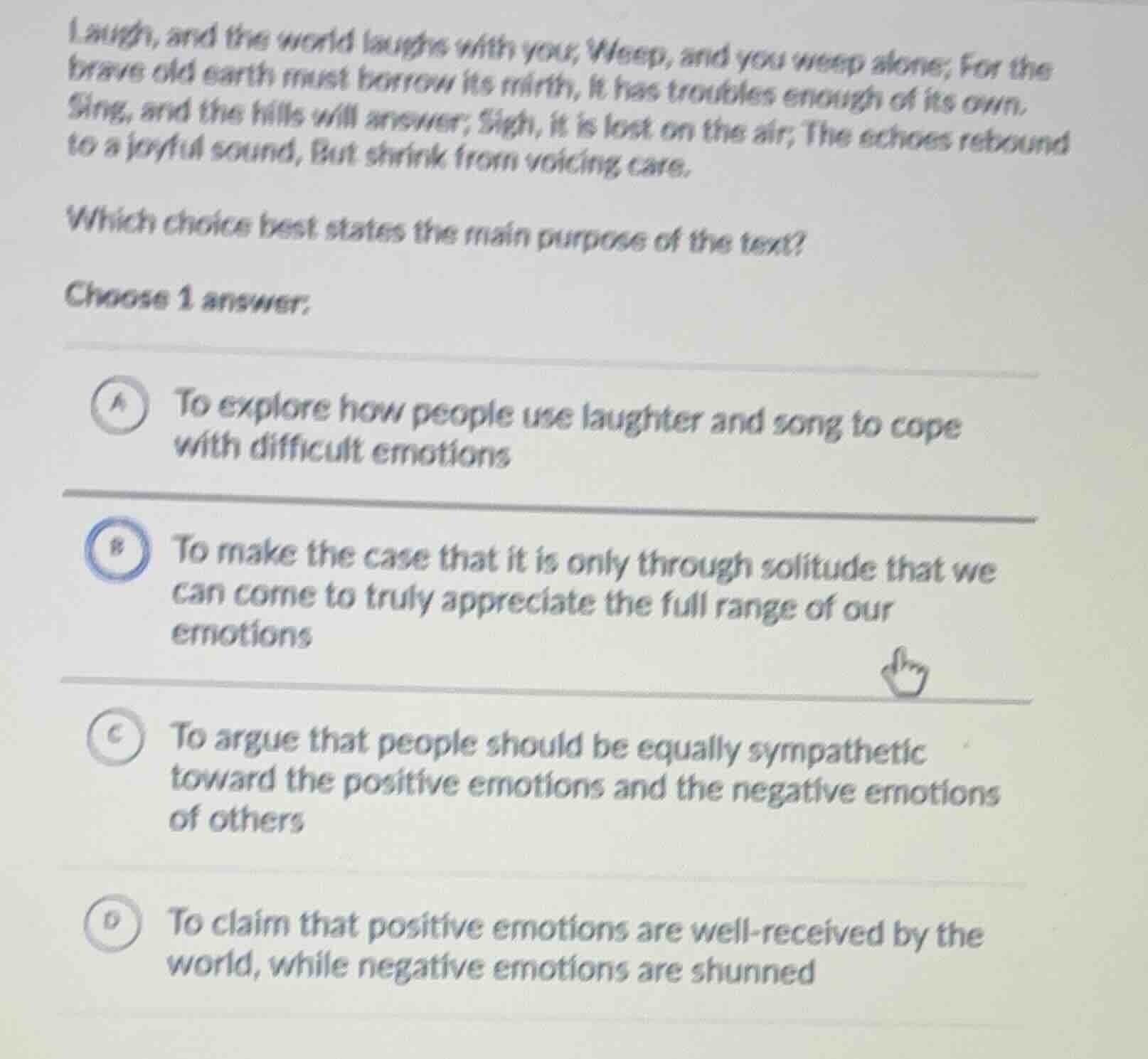
laugh, and the world laughs with you; weep, and you weep alone; for the brave old earth must borrow its mirth, it has troubles enough of its own. sing, and the hills will answer; sigh, it is lost on the air; the echoes rebound to a joyful sound, but shrink from voicing care.
which choice best states the main purpose of the text?
choose 1 answer:
(a) to explore how people use laughter and song to cope with difficult emotions
(b) to make the case that it is only through solitude that we can come to truly appreciate the full range of our emotions
(c) to argue that people should be equally sympathetic toward the positive emotions and the negative emotions of others
(d) to claim that positive emotions are well-received by the world, while negative emotions are shunned
Analyze the poem's structure and contrast
The poem contrasts how the world responds to positive versus negative expressions. It pairs "Laugh" with "the world laughs with you" and "Sing" with "the hills will answer." Conversely, it pairs "Weep" with "you weep alone" and "Sigh" with "it is lost on the air." This structure highlights a clear division in social reception.
Evaluate the role of textual evidence
Using Textual Evidence, we see the text states the "old earth must borrow its mirth" because it has "troubles enough of its own." This explains why positive sounds are welcomed while negative ones ("voicing care") are avoided or shrunk from. The primary purpose is to show that joy is shared, while sorrow is isolated.
Assess the given options
- (A) is incorrect because the text does not discuss laughter and song as coping mechanisms.
- (B) is incorrect because the poem does not claim solitude helps us appreciate emotions.
- (C) is incorrect because the poem describes how people actually react, rather than arguing how they "should" behave.
- (D) is correct because it accurately reflects the contrast between the warm reception of positive emotions and the avoidance of negative ones.

Snap & solve any problem in the app
Get step-by-step solutions on Sovi AI
Photo-based solutions with guided steps
Explore more problems and detailed explanations
- (A) To explore how people use laughter and song to cope with difficult emotions
- (B) To make the case that it is only through solitude that we can come to truly appreciate the full range of our emotions
- (C) To argue that people should be equally sympathetic toward the positive emotions and the negative emotions of others
- (D) To claim that positive emotions are well-received by the world, while negative emotions are shunned (Correct answer)