QUESTION IMAGE
Question
knowledge & thinking (20 marks) (10 k and 10 t)
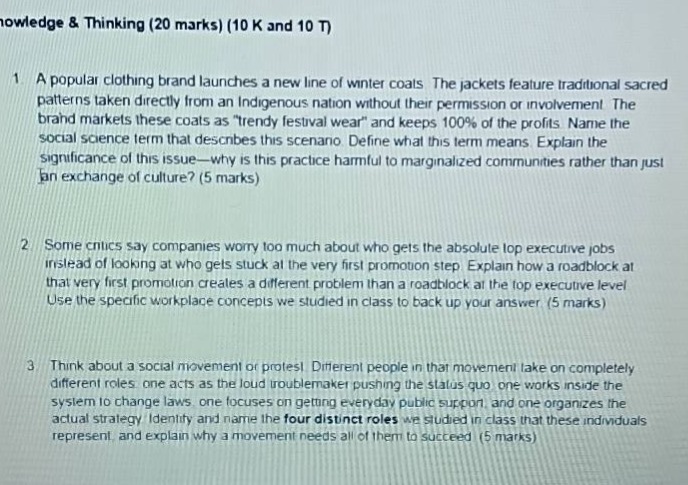
- a popular clothing brand launches a new line of winter coats. the jackets feature traditional sacred patterns taken directly from an indigenous nation without their permission or involvement. the brand markets these coats as \trendy festival wear\ and keeps 100% of the profits. name the social science term that describes this scenario. define what this term means. explain the significance of this issue-why is this practice harmful to marginalized communities rather than just an exchange of culture? (5 marks)
- some critics say companies worry too much about who gets the absolute top executive jobs instead of looking at who gets stuck at the very first promotion step. explain how a roadblock at that very first promotion creates a different problem than a roadblock at the top executive level. use the specific workplace concepts we studied in class to back up your answer. (5 marks)
- think about a social movement or protest. different people in that movement take on completely different roles: one acts as the loud troublemaker pushing the status quo, one works inside the system to change laws, one focuses on getting everyday public support, and one organizes the actual strategy. identify and name the four distinct roles we studied in class that these individuals represent, and explain why a movement needs all of them to succeed. (5 marks)
🆕 New Concept Discovered: Cultural Appropriation vs. Exchange · Workplace Barriers · Social Movement Roles
---
Step 1: Identify and Define the Term for Question 1
The scenario describes Cultural Appropriation.
- Definition: Cultural appropriation is the unacknowledged or inappropriate adoption of elements (such as customs, practices, ideas, or sacred symbols) of one culture or identity by members of another, typically more dominant culture or identity.
- Significance and Harm: This practice is harmful rather than a simple "cultural exchange" because of the power imbalance involved. In a true cultural exchange, there is mutual respect, consent, and shared benefit. In this scenario, the dominant culture's brand exploits sacred Indigenous patterns without permission, trivializes their deep spiritual meaning by marketing them as "trendy festival wear," and deprives the marginalized community of both intellectual property rights and financial compensation (keeping 100% of the profits).
---
Step 2: Analyze Workplace Barriers for Question 2
This question contrasts two distinct workplace barriers:
- The "Broken Rung" (Roadblock at the first promotion): This concept refers to the barrier women and minority groups face at the very first step up to a managerial or supervisory role. When people are blocked here, it prevents them from entering the leadership pipeline entirely. This creates a foundational bottleneck, meaning there are far fewer diverse candidates available to even be considered for mid-level or senior roles later on.
- The "Glass Ceiling" (Roadblock at the top executive level): This concept refers to an invisible barrier that prevents qualified individuals from rising to the absolute highest levels of executive leadership (such as C-suite or Board positions), despite having successfully climbed the middle-management ladder.
- The Difference: A roadblock at the top (glass ceiling) limits representation at the pinnacle of power, but a roadblock at the very beginning (broken rung) decimates the talent pipeline early on, ensuring that marginalized groups remain concentrated in entry-level, lower-paying positions.
---
Step 3: Identify Social Movement Roles for Question 3
According to Bill Moyer's Movement Action Plan (MAP), there are four distinct roles necessary for a social movement to succeed:
- The Rebel (The "loud troublemaker"): Pushes the status quo, puts issues on the public agenda through dramatic non-violent direct action, and says "no" to institutional violations.
- The Reformer (The one working "inside the system"): Works with official bodies, politicians, and courts to translate the movement's goals into laws, policies, and institutional changes.
- The Citizen (The one getting "everyday public support"): Establishes the movement's legitimacy in the eyes of the general public, showing that the movement represents common values and everyday people.
- The Change Agent (The "organizer of actual strategy"): Organizes grassroots networks, educates the public, and coordinates long-term strategies to build mass social movements from the ground up.
- Why a movement needs all four: A movement needs all four roles because they balance each other's weaknesses. Without Rebels, the movement lacks urgency and public attention; without Reformers, the energy cannot be codified into lasting laws; without Citizens, the movement is easily dismissed as radical or extremist; and without Change Agents, the movement lacks the organized strateg…

Snap & solve any problem in the app
Get step-by-step solutions on Sovi AI
Photo-based solutions with guided steps
Explore more problems and detailed explanations
Question 1
- Term: Cultural Appropriation.
- Definition: The unauthorized or inappropriate adoption of elements of a marginalized culture by a dominant culture.
- Harm vs. Exchange: It is harmful because it lacks consent, exploits sacred symbols for commercial gain ("trendy festival wear"), and denies the marginalized group financial benefits (keeping 100% of profits), reinforcing historical power imbalances rather than fostering mutual respect.
Question 2
- Concepts: The Broken Rung (first promotion roadblock) vs. the Glass Ceiling (top executive roadblock).
- Difference: A roadblock at the top (Glass Ceiling) keeps qualified mid-level managers out of the executive suite. A roadblock at the very first step (Broken Rung) prevents marginalized employees from ever entering the management track, drying up the leadership pipeline at its foundation and keeping them trapped in entry-level roles.
Question 3
- Four Roles:
- The Rebel (pushes status quo/troublemaker)
- The Reformer (works inside the system to change laws)
- The Citizen (gains everyday public support and legitimacy)
- The Change Agent (organizes grassroots strategy)
- Why all are needed: They create a balanced ecosystem. Rebels generate urgency, Change Agents organize the masses, Citizens build mainstream legitimacy, and Reformers secure permanent legal changes. Without any one of these, the movement will stall, lose public support, or fail to achieve concrete policy changes.