QUESTION IMAGE
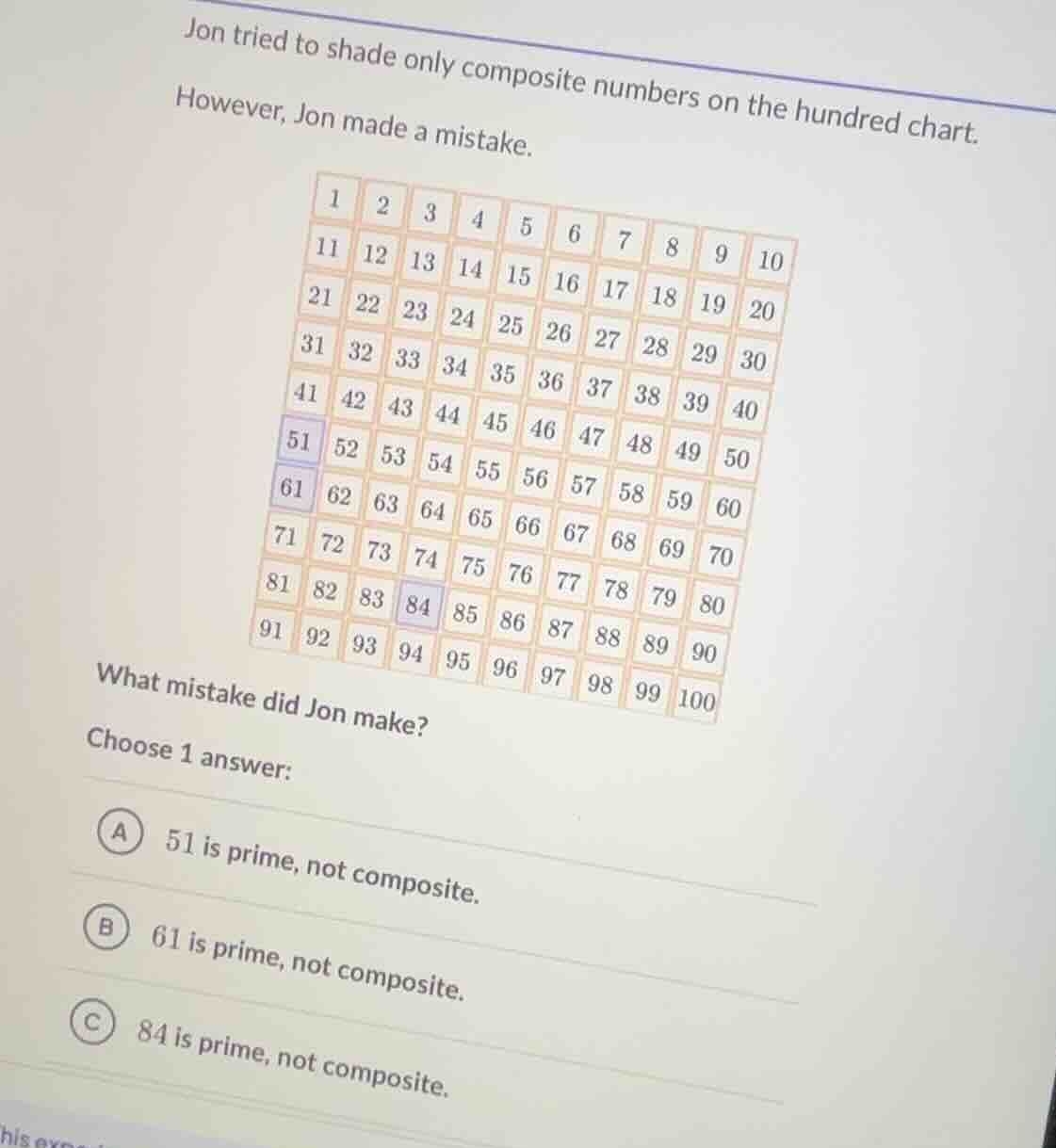
Question
jon tried to shade only composite numbers on the hundred chart.
however, jon made a mistake.
what mistake did jon make?
choose 1 answer:
a 51 is prime, not composite.
b 61 is prime, not composite.
c 84 is prime, not composite.
Analyze Jon's shaded numbers
Using the Composite Numbers knowledge point
Jon shaded the numbers 51, 61, 71, 81, 84, 91 on the hundred chart.
A composite number is a positive integer greater than 1 that has a positive divisor other than 1 and itself.
Evaluate the number 51
Using the Composite Numbers and Prime Numbers knowledge points
Since 51 has factors other than 1 and itself, it is composite. Jon was correct to shade 51.
Evaluate the number 61
Using the Prime Numbers knowledge point
The prime factors of 61 are tested by checking divisibility by primes up to \(\sqrt{61} \approx 7.8\):
- Not divisible by 2 (ends in 1)
- Not divisible by 3 (\(6 + 1 = 7\))
- Not divisible by 5 (ends in 1)
- Not divisible by 7 (\(61 = 7 \times 8 + 5\))
Thus, 61 is prime. Jon made a mistake by shading 61.
Evaluate the number 84
Using the Composite Numbers knowledge point
Since 84 is even and greater than 2, it is composite. Jon was correct to shade 84.
Identify the correct option
Using the Prime Numbers knowledge point
Comparing our findings with the given choices:
- Option A: Incorrect, because 51 is composite.
- Option B: Correct, because 61 is prime, so it should not be shaded.
- Option C: Incorrect, because 84 is composite.

Snap & solve any problem in the app
Get step-by-step solutions on Sovi AI
Photo-based solutions with guided steps
Explore more problems and detailed explanations
- (A) 51 is prime, not composite.
- (B) 61 is prime, not composite. (Correct answer)
- (C) 84 is prime, not composite.