QUESTION IMAGE
Question
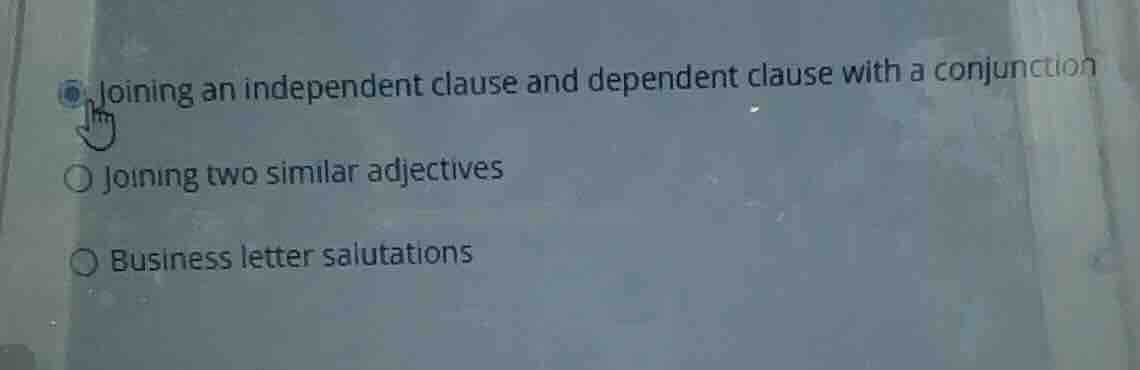
joining an independent clause and dependent clause with a conjunction
joining two similar adjectives
business letter salutations
🆕 New Concept Discovered: Punctuation Rules for Clauses
Connecting complete and incomplete thoughts
Step 1: Analyze the options and context
The image shows a multiple-choice question with the following options:
- Joining an independent clause and dependent clause with a conjunction
- Joining two similar adjectives
- Business letter salutations
This question asks to identify a scenario related to punctuation rules (specifically, when to use or not use a comma or colon).
Let's look at the rules for each option:
- Joining an independent clause and a dependent clause with a conjunction: When a coordinating conjunction (like and, but, or) connects an independent clause to a dependent clause (or a compound predicate), we do not use a comma before the conjunction. If the dependent clause comes first, we use a comma after it, but no coordinating conjunction is used to join them in that manner.
- Joining two similar adjectives: Coordinate adjectives (adjectives that independently modify the same noun and can be reversed) are separated by a comma.
- Business letter salutations: A business letter salutation is followed by a colon (e.g., Dear Hiring Manager:), whereas a personal letter salutation is followed by a comma.
Depending on the exact question prompt (which is cut off but typically asks about a specific punctuation rule, such as "Which of the following does NOT require a comma?" or "When do you use a colon?"), we can determine the correct choice.
Given that the first option is selected in the screenshot:
- "Joining an independent clause and dependent clause with a conjunction" is a classic rule for omitting a comma. For example, in the sentence "She walked to the park and played on the swings," no comma is placed before "and" because "played on the swings" is a dependent clause (it lacks a subject).
Step 2: Confirm the selected answer
The radio button for the first option is selected:
- Joining an independent clause and dependent clause with a conjunction

Snap & solve any problem in the app
Get step-by-step solutions on Sovi AI
Photo-based solutions with guided steps
Explore more problems and detailed explanations
Joining an independent clause and dependent clause with a conjunction