QUESTION IMAGE
Question
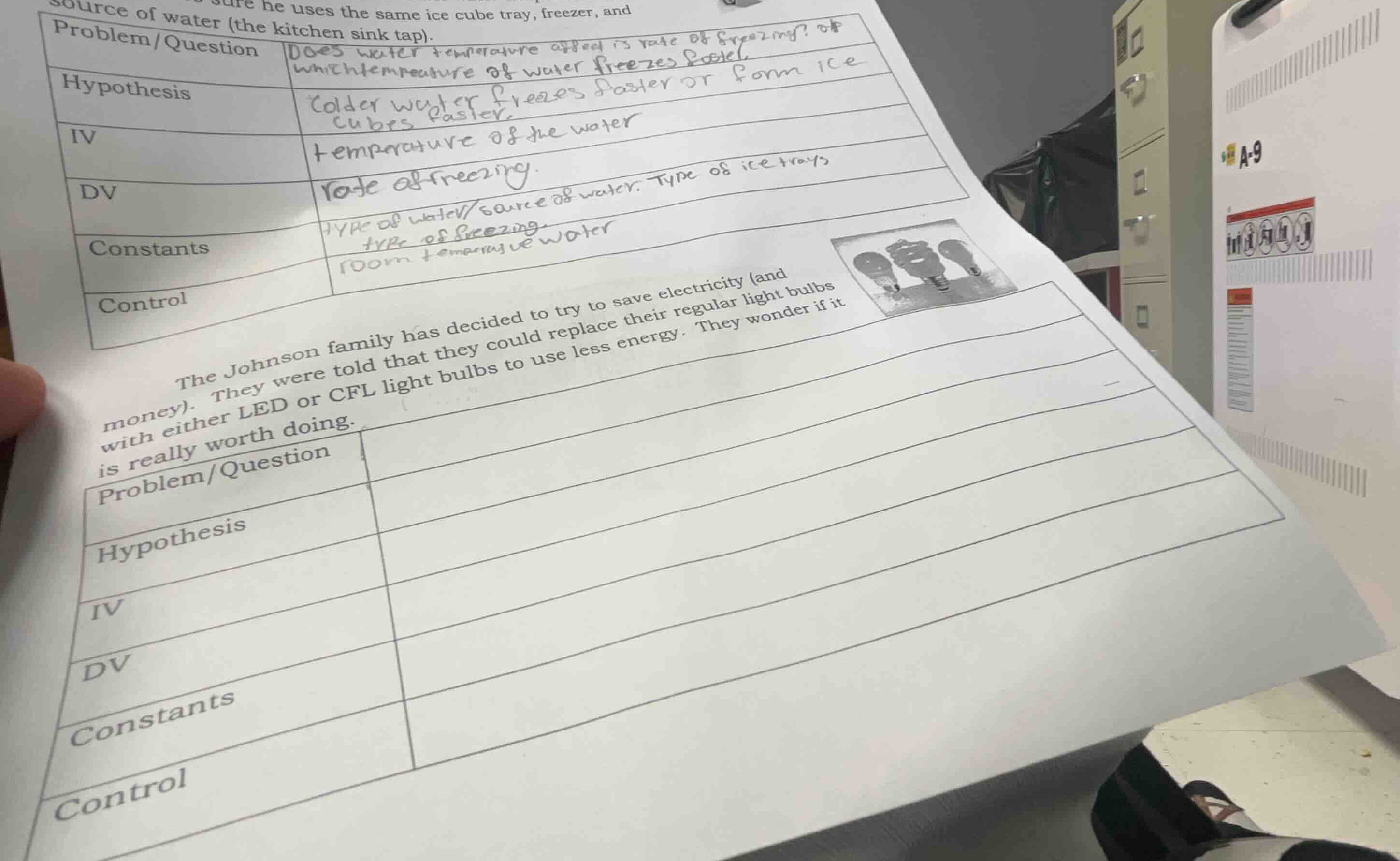
the johnson family has decided to try to save electricity (and money). they were told that they could replace their regular light bulbs with either led or cfl light bulbs to use less energy. they wonder if it is really worth doing.
\
🆕 New Concept Discovered: Scientific Variables
Identifying testable questions, predictions, and experimental controls.
Step 1: Formulate the Problem/Question
The scientific method begins with a clear, testable question. Based on the scenario, the Johnson family wants to know if replacing their regular light bulbs with LED or CFL bulbs actually uses less energy.
- Question: Do LED or CFL light bulbs use less energy than regular light bulbs?
Step 2: Formulate the Hypothesis
A hypothesis is an educated guess or prediction that can be tested. It often uses an "If..., then..." format to connect the change we make to the expected result.
- Hypothesis: If regular light bulbs are replaced with LED or CFL light bulbs, then the amount of energy used will decrease.
Step 3: Identify the Independent Variable (IV)
The Independent Variable is the factor that the investigator actively changes or manipulates in the experiment. Here, we are changing the type of light bulb being used.
- Independent Variable (IV): Type of light bulb (Regular, LED, CFL)
Step 4: Identify the Dependent Variable (DV)
The Dependent Variable is what you measure or observe to see the effect of the change. It "depends" on the independent variable. In this experiment, we want to measure how much electricity is consumed.
- Dependent Variable (DV): Amount of energy/electricity used (measured in watts or kilowatt-hours)
Step 5: Identify the Constants
Constants are all the factors that must be kept exactly the same throughout the experiment to ensure a fair test. If these change, we won't know if the bulb type or something else caused the difference in energy use.
- Constants:
- The amount of time the light bulbs are left turned on.
- The fixture/lamp used to test the bulbs.
- The brightness level (lumens) of the bulbs being compared.
- The room/environment where the test takes place.
Step 6: Identify the Control
The control (or control group) serves as the standard for comparison. It represents the "normal" or baseline condition before any experimental changes are made.
- Control: The regular (incandescent) light bulb.
---

Snap & solve any problem in the app
Get step-by-step solutions on Sovi AI
Photo-based solutions with guided steps
Explore more problems and detailed explanations
- Problem/Question: Do LED or CFL light bulbs use less energy than regular light bulbs?
- Hypothesis: If regular light bulbs are replaced with LED or CFL light bulbs, then the amount of energy used will decrease.
- IV (Independent Variable): Type of light bulb (Regular, LED, CFL)
- DV (Dependent Variable): Amount of energy/electricity used
- Constants: Same amount of time turned on, same lamp/fixture, same brightness level (lumens)
- Control: Regular light bulb