QUESTION IMAGE
Question
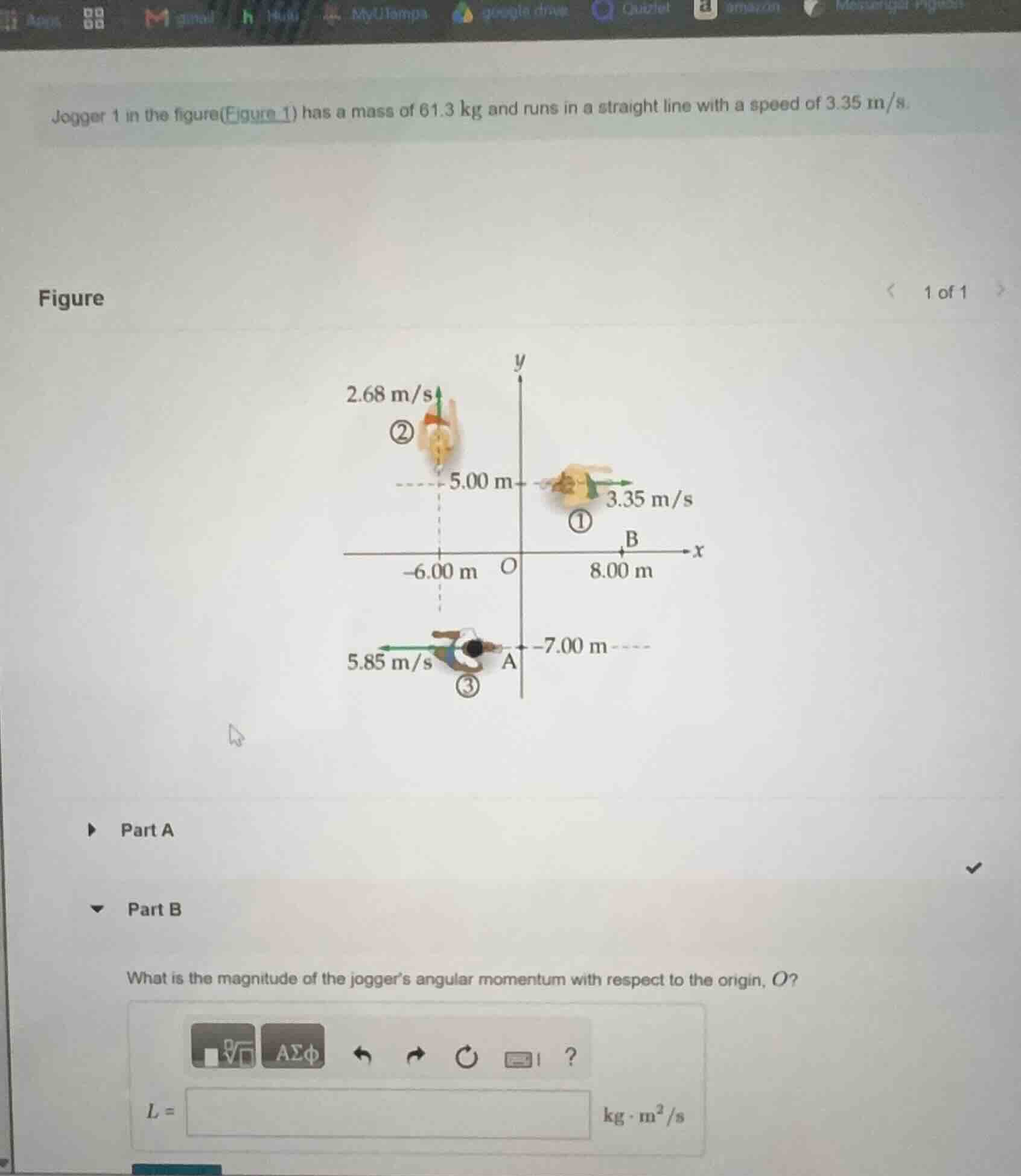
jogger 1 in the figure has a mass of 61.3 kg and runs in a straight line with a speed of 3.35 m/s.
what is the magnitude of the joggers angular momentum with respect to the origin, \\(o\\)?
\\(l =\\) \\(\text{kg} \cdot \text{m}^2/\text{s}\\)
Identify the given parameters
We are given the following physical quantities for Jogger 1:
- Mass of Jogger 1, \(m = 61.3\text{ kg}\).
- Speed of Jogger 1, \(v = 3.35\text{ m/s}\).
- From the figure, Jogger 1 (labeled as ①) is running parallel to the x-axis in the positive x-direction.
- The position of Jogger 1's line of motion is at a constant y-coordinate, \(y = 5.00\text{ m}\).
Formulate the angular momentum equation
The angular momentum \(\vec{L}\) of a point particle relative to the origin \(O\) is defined by the cross product:
where \(\vec{r}\) is the position vector of the particle and \(\vec{p} = m\vec{v}\) is its linear momentum.
Calculate the magnitude of angular momentum
For a particle moving parallel to the x-axis, the perpendicular distance (lever arm) from the origin to the line of motion is the absolute value of its y-coordinate:
The magnitude of the angular momentum \(L\) is given by:
Compute the numerical value
Substitute the given values into the magnitude formula:
Rounding to three significant figures (matching the given values \(61.3\), \(3.35\), and \(5.00\)):

Snap & solve any problem in the app
Get step-by-step solutions on Sovi AI
Photo-based solutions with guided steps
Explore more problems and detailed explanations
What is the magnitude of the jogger's angular momentum with respect to the origin, \(O\)?
\(L =\) <blank>\(1030\)</blank> \(\text{kg}\cdot\text{m}^2/\text{s}\)