Sovi.AI - AI Math Tutor

Scan to solve math questions

QUESTION IMAGE

jimmy rides home from karate practice with his friend and his friends m…

Question

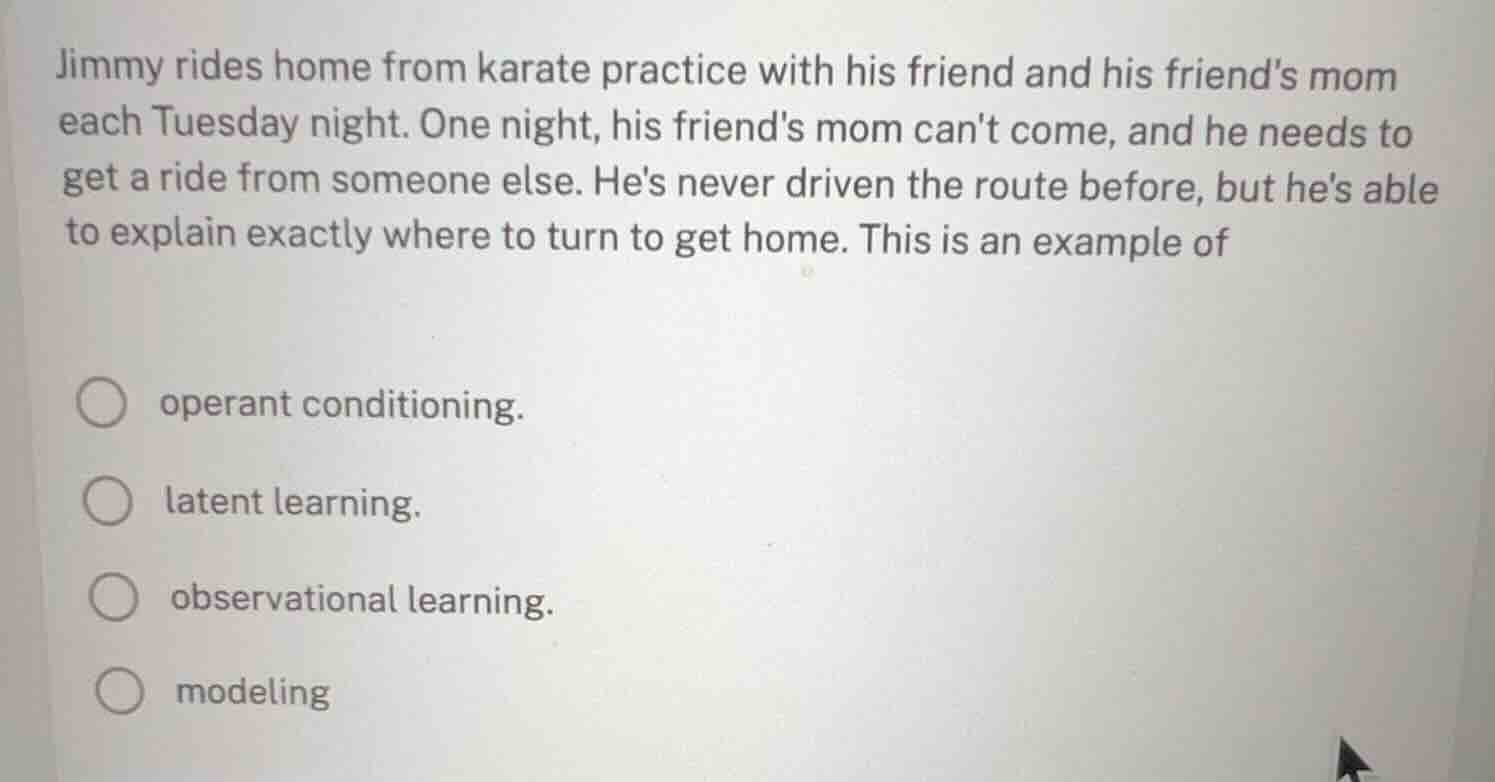
jimmy rides home from karate practice with his friend and his friends mom each tuesday night. one night, his friends mom cant come, and he needs to get a ride from someone else. hes never driven the route before, but hes able to explain exactly where to turn to get home. this is an example of

operant conditioning.
latent learning.
observational learning.
modeling

Explanation:

Response

<pre_analysis>
{
"quality": "clear",
"question_count": 1,
"skills_matched": [
"direct_cot",
"multiple_choice_formatter",
"explain_then_answer",
"tutor",
"mastery_adaptive_brevity"
],
"needs_drawing": false,
"concepts_used": [
"Latent Learning"
],
"new_concepts": [],
"current_concepts": [
"Latent Learning",
"Operant Conditioning",
"Observational Learning",
"Modeling"
]
}
</pre_analysis>

<reasoning>

Analyze the scenario

Using the Latent Learning knowledge point

Jimmy has acquired knowledge of the route passively during his weekly rides without any immediate reinforcement or active demonstration of learning. The learning only becomes apparent (is demonstrated) when a need arises (he has to guide a different driver home). This is the classic definition of Latent Learning, which occurs without obvious reinforcement and remains hidden until there is an incentive to demonstrate it.

Evaluate the options

Using the Latent Learning knowledge point

  • operant conditioning: Incorrect. This involves learning through voluntary behaviors paired with consequences (rewards or punishments), which is not described here.
  • latent learning: Correct. Jimmy learned the cognitive map of the route passively, and the learning was demonstrated only when needed.
  • observational learning: Incorrect. This involves actively watching and mimicking a specific model's behavior to learn a new skill.
  • modeling: Incorrect. This is the process of demonstrating a behavior for others to imitate.

</reasoning>

<answer>
<mcq-option>operant conditioning.</mcq-option>
<mcq-correct>latent learning.</mcq-correct>
<mcq-option>observational learning.</mcq-option>
<mcq-option>modeling</mcq-option>
</answer>

<post_analysis>
{
"subject": "Social Science",
"question_type": "Multiple Choice",
"knowledge_point": [
"Social Science",
"Psychology",
"Latent Learning"
]
}
</post_analysis>

Answer:

<pre_analysis>
{
"quality": "clear",
"question_count": 1,
"skills_matched": [
"direct_cot",
"multiple_choice_formatter",
"explain_then_answer",
"tutor",
"mastery_adaptive_brevity"
],
"needs_drawing": false,
"concepts_used": [
"Latent Learning"
],
"new_concepts": [],
"current_concepts": [
"Latent Learning",
"Operant Conditioning",
"Observational Learning",
"Modeling"
]
}
</pre_analysis>

<reasoning>

Analyze the scenario

Using the Latent Learning knowledge point

Jimmy has acquired knowledge of the route passively during his weekly rides without any immediate reinforcement or active demonstration of learning. The learning only becomes apparent (is demonstrated) when a need arises (he has to guide a different driver home). This is the classic definition of Latent Learning, which occurs without obvious reinforcement and remains hidden until there is an incentive to demonstrate it.

Evaluate the options

Using the Latent Learning knowledge point

  • operant conditioning: Incorrect. This involves learning through voluntary behaviors paired with consequences (rewards or punishments), which is not described here.
  • latent learning: Correct. Jimmy learned the cognitive map of the route passively, and the learning was demonstrated only when needed.
  • observational learning: Incorrect. This involves actively watching and mimicking a specific model's behavior to learn a new skill.
  • modeling: Incorrect. This is the process of demonstrating a behavior for others to imitate.

</reasoning>

<answer>
<mcq-option>operant conditioning.</mcq-option>
<mcq-correct>latent learning.</mcq-correct>
<mcq-option>observational learning.</mcq-option>
<mcq-option>modeling</mcq-option>
</answer>

<post_analysis>
{
"subject": "Social Science",
"question_type": "Multiple Choice",
"knowledge_point": [
"Social Science",
"Psychology",
"Latent Learning"
]
}
</post_analysis>