QUESTION IMAGE
Question
intersectionality
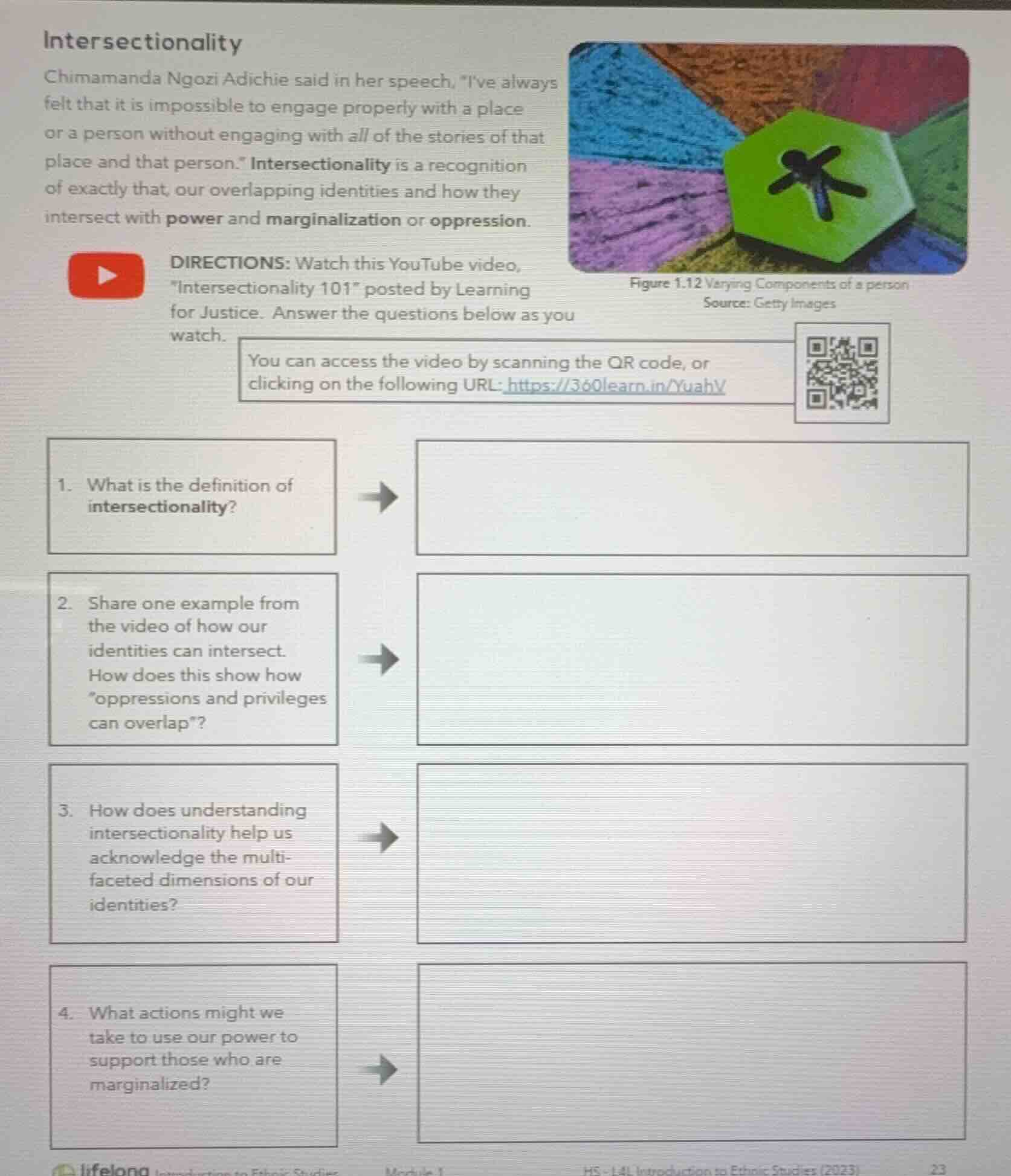
chimamanda ngozi adichie said in her speech, \ive always felt that it is impossible to engage properly with a place or a person without engaging with all of the stories of that place and that person.\ intersectionality is a recognition of exactly that, our overlapping identities and how they intersect with power and marginalization or oppression.
directions: watch this youtube video, \intersectionality 101\ posted by learning for justice. answer the questions below as you watch.
you can access the video by scanning the qr code, or clicking on the following url: https://360learn.in/yuahv
- what is the definition of intersectionality?
- share one example from the video of how our identities can intersect. how does this show how \oppressions and privileges can overlap\?
- how does understanding intersectionality help us acknowledge the multi-faceted dimensions of our identities?
- what actions might we take to use our power to support those who are marginalized?
Define intersectionality based on the text and video
Intersectionality is the recognition of how our overlapping social identities (such as race, gender, class, and sexuality) intersect with systems of power, privilege, marginalization, or oppression.
Analyze overlapping identities and privileges
An individual can hold a combination of privileged and marginalized identities simultaneously (e.g., being male, which carries gender privilege, while also being a person of color, which may subject them to racial discrimination). This shows that oppression and privilege do not exist in isolation but overlap to shape unique lived experiences.
Evaluate the importance of understanding multi-faceted identities
Recognizing intersectionality prevents us from viewing people through a single, oversimplified lens. It helps us acknowledge that everyone has a complex, multi-layered identity that influences how they navigate the world and experience systemic barriers or advantages.
Identify actions to support marginalized groups
We can use our areas of privilege to advocate for others by actively listening to marginalized voices, calling out discriminatory behavior, sharing resources, and supporting policies that promote equity and inclusion.

Snap & solve any problem in the app
Get step-by-step solutions on Sovi AI
Photo-based solutions with guided steps
Explore more problems and detailed explanations
Question 1
The recognition of how our overlapping social identities (such as race, gender, class, and sexuality) intersect and interact with systems of power, marginalization, or oppression.
Question 2
An individual may experience privilege in one aspect of their identity (e.g., being able-bodied) while simultaneously experiencing marginalization in another (e.g., experiencing racial discrimination). This demonstrates that privilege and oppression are not mutually exclusive but overlap to shape a person's unique daily experiences.
Question 3
It prevents us from reducing individuals to a single characteristic or label. By understanding that identities are multi-layered, we can better appreciate the complex, unique lived experiences and distinct challenges that each person faces.
Question 4
We can listen to and amplify marginalized voices, educate ourselves on systemic inequities, speak up against discrimination, and actively share resources or opportunities to help dismantle barriers.