QUESTION IMAGE
Question
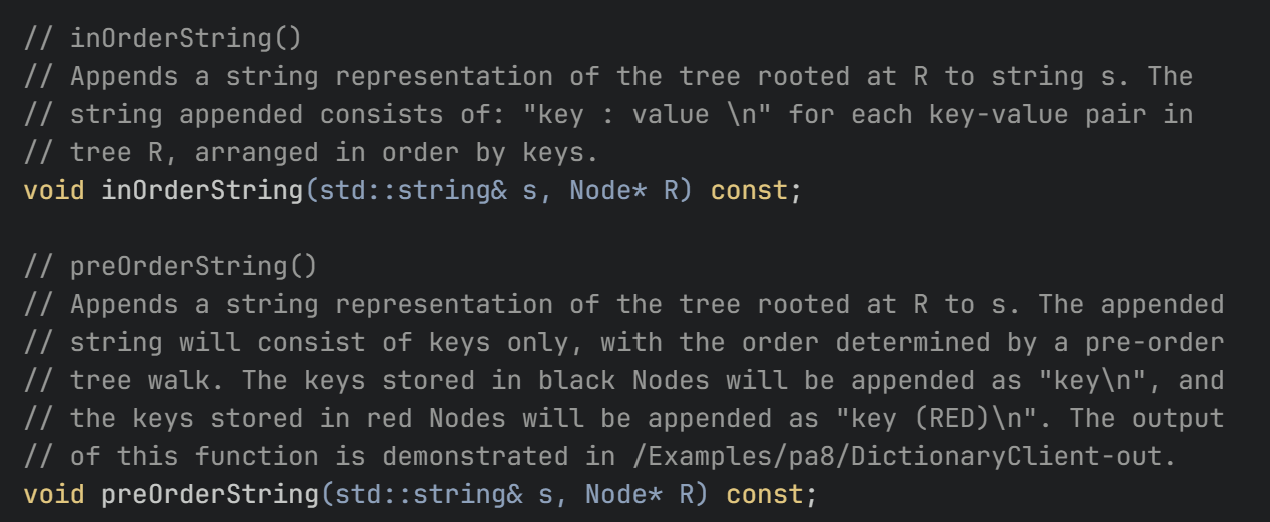
// inorderstring()
// appends a string representation of the tree rooted at r to string s. the
// string appended consists of: \key : value \
\ for each key-value pair in
// tree r, arranged in order by keys.
void inorderstring(std::string& s, node* r) const;
// preorderstring()
// appends a string representation of the tree rooted at r to s. the appended
// string will consist of keys only, with the order determined by a pre-order
// tree walk. the keys stored in black nodes will be appended as \key\
\, and
// the keys stored in red nodes will be appended as \key (red)\
\. the output
// of this function is demonstrated in /examples/pa8/dictionaryclient-out.
void preorderstring(std::string& s, node* r) const;
🆕 New Concept Discovered: Binary Tree Traversals
Visiting nodes in a specific, structured order
Step 1: Understand the Node Structure
To implement these helper functions, we assume a standard Red-Black Tree Node structure containing:
R->key(the key, likely astd::stringor templated type)R->value(the value associated with the key)R->color(an indicator of red or black, e.g., an integer or enum where0orREDrepresents red)R->left(pointer to the left child)R->right(pointer to the right child)- A sentinel node (often called
nil) representing empty leaves, or simplynullptr. In standard implementations for this assignment, empty subtrees are represented by a sentinel node (e.g.,nil) ornullptr. We will use a check against the null/sentinel state.
---
Step 2: Implement inOrderString
An in-order traversal visits the tree in the order: **Left Subtree $
ightarrow$ Current Node $
ightarrow$ Right Subtree**.
- Base Case: If the current node
Ris the sentinel node (let's assumenilornullptr), we do nothing and return. - Recursive Steps:
- Recursively call
inOrderString(s, R->left). - Append the current node's data to the string
sin the format: `"key : value
"`.
- Recursively call
inOrderString(s, R->right).
---
Step 3: Implement preOrderString
A pre-order traversal visits the tree in the order: **Current Node $
ightarrow$ Left Subtree $
ightarrow$ Right Subtree**.
- Base Case: If the current node
Ris the sentinel node (e.g.,nilornullptr), return. - Recursive Steps:
- Process the current node
R:
- If the node is Red, append `"key (RED)
" to s`.
- If the node is Black, append `"key
" to s`.
- Recursively call
preOrderString(s, R->left). - Recursively call
preOrderString(s, R->right).

Snap & solve any problem in the app
Get step-by-step solutions on Sovi AI
Photo-based solutions with guided steps
Explore more problems and detailed explanations
Below is the C++ implementation for both helper functions.
(Note: Replace nil with nullptr if your specific implementation does not use a sentinel node).
// inOrderString()
// Appends a string representation of the tree rooted at R to string s.
// The string appended consists of: "key : value
" for each key-value pair in
// tree R, arranged in order by keys.
void Dictionary::inOrderString(std::string& s, Node* R) const {
    if (R != nil) { // Or R != nullptr depending on your implementation
        inOrderString(s, R->left);
        s += R->key + " : " + R->value + "
";
        inOrderString(s, R->right);
    }
}

// preOrderString()
// Appends a string representation of the tree rooted at R to s. The appended
// string will consist of keys only, with the order determined by a pre-order
// tree walk. The keys stored in black Nodes will be appended as "key
", and
// the keys stored in red Nodes will be appended as "key (RED)
".
void Dictionary::preOrderString(std::string& s, Node* R) const {
    if (R != nil) { // Or R != nullptr depending on your implementation
        if (R->color == RED) { // Assumes RED is defined (e.g., 0 or an enum)
            s += R->key + " (RED)
";
        } else {
            s += R->key + "
";
        }
        preOrderString(s, R->left);
        preOrderString(s, R->right);
    }
}