QUESTION IMAGE
Question
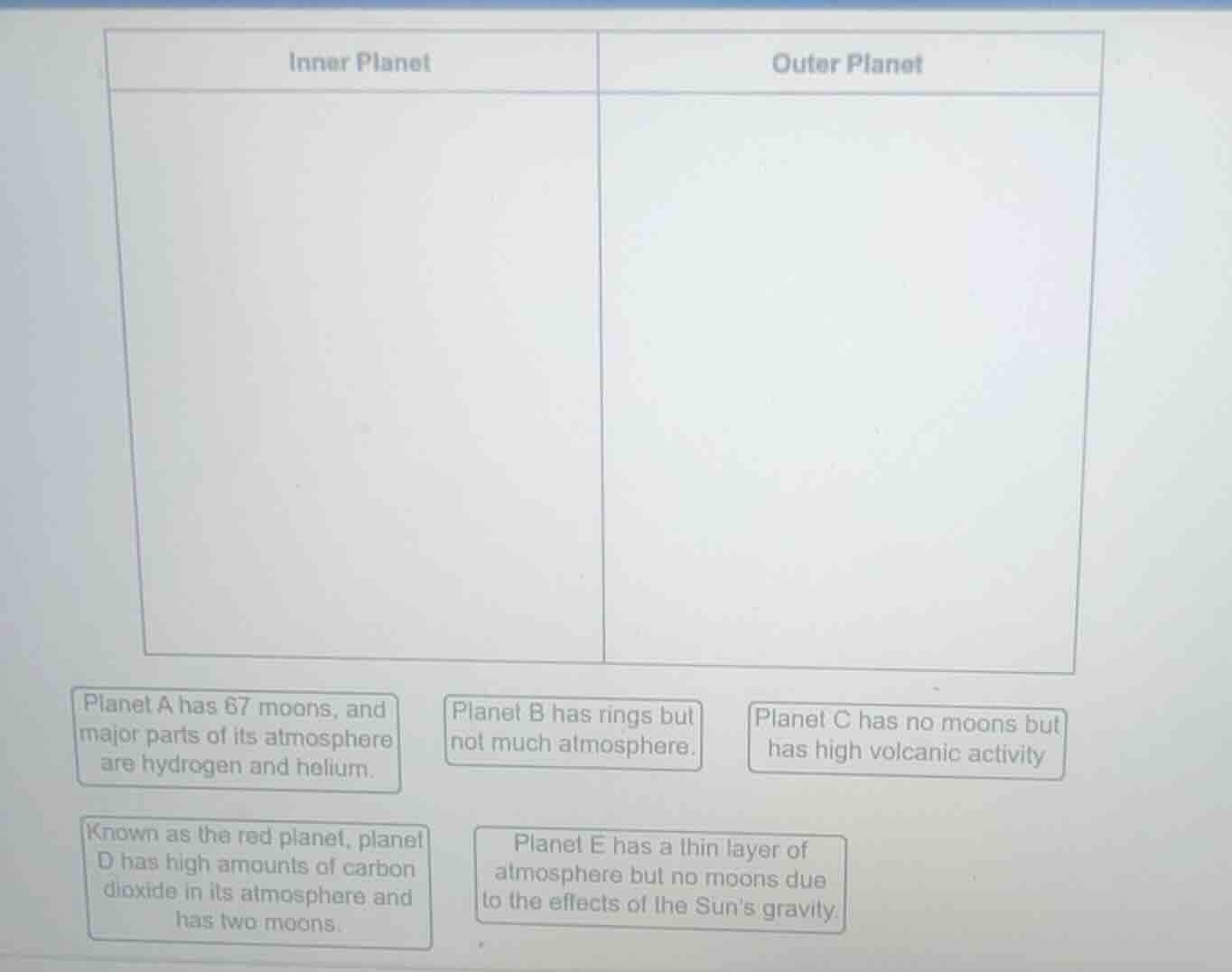
inner planet | outer planet
planet a has 67 moons, and major parts of its atmosphere are hydrogen and helium.
planet b has rings but not much atmosphere.
planet c has no moons but has high volcanic activity.
known as the red planet, planet d has high amounts of carbon dioxide in its atmosphere and has two moons.
planet e has a thin layer of atmosphere but no moons due to the effects of the suns gravity.
Classify Planet A
Using the Gas Giant Characteristics and Planetary Moons knowledge points
- Planet A has 67 moons and a hydrogen/helium atmosphere.
- These are key characteristics of gas giants (outer planets).
- Therefore, Planet A is an Outer Planet.
Classify Planet B
Using the Inner and Outer Planets knowledge point
- Planet B has rings but not much atmosphere.
- Planetary ring systems are exclusive to the outer planets.
- Therefore, Planet B is an Outer Planet.
Classify Planet C
Using the Venusian Geology and Terrestrial Planets knowledge points
- Planet C has no moons but high volcanic activity (characteristic of Venus).
- Venus is a terrestrial planet located close to the Sun.
- Therefore, Planet C is an Inner Planet.
Classify Planet D
Using the Terrestrial Planets and Planetary Atmospheres knowledge points
- Planet D is known as the "red planet" (Mars), with carbon dioxide and two moons.
- Mars is a terrestrial planet.
- Therefore, Planet D is an Inner Planet.
Classify Planet E
Using the Inner and Outer Planets and Terrestrial Planets knowledge points
- Planet E has a thin atmosphere, no moons, and is strongly affected by the Sun's gravity (characteristic of Mercury).
- Mercury is the innermost terrestrial planet.
- Therefore, Planet E is an Inner Planet.

Snap & solve any problem in the app
Get step-by-step solutions on Sovi AI
Photo-based solutions with guided steps
Explore more problems and detailed explanations
| Inner Planet | Outer Planet |
|---|---|
| Planet D | Planet B |
| Planet E |