QUESTION IMAGE
Question
identifying evidence of characterization
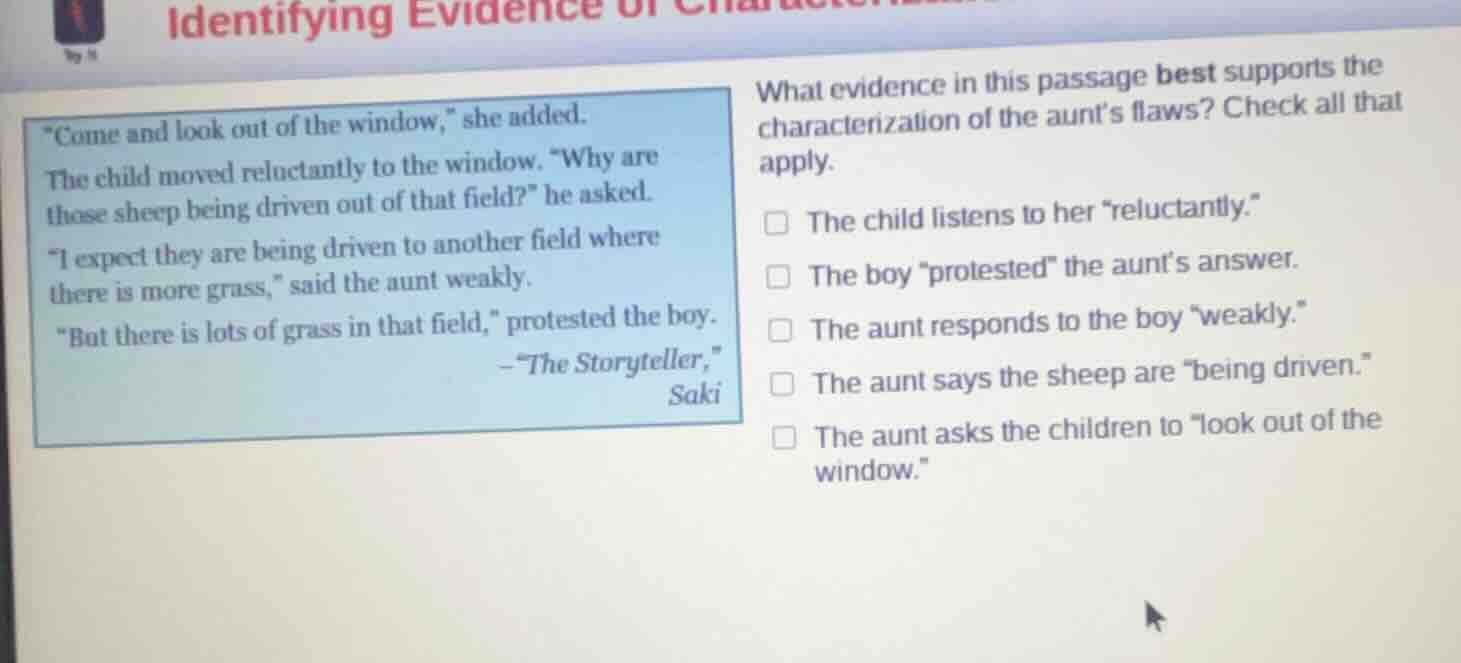
\come and look out of the window,\ she added.
the child moved reluctantly to the window. \why are those sheep being driven out of that field?\ he asked.
\i expect they are being driven to another field where there is more grass,\ said the aunt weakly.
\but there is lots of grass in that field,\ protested the boy.
--\the storyteller,\ saki
what evidence in this passage best supports the characterization of the aunt’s flaws? check all that apply.
□ the child listens to her
eluctantly.\
□ the boy \protested\ the aunt’s answer.
□ the aunt responds to the boy \weakly.\
□ the aunt says the sheep are \being driven.\
□ the aunt asks the children to \look out of the window.\
- For "The child listens to her'reluctantly'": The child's reluctance to follow her request shows the aunt may not have a strong, positive influence or connection, hinting at a flaw in her ability to engage the child.
- For "The boy 'protested' the aunt’s answer": The boy's protest implies that the aunt's answer was unconvincing or flawed, as it was met with disagreement.
- For "The aunt responds to the boy 'weakly'": The word "weakly" describes the aunt's response, suggesting she lacks confidence or a strong, valid argument, which is a flaw.
- The option "The aunt says the sheep are 'being driven'" is just a statement of fact about the sheep, not evidence of the aunt's flaws.
- The option "The aunt asks the children to 'look out of the window'" is a simple request, not evidence of a flaw.

Snap & solve any problem in the app
Get step-by-step solutions on Sovi AI
Photo-based solutions with guided steps
Explore more problems and detailed explanations
- The child listens to her "reluctantly."
- The boy "protested" the aunt’s answer.
- The aunt responds to the boy "weakly."