QUESTION IMAGE
Question
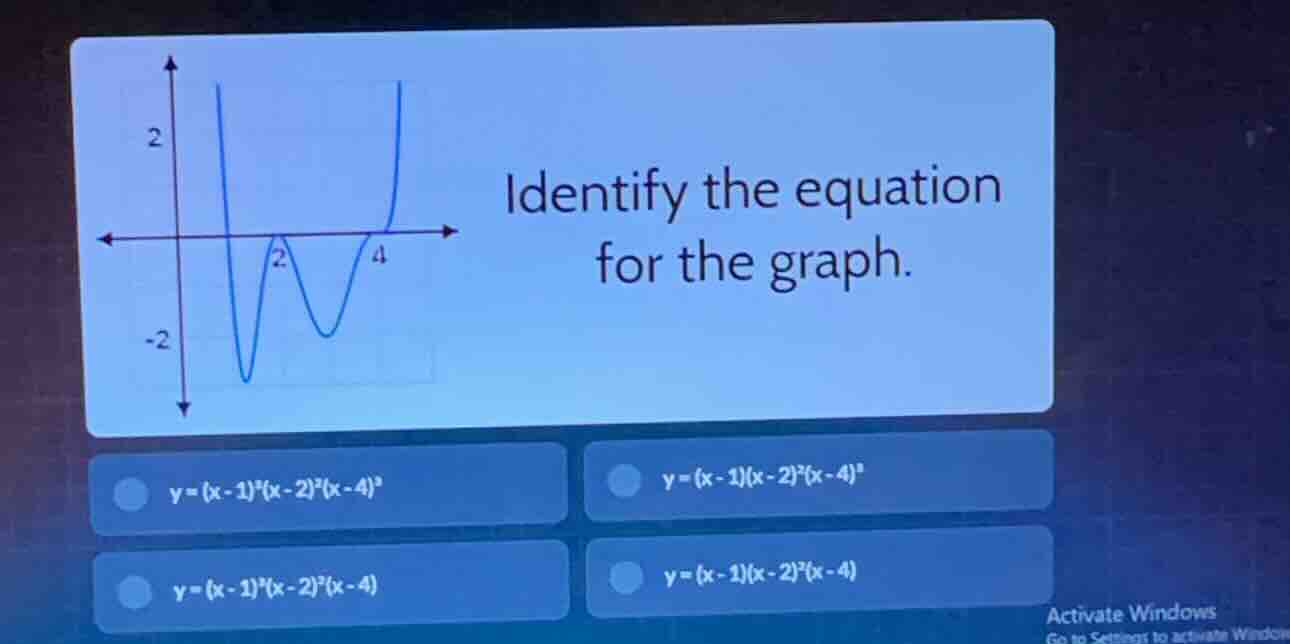
identify the equation for the graph.
- \\(y = (x-1)^3(x-2)^2(x-4)^3\\)
- \\(y = (x-1)(x-2)^2(x-4)^3\\)
- \\(y = (x-1)^3(x-2)^2(x-4)\\)
- \\(y = (x-1)(x-2)^2(x-4)\\)
Identify the roots from the graph
The graph intersects or touches the x-axis at three distinct points:
$$
x = 1, \quad x = 2, \quad x = 4
$$
Determine multiplicity at each root
Using the Polynomial Multiplicity and Graph Behavior at Roots knowledge points
$$
LATEXBLOCK0
$$
Match with the given options
We analyze the exponents of the factors \( (x-1) \), \( (x-2) \), and \( (x-4) \) in each option:
- Option 1: \( y = (x-1)^3(x-2)^2(x-4)^3 \)
- Multiplicities: \( x=1 \) is 3 (crosses), \( x=2 \) is 2 (touches), \( x=4 \) is 3 (crosses). Total degree is 8.
- Option 2: \( y = (x-1)(x-2)^2(x-4)^3 \)
- Multiplicities: \( x=1 \) is 1 (crosses), \( x=2 \) is 2 (touches), \( x=4 \) is 3 (crosses). Total degree is 6.
- Option 3: \( y = (x-1)^3(x-2)^2(x-4) \)
- Multiplicities: \( x=1 \) is 3 (crosses), \( x=2 \) is 2 (touches), \( x=4 \) is 1 (crosses). Total degree is 6.
- Option 4: \( y = (x-1)(x-2)^2(x-4) \)
- Multiplicities: \( x=1 \) is 1 (crosses), \( x=2 \) is 2 (touches), \( x=4 \) is 1 (crosses). Total degree is 4.
Analyze end behavior and inflection
We observe the behavior at the crossings:
- At \( x = 1 \), the graph crosses very steeply and directly, resembling a linear crossing (multiplicity 1).
- At \( x = 4 \), the graph flattens out slightly as it crosses, indicating an inflection point characteristic of a cubic crossing (multiplicity 3).
- Both ends of the graph point upwards as \( x \to \pm\infty \), which requires an even overall degree.
- Checking the degrees:
- Option 2 has degree \( 1 + 2 + 3 = 6 \) (even degree, correct end behavior).
- Option 4 has degree \( 1 + 2 + 1 = 4 \) (even degree, but lacks the cubic flattening at \( x = 4 \)).
- Therefore, the factor \( (x-4) \) must have a multiplicity of 3, and \( (x-1) \) has a multiplicity of 1. This matches \( y = (x-1)(x-2)^2(x-4)^3 \).

Snap & solve any problem in the app
Get step-by-step solutions on Sovi AI
Photo-based solutions with guided steps
Explore more problems and detailed explanations
- y = (x-1)^3(x-2)^2(x-4)^3
- y = (x-1)(x-2)^2(x-4)^3 (Correct answer)
- y = (x-1)^3(x-2)^2(x-4)
- y = (x-1)(x-2)^2(x-4)