QUESTION IMAGE
Question
Question was provided via image upload.
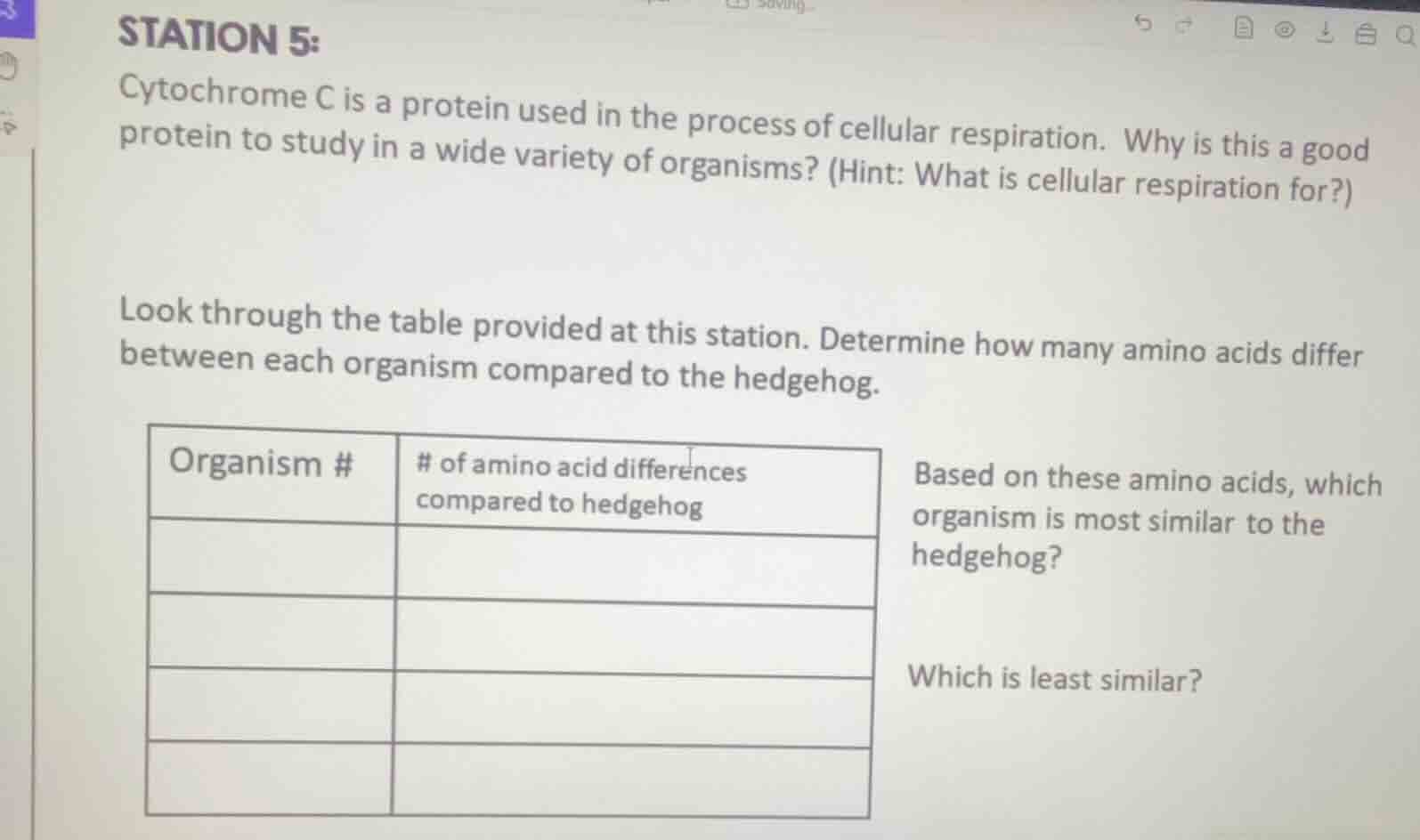
Analyze the utility of Cytochrome C
Using the Evolutionary Evidence knowledge point, we analyze why Cytochrome C is studied. Cellular respiration is a fundamental process used by almost all living organisms to produce energy (ATP). Because cellular respiration is essential for life, the gene and protein sequence for Cytochrome C are highly conserved across a vast range of diverse taxonomic domains and kingdoms, making it an excellent molecular clock to study evolutionary relationships.
Address the missing reference table
The prompt asks to "Look through the table provided at this station" to find the number of amino acid differences compared to the hedgehog. However, this reference table is not visible in the provided image. Therefore, the exact numerical differences for the specific organisms cannot be determined without the source data.
Determine similarity based on sequence differences
In molecular systematics, the degree of evolutionary relationship is reflected in sequence similarity:
- The organism with the fewest amino acid differences compared to the hedgehog is the most genetically similar and shares the most recent common ancestor.
- The organism with the most amino acid differences compared to the hedgehog is the least genetically similar.

Snap & solve any problem in the app
Get step-by-step solutions on Sovi AI
Photo-based solutions with guided steps
Explore more problems and detailed explanations
Question 1
Cytochrome C is an excellent protein to study because cellular respiration is a fundamental life process shared by almost all aerobic organisms. Because it is essential for survival, the protein is highly conserved across diverse species, allowing scientists to compare evolutionary relationships across widely different taxonomic groups.
Question 2
The specific reference table containing the amino acid sequences or differences for the organisms at this station is missing from the image, so the exact numerical values cannot be filled into the table.
Question 3
- Most similar organism: The organism with the lowest number of amino acid differences compared to the hedgehog.
- Least similar organism: The organism with the highest number of amino acid differences compared to the hedgehog.