QUESTION IMAGE
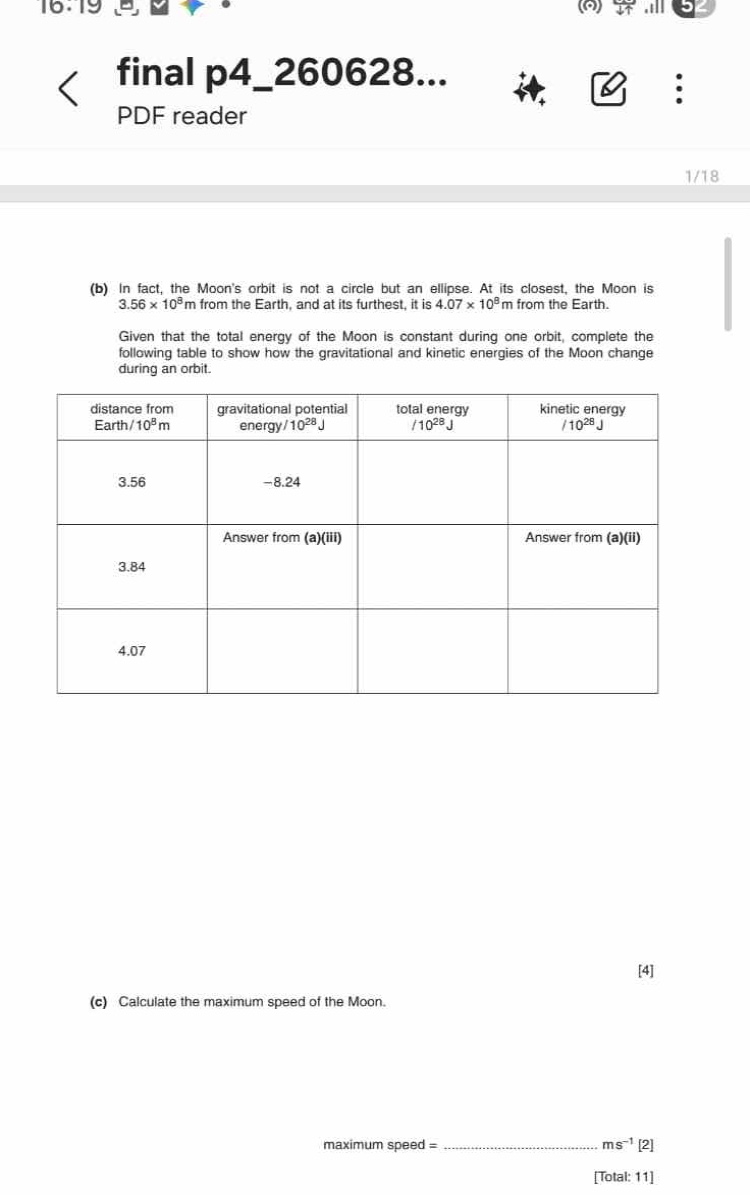
Question
Question was provided via image upload.
Identify missing values from previous parts
The table refers to "Answer from (a)(iii)" and "Answer from (a)(ii)" for a circular orbit of radius \(3.84 \times 10^8\text{ m}\).
For a circular orbit of the Moon around the Earth:
- The mass of the Earth is \(M \approx 5.97 \times 10^{24}\text{ kg}\).
- The mass of the Moon is \(m \approx 7.35 \times 10^{22}\text{ kg}\).
- The orbital radius is \(r = 3.84 \times 10^8\text{ m}\).
- Gravitational Potential Energy is:
$$E_p = -\frac{GMm}{r} \approx -\frac{6.674 \times 10^{-11} \times 5.97 \times 10^{24} \times 7.35 \times 10^{22}}{3.84 \times 10^8} \approx -7.63 \times 10^{28}\text{ J}$$
- For a circular orbit, the Kinetic Energy is:
$$E_k = \frac{GMm}{2r} = -\frac{1}{2}E_p \approx 3.82 \times 10^{28}\text{ J}$$
- The total energy \(E\) is:
$$E = E_p + E_k \approx -3.82 \times 10^{28}\text{ J}$$
Complete the energy table
Using the conservation of total mechanical energy:
- The total energy is constant during the orbit: \(E = -3.82 \times 10^{28}\text{ J}\) (or more precisely, from the circular orbit values, \(E = -3.81 \times 10^{28}\text{ J}\) to \( -3.82 \times 10^{28}\text{ J}\)).
- At \(r = 3.56 \times 10^8\text{ m}\):
- \(E_p = -8.24 \times 10^{28}\text{ J}\)
- \(E = -3.82 \times 10^{28}\text{ J}\)
- \(E_k = E - E_p = -3.82 - (-8.24) = 4.42 \times 10^{28}\text{ J}\)
- At \(r = 4.07 \times 10^8\text{ m}\):
- \(E_p = -\frac{GMm}{r} = -8.24 \times \frac{3.56}{4.07} \approx -7.21 \times 10^{28}\text{ J}\)
- \(E = -3.82 \times 10^{28}\text{ J}\)
- \(E_k = E - E_p = -3.82 - (-7.21) = 3.39 \times 10^{28}\text{ J}\)
Calculate the maximum speed of the Moon
The maximum speed occurs at the closest approach (perigee), where the Kinetic Energy is at its maximum:
- \(E_{k,\text{max}} = 4.42 \times 10^{28}\text{ J}\)
- Using the formula for kinetic energy:
$$E_k = \frac{1}{2} m v^2$$
- Solving for \(v_{\text{max}}\):
$$v_{\text{max}} = \sqrt{\frac{2 E_{k,\text{max}}}{m}} = \sqrt{\frac{2 \times 4.42 \times 10^{28}}{7.35 \times 10^{22}}} \approx 1.10 \times 10^3\text{ m s}^{-1}$$

Snap & solve any problem in the app
Get step-by-step solutions on Sovi AI
Photo-based solutions with guided steps
Explore more problems and detailed explanations
Question 1
The completed table showing the energy values (in units of \(10^{28}\text{ J}\)):
| distance from Earth / \(10^8\text{ m}\) | gravitational potential energy / \(10^{28}\text{ J}\) | total energy / \(10^{28}\text{ J}\) | kinetic energy / \(10^{28}\text{ J}\) |
|---|---|---|---|
| 3.84 | \(-7.63\) | \(-3.82\) | \(3.81\) |
| 4.07 | \(-7.21\) | \(-3.82\) | \(3.39\) |
Question 2
The maximum speed of the Moon is:
maximum speed = <blank>\(1.10 \times 10^3\)</blank> \(\text{m s}^{-1}\)