QUESTION IMAGE
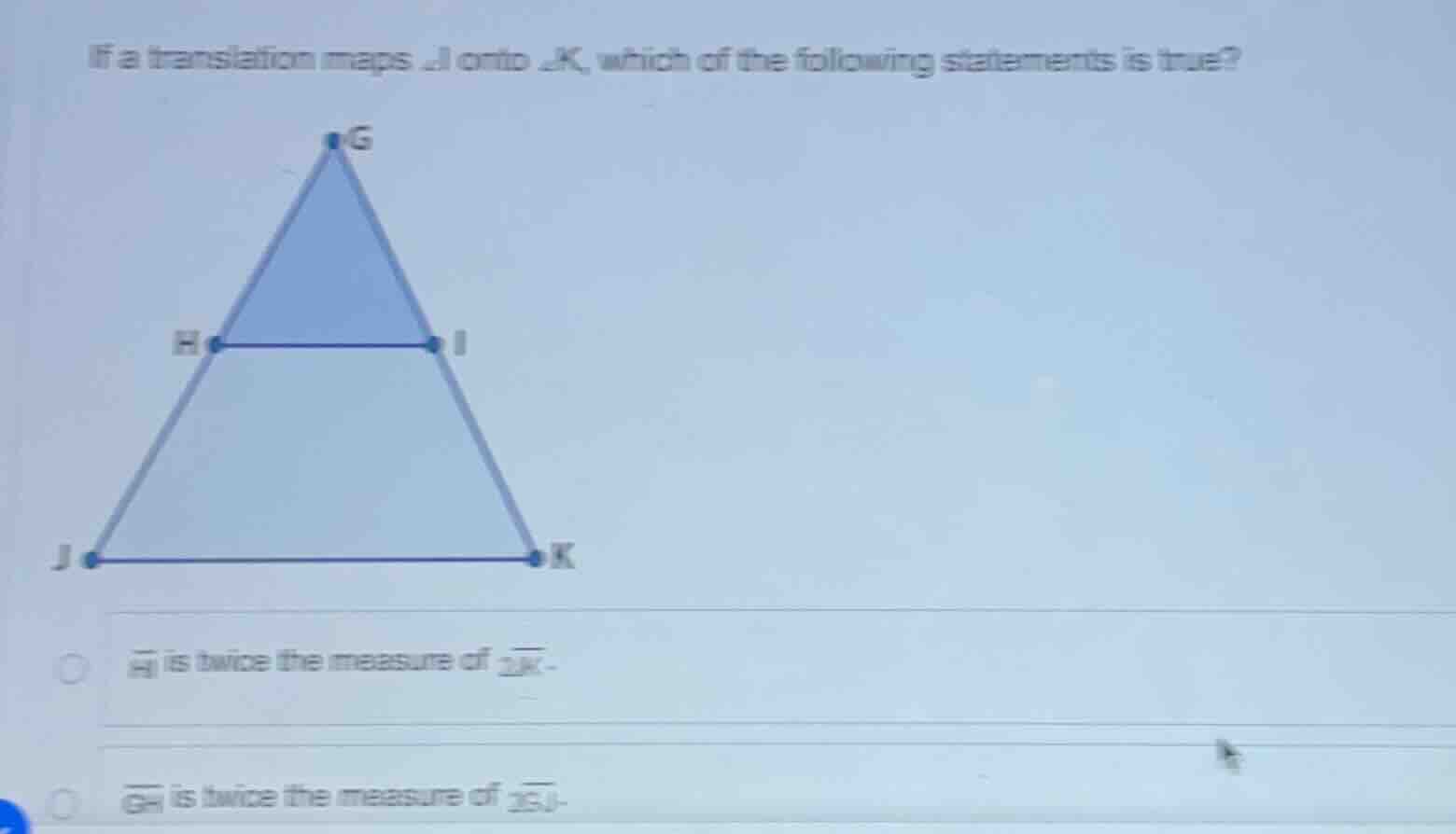
Question
Question was provided via image upload.
Analyze the transformation
The problem states that a translation maps \(\angle J\) onto \(\angle K\). A translation is a rigid motion, which is a type of Geometric Transformations.
Apply translation properties
Translations preserve angle measures. Therefore, if a translation maps \(\angle J\) onto \(\angle K\), the two angles must be congruent:
$$
\angle J \cong \angle K
$$
This means their measures are equal:
$$
m\angle J = m\angle K
$$
Evaluate the options
Let's look at the visible options:
- Option 1: \(\angle J\) is twice the measure of \(\angle K\). (False, they must be equal)
- Option 2: \(\angle H\) is twice the measure of \(\angle J\). (No basis for this)
- Since translations preserve angle measure, the correct statement must express that the measure of \(\angle J\) is equal to the measure of \(\angle K\).

Snap & solve any problem in the app
Get step-by-step solutions on Sovi AI
Photo-based solutions with guided steps
Explore more problems and detailed explanations
- (A) \(\angle J\) is equal to the measure of \(\angle K\) (Correct answer)
- (B) \(\angle J\) is twice the measure of \(\angle K\)
- (C) \(\angle H\) is twice the measure of \(\angle J\)