QUESTION IMAGE
Question
Question was provided via image upload.
Analyze the end behavior of each function as \(x \to -\infty\)
For \(f(x)\):
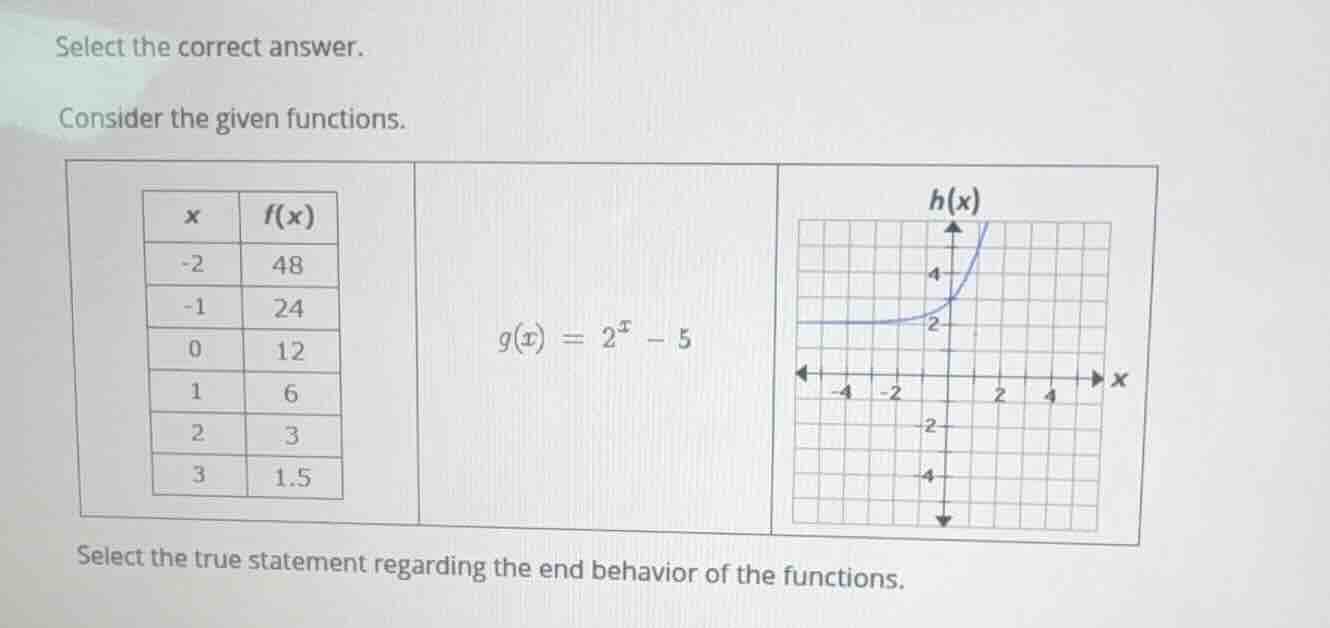
The table shows \(f(x)\) values doubling as \(x\) decreases by 1:
\(f(0) = 12\), \(f(-1) = 24\), \(f(-2) = 48\).
Thus, \(f(x) = 12 \cdot 2^{-x} = 12 \cdot (0.5)^x\).
As \(x \to -\infty\), \(f(x) \to \infty\).
For \(g(x) = 2^x - 5\):
As \(x \to -\infty\), \(2^x \to 0\).
Thus, \(g(x) \to -5\).
For \(h(x)\):
The graph shows a horizontal asymptote as \(x \to -\infty\).
The curve levels off at \(y = 2\).
Thus, as \(x \to -\infty\), \(h(x) \to 2\).
Analyze the end behavior of each function as \(x \to \infty\)
For \(f(x) = 12 \cdot (0.5)^x\):
As \(x \to \infty\), \(f(x) \to 0\).
For \(g(x) = 2^x - 5\):
As \(x \to \infty\), \(g(x) \to \infty\).
For \(h(x)\):
The graph shows the curve rising rapidly to the right.
As \(x \to \infty\), \(h(x) \to \infty\).
Determine the true statements regarding end behavior
Based on the analysis:
- As \(x \to -\infty\), \(f(x) \to \infty\), \(g(x) \to -5\), and \(h(x) \to 2\).
- As \(x \to \infty\), \(f(x) \to 0\), \(g(x) \to \infty\), and \(h(x) \to \infty\).

Snap & solve any problem in the app
Get step-by-step solutions on Sovi AI
Photo-based solutions with guided steps
Explore more problems and detailed explanations
Because the multiple-choice options are cut off in the image, the complete set of true end behavior statements for the given functions is provided below:
- As \(x \to -\infty\), \(f(x) \to \infty\), \(g(x) \to -5\), and \(h(x) \to 2\).
- As \(x \to \infty\), \(f(x) \to 0\), \(g(x) \to \infty\), and \(h(x) \to \infty\).