QUESTION IMAGE
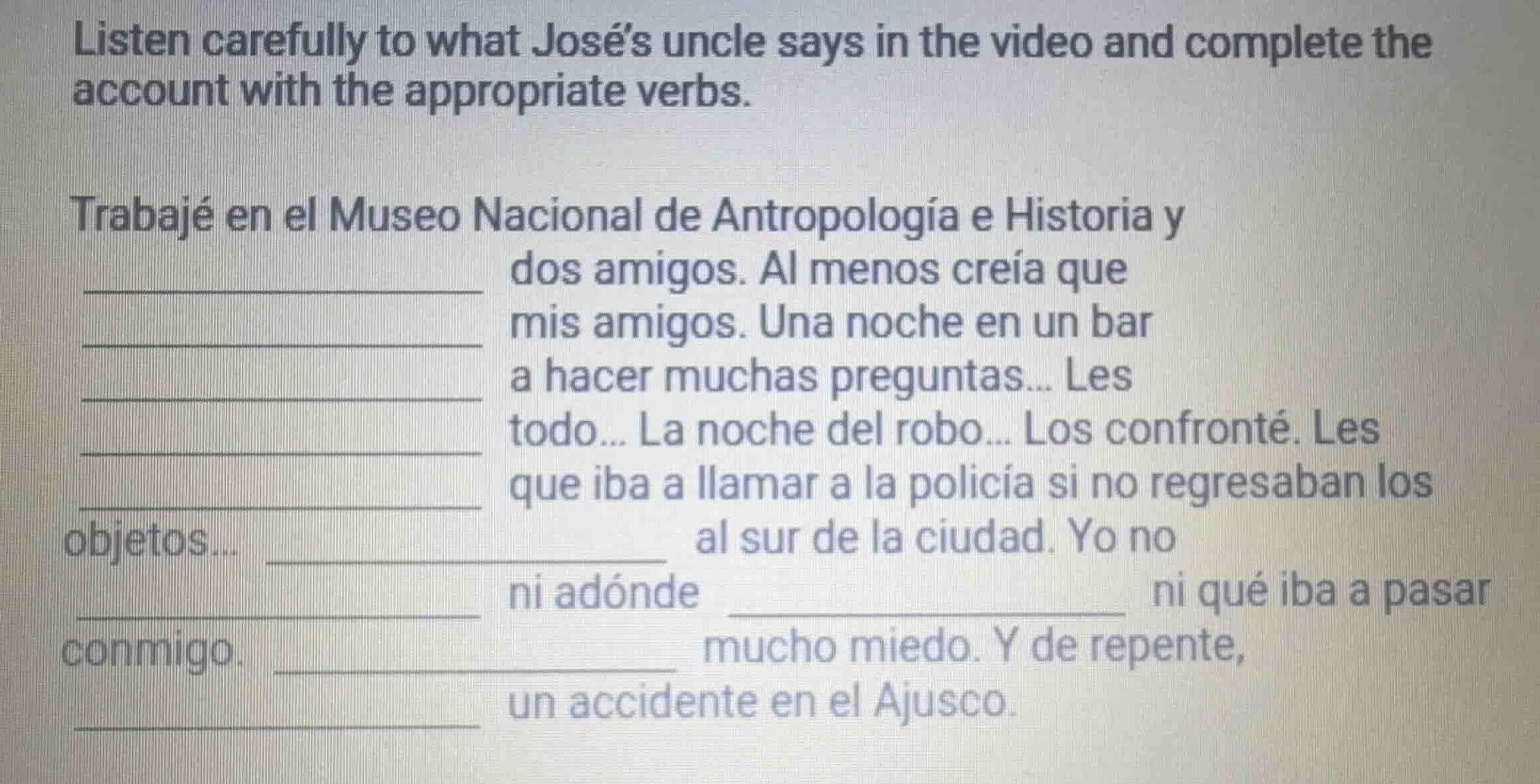
Question
Question was provided via image upload.
Analyze context and grammatical clues
The text is a first-person narrative in Spanish describing a past event involving a museum job, friends, a bar, a robbery, and an accident. We must determine the missing verbs based on grammatical context, syntax, and narrative flow.
- "Trabajé en el Museo Nacional de Antropología e Historia y [blank 1] dos amigos."
- Context: "I worked at the National Museum of Anthropology and History and [had/met] two friends."
- Verb: tener (to have) or conocer (to meet). In the imperfect, "tenía" (I had) fits perfectly to describe a past state: tenía.
- "Al menos creía que [blank 2] mis amigos."
- Context: "At least I believed they [were] my friends."
- Verb: ser (to be). Since it describes a past state/characteristic, the imperfect "eran" is required: eran.
- "Una noche en un bar [blank 3] a hacer muchas preguntas..."
- Context: "One night in a bar [they started] to ask many questions..."
- Verb: empezar or comenzar (to start/begin) followed by "a + infinitive". Since it is a specific completed action in the past, the preterite "empezaron" or "comenzaron" is used: empezaron.
- "Les [blank 4] todo..."
- Context: "I [told/confessed] everything to them..."
- Verb: decir (to tell) or contar (to tell/recount). In the preterite for a completed action: conté (or dije).
- "Les [blank 5] que iba a llamar a la policía si no regresaban los objetos..."
- Context: "I [told] them that I was going to call the police if they didn't return the objects..."
- Verb: decir (to tell). In the preterite: dije.
- "[blank 6] al sur de la ciudad."
- Context: "They [went/fled] to the south of the city."
- Verb: ir (to go) or huir (to flee). In the preterite: fueron (or huyeron).
- "Yo no [blank 7] ni adónde [blank 8] ni qué iba a pasar conmigo."
- Context: "I didn't [know] where [they went] nor what was going to happen to me."
- Verbs: saber (to know) and ir (to go).
- "Yo no sabía" (imperfect of saber for mental state) "ni adónde iban" (imperfect of ir for ongoing destination) or "se habían ido" (pluperfect): sabía and iban (or fueron).
- "[blank 9] mucho miedo."
- Context: "I [was/had] very scared."
- Verb: tener (to have) used with "miedo". Imperfect for describing a past emotional state: tenía.
- "Y de repente, [blank 10] un accidente en el Ajusco."
- Context: "And suddenly, there [was] an accident in El Ajusco."
- Verb: haber (there to be). Preterite "hubo" is used for a sudden, completed event: hubo.
Synthesize the complete paragraph
Let's reconstruct the paragraph with the most natural contextual verbs:
"Trabajé en el Museo Nacional de Antropología e Historia y tenía dos amigos. Al menos creía que eran mis amigos. Una noche en un bar empezaron a hacer muchas preguntas... Les conté todo... La noche del robo... Los confronté.…

Snap & solve any problem in the app
Get step-by-step solutions on Sovi AI
Photo-based solutions with guided steps
Explore more problems and detailed explanations
Listen carefully to what José’s uncle says in the video and complete the account with the appropriate verbs.
Trabajé en el Museo Nacional de Antropología e Historia y <blank>\(tenía\)</blank> dos amigos. Al menos creía que <blank>\(eran\)</blank> mis amigos. Una noche en un bar <blank>\(empezaron\)</blank> a hacer muchas preguntas... Les <blank>\(conté\)</blank> todo... La noche del robo... Los confronté. Les <blank>\(dije\)</blank> que iba a llamar a la policía si no regresaban los objetos... <blank>\(Fueron\)</blank> al sur de la ciudad. Yo no <blank>\(sabía\)</blank> ni adónde <blank>\(iban\)</blank> ni qué iba a pasar conmigo. <blank>\(Tenía\)</blank> mucho miedo. Y de repente, <blank>\(hubo\)</blank> un accidente en el Ajusco.