QUESTION IMAGE
Question
Question was provided via image upload.
Analyze the visible options
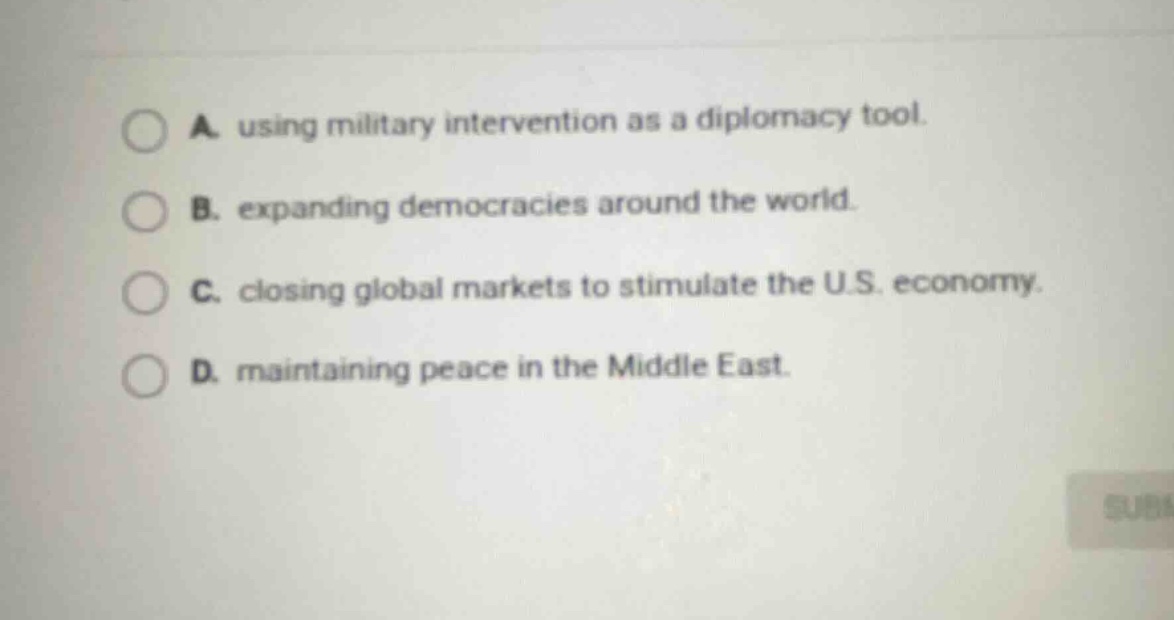
The image displays four multiple-choice options related to historical US foreign policy or diplomatic goals:
- A. using military intervention as a diplomacy tool.
- B. expanding democracies around the world.
- C. closing global markets to stimulate the U.S. economy.
- D. maintaining peace in the Middle East.
Identify the context of the missing question stem
Based on standard US History curricula covering the late 20th century (specifically the post-Cold War era, Clinton administration, or general modern US foreign policy objectives), a common question asks about a primary goal of US foreign policy during this period.
- Option B ("expanding democracies around the world"), often referred to as democratic enlargement, was a cornerstone of US foreign policy in the post-Cold War era (particularly under the Clinton administration).
- Option C is historically incorrect as the US sought to open global markets (e.g., NAFTA, WTO) rather than close them.
- Option A and D are specific strategies or regional goals, but "expanding democracies around the world" (democratic enlargement) represents a primary, broad ideological goal of modern US foreign policy.
Determine the most historically accurate primary goal
Expanding democracy and promoting free markets worldwide have been the defining pillars of modern US foreign policy guidelines. Therefore, Option B is the most comprehensive and standard correct answer for general questions of this type.

Snap & solve any problem in the app
Get step-by-step solutions on Sovi AI
Photo-based solutions with guided steps
Explore more problems and detailed explanations
- (A) using military intervention as a diplomacy tool.
- (B) expanding democracies around the world. (Correct answer)
- (C) closing global markets to stimulate the U.S. economy.
- (D) maintaining peace in the Middle East.