QUESTION IMAGE
Question
Question was provided via image upload.
Analyze the historical context of the digital divide in the 2010s
In the 2010s, essential services, bill payments, and civic processes (like voter registration) increasingly transitioned online. This shift created a significant disadvantage for individuals lacking reliable internet access, a phenomenon known as the digital divide.
Evaluate the given options
- Option A correctly identifies how a lack of internet access directly hindered everyday tasks like paying bills or registering to vote.
- Option B is historically inaccurate because the majority of schools in economically disadvantaged areas did have basic internet access by the 2010s, even if bandwidth differed.
- Option C is incorrect because smartphones became highly widespread and affordable for a vast majority of Americans during this decade.
- Option D is incorrect because high-speed broadband access was widely available to the middle class, not exclusively the wealthiest Americans.

Snap & solve any problem in the app
Get step-by-step solutions on Sovi AI
Photo-based solutions with guided steps
Explore more problems and detailed explanations
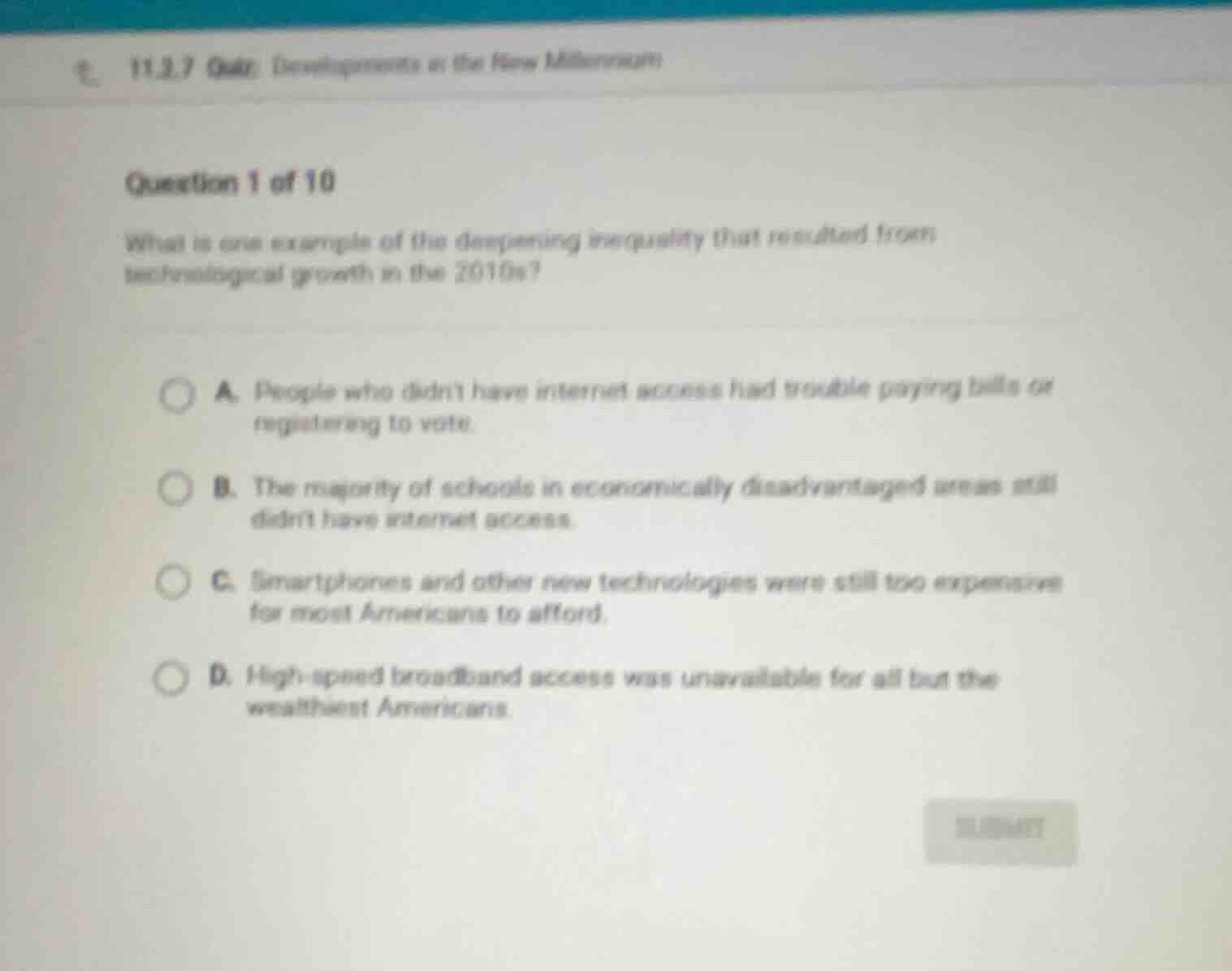
- (A) People who didn't have internet access had trouble paying bills or registering to vote. (Correct answer)
- (B) The majority of schools in economically disadvantaged areas still didn't have internet access.
- (C) Smartphones and other new technologies were still too expensive for most Americans to afford.
- (D) High-speed broadband access was unavailable for all but the wealthiest Americans.