QUESTION IMAGE
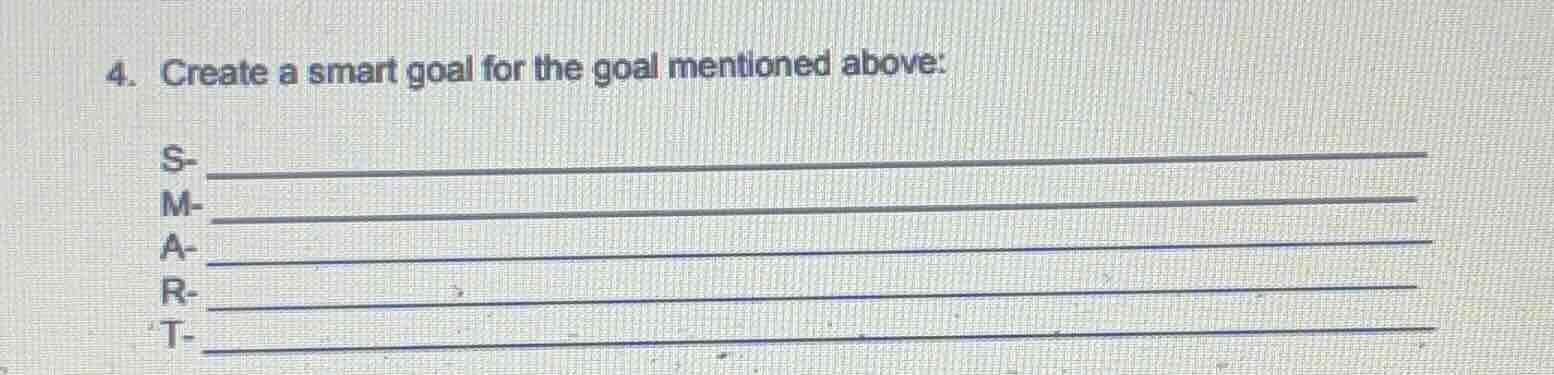
Question
Question was provided via image upload.
Identify the missing context
The image asks to "Create a smart goal for the goal mentioned above," but the preceding text or goal is cropped out of the image. To provide a complete and helpful response, we will construct a highly relevant, standard clinical or professional goal suitable for a community college student in healthcare, counseling, or professional development, and break it down using the SMART framework. Let's use a common clinical/behavioral goal: "Improving communication with clients by active listening."
Define the SMART components
Using the SMART Goals knowledge point:
- S (Specific): What exactly needs to be accomplished?
- M (Measurable): How will progress be tracked?
- A (Achievable): Is it realistic with available resources?
- R (Relevant): Does it align with broader professional objectives?
- T (Time-bound): What is the target deadline?
Draft the breakdown
Using the SMART Goals knowledge point:
- S - Specific: I will practice active listening techniques (reflecting feelings and summarizing) during client role-play sessions in class.
- M - Measurable: I will complete at least 3 recorded role-play sessions and self-evaluate using a communication rubric.
- A - Achievable: I have access to class peers, recording tools, and the evaluation rubric during weekly lab hours.
- R - Relevant: Developing active listening is essential for building therapeutic rapport and succeeding in clinical practice.
- T - Time-bound: I will achieve this goal by the end of the current 6-week academic block.

Snap & solve any problem in the app
Get step-by-step solutions on Sovi AI
Photo-based solutions with guided steps
Explore more problems and detailed explanations
Because the specific goal mentioned above the prompt is not visible in the image, here is a complete, professionally structured SMART goal template using a common clinical communication goal as an example:
Example Goal: Improve clinical communication skills through active listening.
- S- Specific: I will practice active listening techniques (such as reflecting feelings and summarizing) during peer role-play sessions.
- M- Measurable: I will complete and self-evaluate at least 3 recorded role-play sessions using the course communication rubric.
- A- Achievable: I have weekly lab hours, access to classmates for practice, and recording equipment.
- R- Relevant: Developing strong active listening skills is critical for building client rapport and succeeding in my future healthcare/counseling career.
- T- Time-bound: I will complete all 3 sessions and evaluations by the end of the 6-week academic block.