QUESTION IMAGE
Question
Question was provided via image upload.
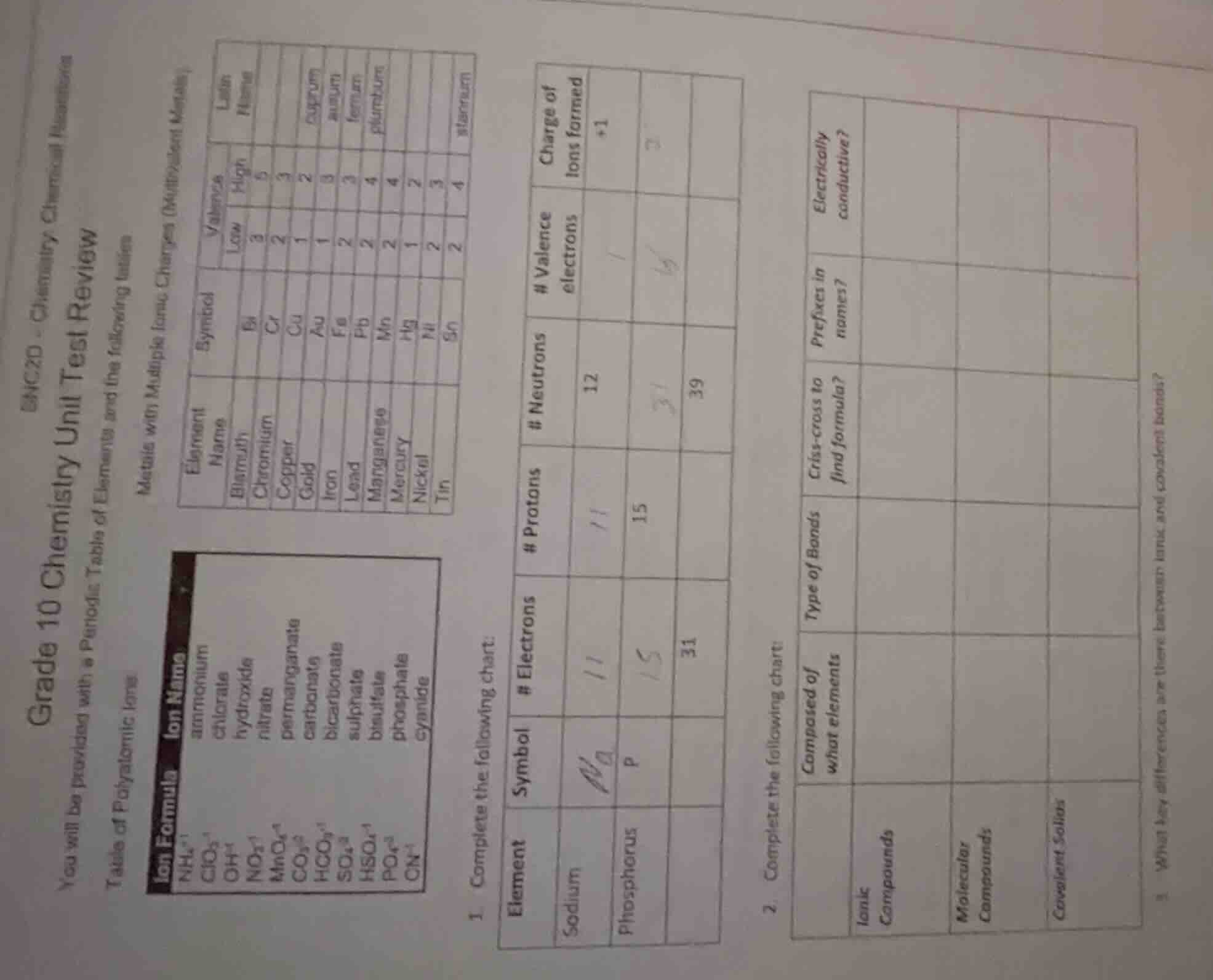
Complete the atomic structure table
We determine the missing values for Sodium, Phosphorus, and the third element using atomic properties.
- Sodium (Na):
- Atomic number \(Z = 11\), so # Protons = 11.
- Neutral atom has # Electrons = 11.
- Mass number \(A = Z + \text{# Neutrons} = 11 + 12 = 23\).
- Valence electrons: Sodium is in Group 1, so # Valence electrons = 1.
- Charge of ion formed: Loses 1 electron to form a \(+1\) ion.
- Phosphorus (P):
- Atomic number \(Z = 15\), so # Protons = 15.
- Neutral atom has # Electrons = 15.
- Mass number for stable isotope is typically 31, so # Neutrons = \(31 - 15 = 16\).
- Valence electrons: Group 15, so # Valence electrons = 5.
- Charge of ion formed: Gains 3 electrons to form a \(-3\) ion.
- Third Element:
- Given # Electrons = 31 (neutral atom, so # Protons = 31, which is Gallium, Ga).
- Given # Neutrons = 39. Mass number \(A = 31 + 39 = 70\).
- Valence electrons: Gallium is in Group 13, so # Valence electrons = 3.
- Charge of ion formed: Loses 3 electrons to form a \(+3\) ion.
Complete the bonding comparison chart
We compare Ionic Compounds, Molecular Compounds, and Covalent Solids.
- Ionic Compounds:
- Composed of: Metals and non-metals.
- Type of Bonds: Ionic bonds (electrostatic attraction).
- Criss-cross to find formula?: Yes.
- Prefixes in names?: No.
- Electrically conductive?: Yes (when molten or dissolved in water).
- Molecular Compounds:
- Composed of: Non-metals only.
- Type of Bonds: Covalent bonds (sharing of electrons).
- Criss-cross to find formula?: No.
- Prefixes in names?: Yes.
- Electrically conductive?: No.
- Covalent Solids (Network):
- Composed of: Metalloids or non-metals (e.g., Carbon, Silicon).
- Type of Bonds: Network covalent bonds.
- Criss-cross to find formula?: No.
- Prefixes in names?: No (usually named by common names or simple empirical formulas).
- Electrically conductive?: Generally no (except graphite).
Identify key differences between bonds
We summarize the main differences between ionic and covalent bonds.
- Ionic bonds involve the complete transfer of electrons from a metal to a non-metal, creating electrostatic attraction between oppositely charged ions.
- Covalent bonds involve the sharing of electron pairs between non-metal atoms to achieve stable electron configurations.

Snap & solve any problem in the app
Get step-by-step solutions on Sovi AI
Photo-based solutions with guided steps
Explore more problems and detailed explanations
Question 1: Atomic Structure Table
| Element | Symbol | # Electrons | # Protons | # Neutrons | # Valence electrons | Charge of ions formed |
|---|---|---|---|---|---|---|
| Phosphorus | \(\text{P}\) | 15 | 15 | 16 | 5 | \(-3\) |
| Gallium | \(\text{Ga}\) | 31 | 31 | 39 | 3 | \(+3\) |
---
Question 2: Bonding Comparison Chart
| Compound Type | Composed of what elements | Type of Bonds | Criss-cross to find formula? | Prefixes in names? | Electrically conductive? |
|---|---|---|---|---|---|
| Molecular Compounds | Non-metals only | Covalent | No | Yes | No |
| Covalent Solids | Metalloids / Carbon / Silicon | Network Covalent | No | No | Generally no (except graphite) |
---
Question 3: Key Differences Between Ionic and Covalent Bonds
- Electron Behavior: Ionic bonds involve the transfer of electrons from a metal to a non-metal, whereas covalent bonds involve the sharing of electrons between non-metal atoms.
- Force of Attraction: Ionic bonds are held together by strong electrostatic forces between oppositely charged ions, while covalent bonds are held together by the shared electrostatic attraction between the nuclei and the shared electrons.