QUESTION IMAGE
Question
Question was provided via image upload.
Analyze the sequence of bone repair
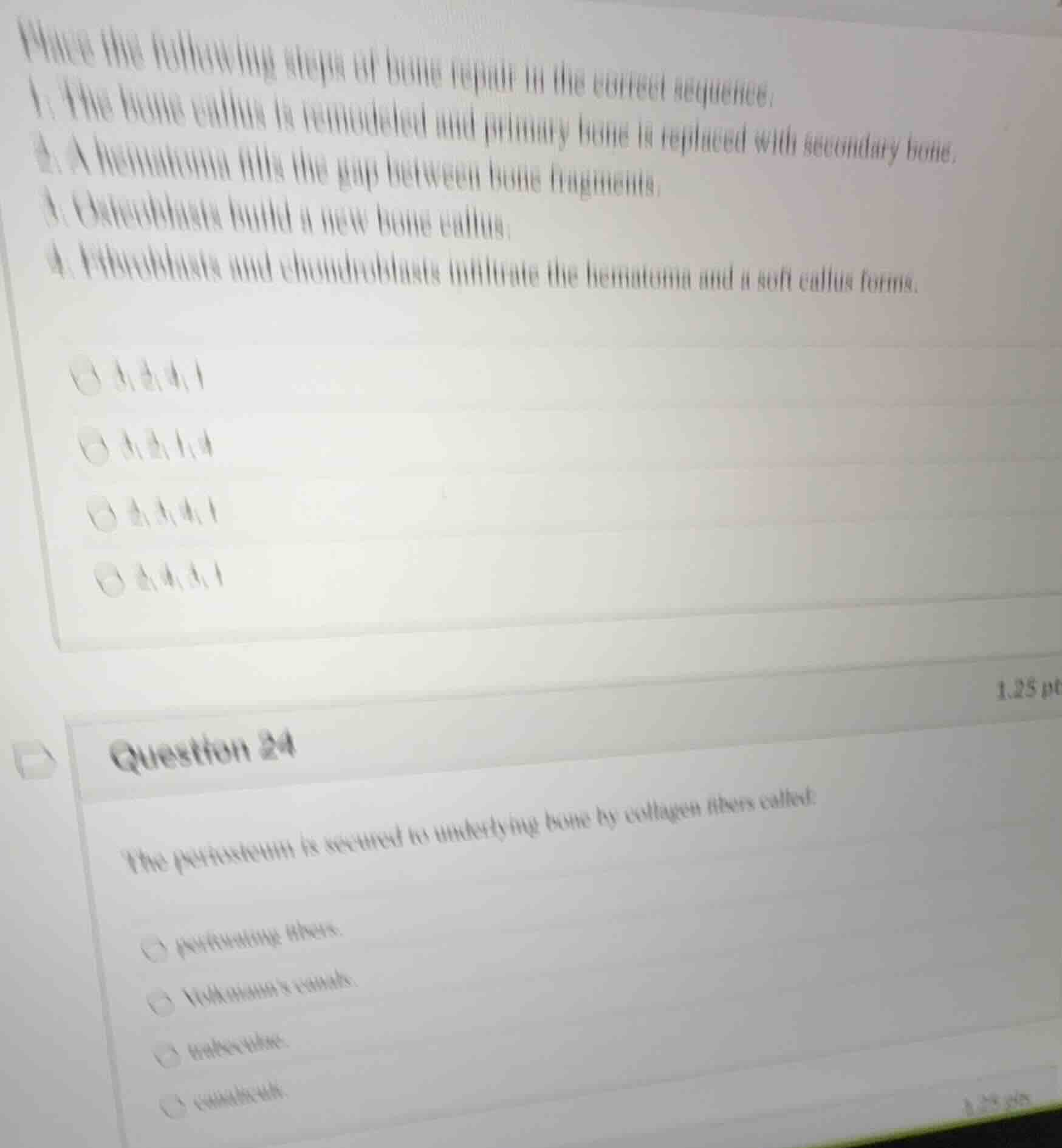
The first question asks to place the steps of bone repair in the correct sequence:
- The bone callus is remodeled and primary bone is replaced with secondary bone.
- A hematoma fills the gap between bone fragments.
- Osteoblasts build a new bone callus.
- Fibroblasts and chondroblasts infiltrate the hematoma and a soft callus forms.
Let's determine the physiological order of these events:
- Immediately after a fracture, blood vessels rupture, leading to the formation of a blood clot or hematoma. Thus, step 2 occurs first.
- Next, active fibroblasts and chondroblasts invade the site to produce collagen fibers and cartilage, forming a soft (fibrocartilaginous) callus. Thus, step 4 occurs second.
- Following this, osteoblasts replace the soft callus with a hard (bony) callus of spongy bone. Thus, step 3 occurs third.
- Finally, over several months, the bony callus is remodeled by osteoclasts and osteoblasts, replacing primary bone with mature secondary bone. Thus, step 1 occurs last.
The correct sequence is 2, 4, 3, 1.
Identify the securing fibers of the periosteum
The second question (labeled Question 24) asks: "The periosteum is secured to underlying bone by collagen fibers called:"
The options are:
- perforating fibers (also known as Sharpey's fibers)
- Volkmann's canals
- trabeculae
- canaliculi
Using the Bone Tissue Layers knowledge point, we know that the periosteum is a dense irregular connective tissue membrane covering the outer surface of bones. It is anchored to the underlying bone matrix by strong tufts of collagen fibers called perforating (or Sharpey's) fibers.
Therefore, the correct option is "perforating fibers".

Snap & solve any problem in the app
Get step-by-step solutions on Sovi AI
Photo-based solutions with guided steps
Explore more problems and detailed explanations
Question 1
- (A) 2, 3, 4, 1
- (B) 2, 1, 4, 3
- (C) 2, 4, 3, 1 (Correct answer)
- (D) 4, 2, 3, 1
Question 2
- (A) perforating fibers (Correct answer)
- (B) Volkmann's canals
- (C) trabeculae
- (D) canaliculi