QUESTION IMAGE
Question
Question was provided via image upload.
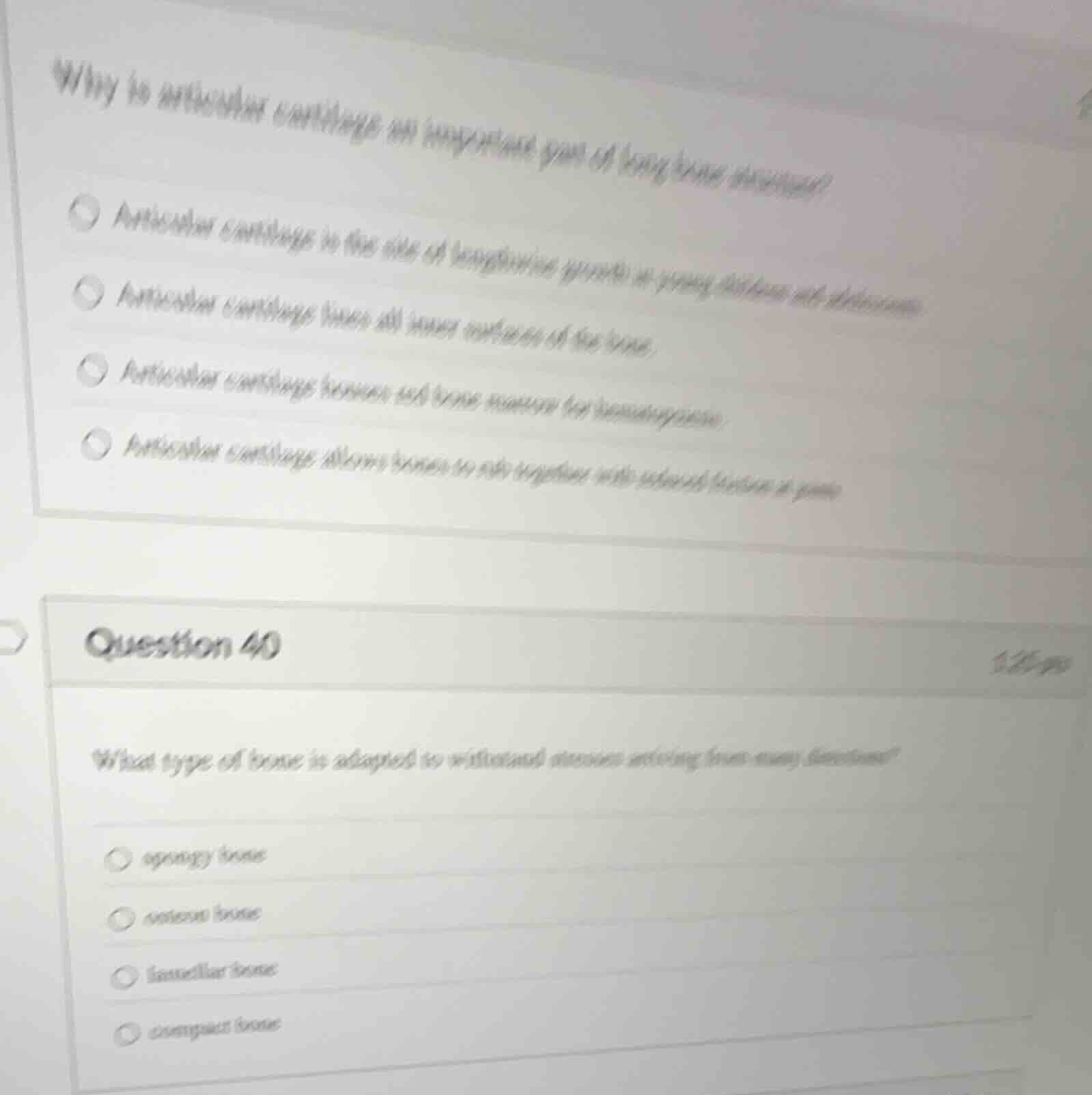
Analyze articular cartilage function
Using the Long Bone Anatomy knowledge point, we evaluate the first question. Articular cartilage is a thin layer of hyaline cartilage covering the epiphysis of a long bone where it forms a joint. Its primary function is to reduce friction and absorb shock at joints.
- Option 1 describes the epiphyseal plate.
- Option 2 describes the endosteum.
- Option 3 describes red bone marrow.
- Option 4 correctly states that it allows bones to rub together with reduced friction at joints.
Analyze bone adaptation to multi-directional stress
Using the Spongy Bone Structure knowledge point, we evaluate the second question (Question 40). Spongy bone (cancellous bone) consists of a network of bony plates and needles called trabeculae. These trabeculae align along lines of stress, allowing the bone to withstand forces arriving from many different directions. In contrast, compact bone is highly structured with osteons aligned parallel to the long axis, making it excellent at handling heavy stress in one primary direction but less adapted to multi-directional stress.
- Option 1 (spongy bone) is the correct adaptation for multi-directional stress.

Snap & solve any problem in the app
Get step-by-step solutions on Sovi AI
Photo-based solutions with guided steps
Explore more problems and detailed explanations
Question 1
- (A) Articular cartilage is the site of lengthwise growth in young children and adolescents.
- (B) Articular cartilage lines all inner surfaces of the bone.
- (C) Articular cartilage houses red bone marrow for hematopoiesis.
- (D) Articular cartilage allows bones to rub together with reduced friction at joints. (Correct answer)
Question 2
- (A) spongy bone (Correct answer)
- (B) osteon bone
- (C) lamellar bone
- (D) compact bone