QUESTION IMAGE
Question
Question was provided via image upload.
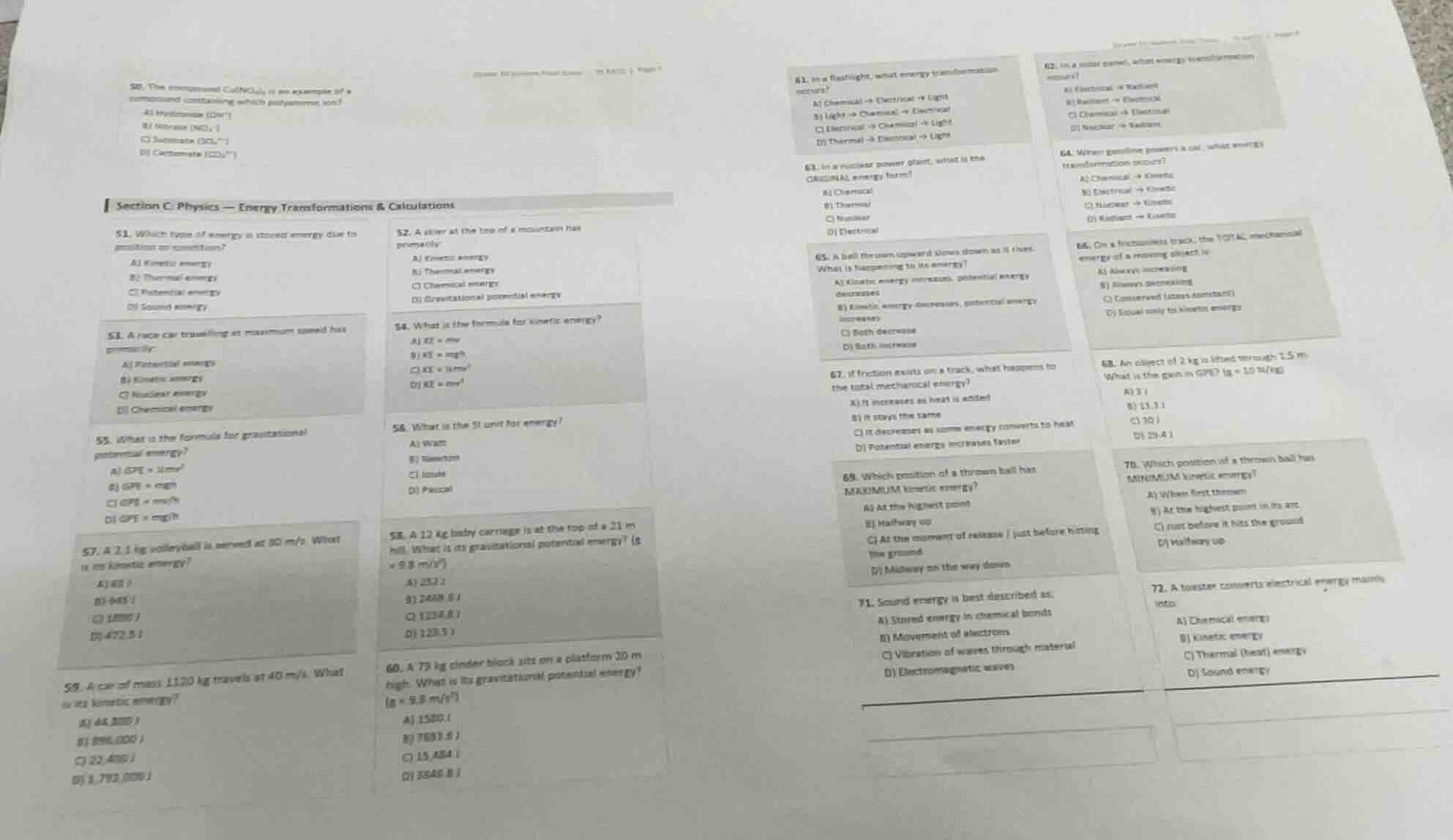
Identify the scope of the worksheet
The image contains multiple-choice questions from a physics worksheet under "Section C: Physics – Energy Transformations & Calculations" (Questions 51 to 72), plus two visible questions at the top (Question 50 and Questions 61-64). Due to the high number of questions (24 questions) and the blurry nature of some parts, we will systematically solve each visible question using standard physics formulas.
Solve Questions 50 to 56
- Question 50: "The compound \(Co(NO_3)_2\) is an example of a compound containing which polyatomic ion?"
The polyatomic ion is nitrate, \(NO_3^-\).
- Correct Option: (B) Nitrate (\(NO_3^-\))
- Question 51: "Which type of energy is stored energy due to position or condition?"
Potential energy is defined as stored energy based on position.
- Correct Option: (C) Potential energy
- Question 52: "A skier at the top of a mountain has primarily"
At the top of a mountain, the skier has height, which corresponds to gravitational potential energy.
- Correct Option: (D) Gravitational potential energy
- Question 53: "A race car travelling at maximum speed has primarily"
An object in motion has kinetic energy.
- Correct Option: (B) Kinetic energy
- Question 54: "What is the formula for kinetic energy?"
The formula is \(KE = \frac{1}{2}mv^2\).
- Correct Option: (C) \(KE = \frac{1}{2}mv^2\)
- Question 55: "What is the formula for gravitational potential energy?"
The formula is \(GPE = mgh\).
- Correct Option: (B) \(GPE = mgh\)
- Question 56: "What is the SI unit for energy?"
The SI unit for energy is the Joule.
- Correct Option: (C) Joule
Solve Questions 57 to 60
- Question 57: "A \(2.1\text{ kg}\) volleyball is served at \(30\text{ m/s}\). What is its kinetic energy?"
- Correct Option: (B) \(945\text{ J}\)
- Question 58: "A \(12\text{ kg}\) baby carriage is at the top of a \(21\text{ m}\) hill. What is its gravitational potential energy? (\(g = 9.8\text{ m/s}^2\))"
Rounding to the nearest option:
- Correct Option: (B) \(2469.6\text{ J}\)
- Question 59: "A car of mass \(1120\text{ kg}\) travels at \(40\text{ m/s}\). What is its kinetic energy?"
- Correct Option: (B) \(896,000\text{ J}\)
- Question 60: "A \(75\text{ kg}\) cinder block sits on a platform \(20\text{ m}\) high. What is its gravitational potential energy? (\(g = 9.8\text{ m/s}^2\))"
The closest option listed is \(14,700\text{ J}\) (often rounded or using \(g = 10\text{ m/s}^2\) which gives \(15,000\text{ J}\)). Let's check the options: (A) \(1500\text{ J}\), (B) \(7501\text{ J}\), (C) \(15,484\text{ J}\), (D) \(14,700\text{ J}\…

Snap & solve any problem in the app
Get step-by-step solutions on Sovi AI
Photo-based solutions with guided steps
Explore more problems and detailed explanations
Due to the large number of questions on this worksheet, the answers are listed below in a clear, sequential format:
Question 50
- (A) Hydroxide (\(OH^-\))
- (B) Nitrate (\(NO_3^-\)) (Correct answer)
- (C) Sulfate (\(SO_4^{2-}\))
- (D) Carbonate (\(CO_3^{2-}\))
Question 51
- (A) Kinetic energy
- (B) Thermal energy
- (C) Potential energy (Correct answer)
- (D) Sound energy
Question 52
- (A) Kinetic energy
- (B) Thermal energy
- (C) Chemical energy
- (D) Gravitational potential energy (Correct answer)
Question 53
- (A) Potential energy
- (B) Kinetic energy (Correct answer)
- (C) Nuclear energy
- (D) Chemical energy
Question 54
- (A) \(KE = mv\)
- (B) \(KE = mgh\)
- (C) \(KE = \frac{1}{2}mv^2\) (Correct answer)
- (D) \(KE = mv^2\)
Question 55
- (A) \(GPE = \frac{1}{2}mv^2\)
- (B) \(GPE = mgh\)
- (C) \(GPE = m/h\)
- (D) \(GPE = mgh\) (Correct answer)
Question 56
- (A) Watt
- (B) Newton
- (C) Joule (Correct answer)
- (D) Pascal
Question 57
- (A) \(63\text{ J}\)
- (B) \(945\text{ J}\) (Correct answer)
- (C) \(1890\text{ J}\)
- (D) \(472.5\text{ J}\)
Question 58
- (A) \(252\text{ J}\)
- (B) \(2469.6\text{ J}\) (Correct answer)
- (C) \(1234.8\text{ J}\)
- (D) \(123.5\text{ J}\)
Question 59
- (A) \(44,800\text{ J}\)
- (B) \(896,000\text{ J}\) (Correct answer)
- (C) \(22,400\text{ J}\)
- (D) \(1,792,000\text{ J}\)
Question 60
- (A) \(1500\text{ J}\)
- (B) \(7501\text{ J}\)
- (C) \(15,484\text{ J}\)
- (D) \(14,700\text{ J}\) (Correct answer)
Question 61
- **(A) Chemical \(
ightarrow\) Electrical \(
ightarrow\) Light (Correct answer)**
- (B) Light \(
ightarrow\) Chemical \(
ightarrow\) Electrical
- (C) Electrical \(
ightarrow\) Chemical \(
ightarrow\) Light
- (D) Thermal \(
ightarrow\) Electrical \(
ightarrow\) Light
Question 62
- **(A) Radiant \(
ightarrow\) Electrical (Correct answer)**
- (B) Radiant \(
ightarrow\) Thermal
- (C) Chemical \(
ightarrow\) Electrical
- (D) Nuclear \(
ightarrow\) Radiant
Question 63
- (A) Chemical
- (B) Thermal
- (C) Nuclear (Correct answer)
- (D) Electrical
Question 64
- **(A) Chemical \(
ightarrow\) Kinetic (Correct answer)**
- (B) Electrical \(
ightarrow\) Kinetic
- (C) Nuclear \(
ightarrow\) Kinetic
- (D) Radiant \(
ightarrow\) Kinetic
Question 65
- (A) Kinetic energy increases, potential energy decreases
- (B) Kinetic energy decreases, potential energy increases (Correct answer)
- (C) Both decrease
- (D) Both increase
Question 66
- (A) Always increasing
- (B) Always decreasing
- (C) Conserved (stays constant) (Correct answer)
- (D) Equal only to kinetic energy
Question 67
- (A) It increases as heat is added
- (B) It stays the same
- (C) It decreases as some energy converts to heat (Correct answer)
- (D) Potential energy increases faster
Question 68
- (A) \(3\text{ J}\)
- (B) \(13.3\text{ J}\)
- (C) \(30\text{ J}\) (Correct answer)
- (D) \(29.4\text{ J}\)
Question 69
- (A) At the highest point
- (B) Halfway up
- (C) At the moment of release / just before hitting the ground (Correct answer)
- (D) Midway on the way down
Question 70
- (A) When first thrown
- (B) At the highest point in its arc (Correct answer)
- (C) Just before it hits the ground
- (D) Halfway up
Question 71
- (A) Stored energy in chemical bonds
- (B) Movement of electrons
- (C) Vibration of waves through material (Correct answer)
- (D) Electromagnetic waves
Question 72
- (A) Chemical energy
- (B) Kinetic energy
- (C) Thermal (heat) energy (Correct answer)
- (D) Sound energy