QUESTION IMAGE
Question
Question was provided via image upload.
⚡ Using what you learned: Zeros and Multiplicity
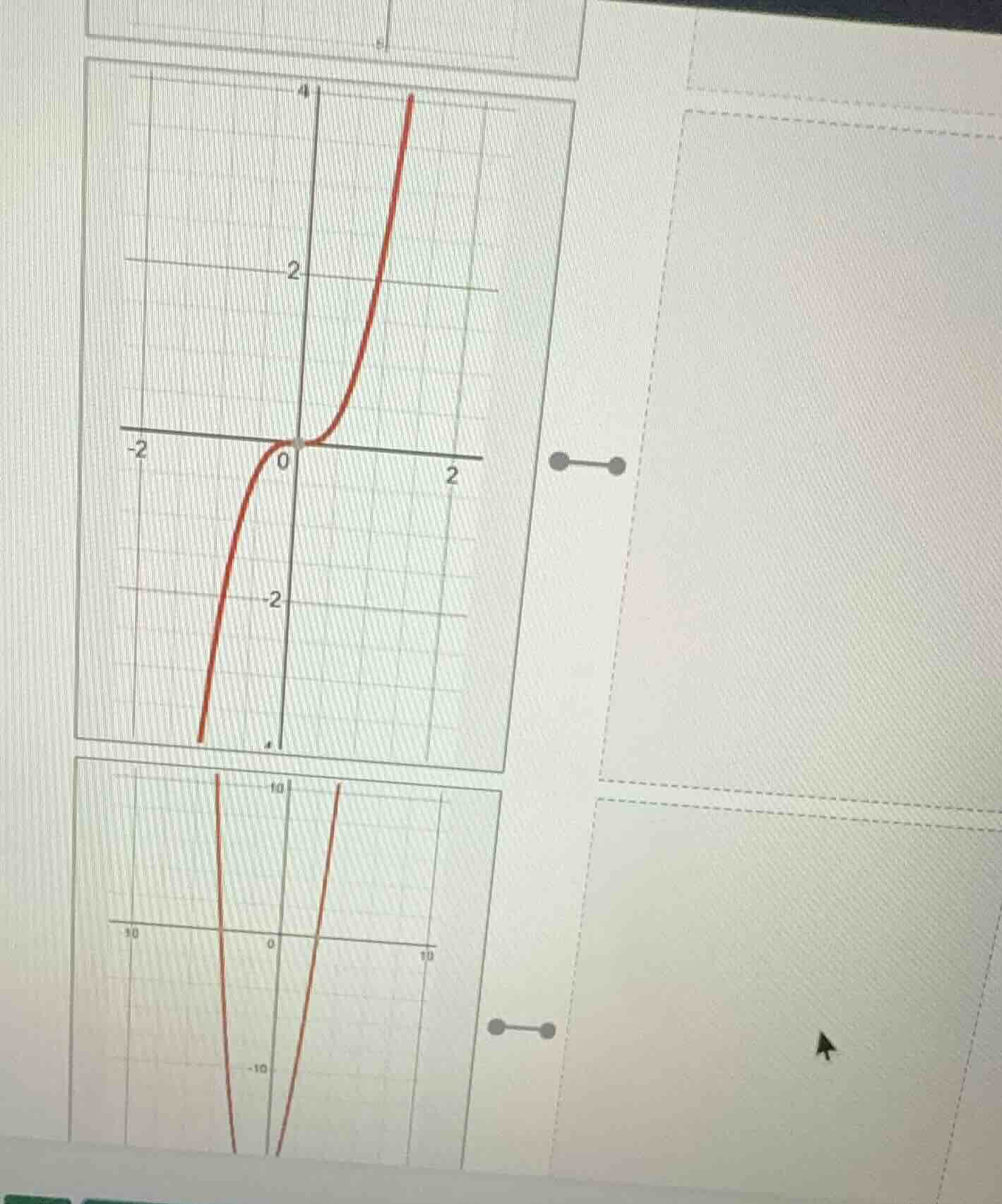
Step 1: Analyze the first graph
The first graph passes through the origin \( (0,0) \). At this point, the curve flattens out as it crosses the x-axis, which is a characteristic shape of a zero with an odd multiplicity greater than 1 (specifically, a cubic behavior, multiplicity of 3).
Looking at the grid:
- When \( x = 1 \), \( y \approx 2 \).
- When \( x = -1 \), \( y \approx -2 \).
This matches the cubic function:
$$ y = 2x^3 $$
Step 2: Analyze the second graph
The second graph is a parabola opening upwards with its vertex below the x-axis.
- The vertex is located at \( (0, -16) \).
- The x-intercepts (zeros) are at \( x = -2 \) and \( x = 2 \).
This matches a quadratic function of the form:
$$ y = a(x - 2)(x + 2) = a(x^2 - 4) $$
Using the y-intercept \( (0, -16) \):
$$ -16 = a(0^2 - 4) \implies a = 4 $$
Thus, the equation is:
$$ y = 4x^2 - 16 $$

Snap & solve any problem in the app
Get step-by-step solutions on Sovi AI
Photo-based solutions with guided steps
Explore more problems and detailed explanations
- First Graph (top): Matches the cubic function \( y = 2x^3 \)
- Second Graph (bottom): Matches the quadratic function \( y = 4x^2 - 16 \)