QUESTION IMAGE
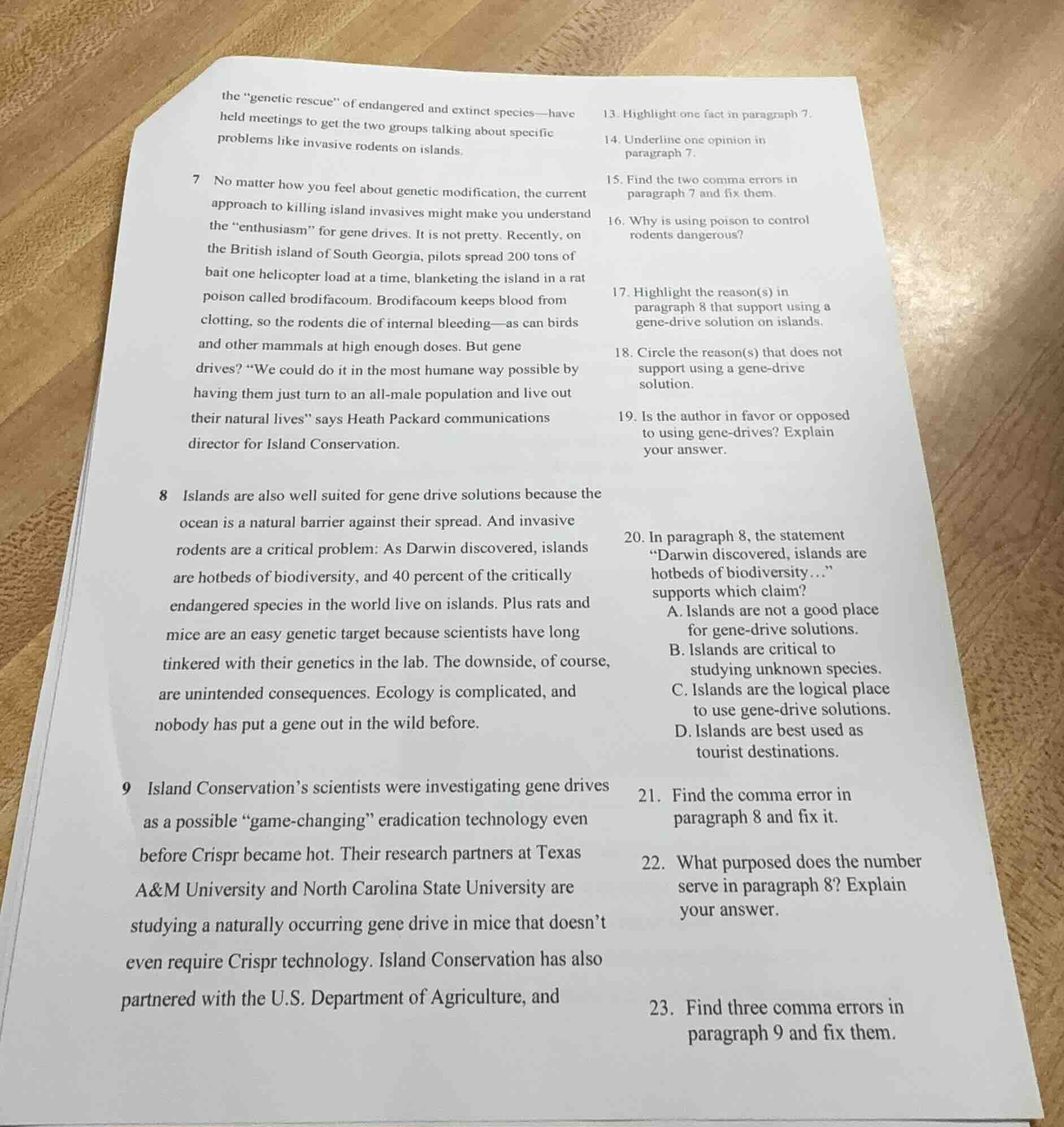
Question
Question was provided via image upload.
Analyze Paragraph 7 Questions (13-16)
- Question 13 (Fact in Paragraph 7): "Recently, on the British island of South Georgia, pilots spread 200 tons of bait one helicopter load at a time..."
- Question 14 (Opinion in Paragraph 7): "It is not pretty." or "No matter how you feel about genetic modification, the current approach to killing island invasives might make you understand the 'enthusiasm' for gene drives."
- Question 15 (Comma errors in Paragraph 7):
- "...pilots spread 200 tons of bait one helicopter load at a time, blanketing the island..." -> There should be a comma before "one helicopter load at a time" to set off the parenthetical/adverbial phrase: "...pilots spread 200 tons of bait, one helicopter load at a time, blanketing..."
- "...as can birds and other mammals at high enough doses." -> There should be a comma before "at high enough doses" or "as can birds, and other mammals, at high enough doses" is not the main issue. Let's look closer: "Brodifacoum keeps blood from clotting, so the rodents die of internal bleeding—as can birds and other mammals at high enough doses." Another error: "But gene drives?" is a fragment, but stylistically acceptable. Let's look at: "Recently, on the British island of South Georgia, pilots..." (correct). "...says Heath Packard communications director..." -> Missing comma setting off the appositive: "...says Heath Packard, communications director for Island Conservation."
- Question 16 (Danger of poison): Brodifacoum prevents blood clotting, causing rodents to die of internal bleeding, and it can also kill non-target species like birds and other mammals at high enough doses.
Analyze Paragraph 8 Questions (17-22)
- Question 17 (Reasons supporting gene-drive on islands): "Islands are also well suited for gene drive solutions because the ocean is a natural barrier against their spread."
- Question 18 (Reasons not supporting gene-drive): "The downside, of course, are unintended consequences. Ecology is complicated, and nobody has put a gene out in the wild before."
- Question 19 (Author's stance): Neutral/objective. The author presents both the benefits (humane, contained by oceans) and the significant risks (unintended consequences, complicated ecology, untested in the wild).
- Question 20 (Multiple Choice): The statement "Darwin discovered, islands are hotbeds of biodiversity..." supports the claim that islands are critical to protect, making them logical places to deploy conservation solutions. Thus, (C) is the best fit.
- Question 21 (Comma error in Paragraph 8): "The downside, of course, are unintended consequences." -> "are" should be "is" (subject-verb agreement), but for commas: "As Darwin discovered, islands..." is correct. "The downside, of course, is..." is correct. Let's look at: "...islands are hotbeds of biodiversity, and 40 percent..." (correct compound sentence). Let's look at: "Ecology is complicated, and nobody..." (correct). What about: "Plus rats and mice..." -> "Plus, rats and mice..." (needs a comma after the introductory transition "Plus").
- Question 22 (Purpose of the number 40 percent): It…

Snap & solve any problem in the app
Get step-by-step solutions on Sovi AI
Photo-based solutions with guided steps
Explore more problems and detailed explanations
Question 13
Fact: Pilots dropped 200 tons of poison bait on the island of South Georgia.
Question 14
Opinion: "It is not pretty."
Question 15
- "...pilots spread 200 tons of bait, one helicopter load at a time, blanketing..." (Add commas around the parenthetical phrase "one helicopter load at a time").
- "...says Heath Packard, communications director for Island Conservation." (Add a comma before the appositive "communications director").
Question 16
It causes animals to die of painful internal bleeding and can accidentally kill non-target wildlife like birds and other mammals.
Question 17
"Islands are also well suited for gene drive solutions because the ocean is a natural barrier against their spread."
Question 18
"The downside, of course, are unintended consequences. Ecology is complicated, and nobody has put a gene out in the wild before."
Question 19
The author is neutral. They present both the positive potential (humane eradication, natural ocean barriers) and the serious risks (unintended ecological consequences).
Question 20
- (A) Islands are not a good place for gene-drive solutions.
- (B) Islands are critical to studying unknown species.
- (C) Islands are the logical place to use gene-drive solutions. (Correct answer)
- (D) Islands are best used as tourist destinations.
Question 21
"Plus rats and mice..." should be "Plus, rats and mice..." (Add a comma after the introductory word "Plus").
Question 22
It provides statistical evidence to show how ecologically valuable islands are, justifying why they are targeted for conservation.
Question 23
- "...eradication technology, even before..." (Add a comma before "even" to separate the adverbial clause).
- "...U.S. Department of Agriculture, and..." (Remove the comma before "and" because it does not connect two independent clauses).
- "...Texas A&M University, and North Carolina State University..." (Remove the comma if present, or add a comma after "University" if treating the partners as an introductory parenthetical: "Their research partners, at Texas A&M University and North Carolina State University, are studying...").