QUESTION IMAGE
Question
Question was provided via image upload.
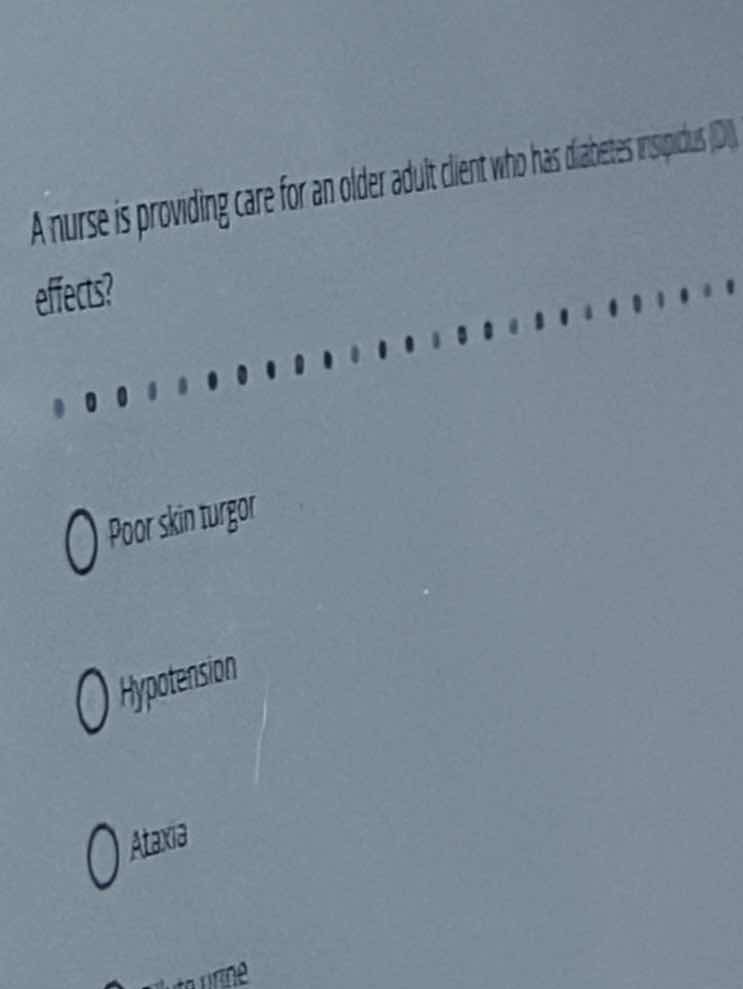
Analyze the clinical scenario
The question asks about a nurse providing care for an older adult client with diabetes insipidus (DI). Although the end of the question is slightly cut off, the context of DI (which causes massive fluid loss, leading to severe dehydration) and the options point toward identifying which clinical manifestation or assessment finding is affected or unreliable in an older adult. Specifically, the question asks which finding is not a reliable indicator of dehydration in an older adult, or which assessment is altered by aging.
Evaluate the clinical indicators of dehydration
In patients with diabetes insipidus, monitoring for dehydration (fluid volume deficit) is critical. Common signs of dehydration include:
- Hypotension (due to decreased blood volume)
- Dilute urine (a hallmark of DI itself due to lack of ADH)
- Tachycardia
- Poor skin turgor
Consider age-related physiological changes
In older adults, skin elasticity naturally decreases due to a loss of collagen and subcutaneous tissue. Consequently, skin turgor is often poor even when the older adult is well-hydrated. Therefore, checking skin turgor (especially on the back of the hand) is not a reliable indicator of dehydration in geriatric patients. Instead, other indicators like dry mucous membranes, blood pressure, and mental status changes are more reliable.
Determine the correct option
Based on standard nursing knowledge regarding geriatric assessment and fluid volume deficit, poor skin turgor is an unreliable sign of dehydration in older adults due to normal age-related skin changes.

Snap & solve any problem in the app
Get step-by-step solutions on Sovi AI
Photo-based solutions with guided steps
Explore more problems and detailed explanations
- (A) Poor skin turgor (Correct answer)
- (B) Hypotension
- (C) Ataxia
- (D) Dilute urine