QUESTION IMAGE
Question
Question was provided via image upload.
Identify the missing question context
The image shows five options (a through e) describing biological or behavioral scenarios, but the main question stem is cropped out. Based on standard high school biology curricula, these options are typically used to identify examples of either stimuli (internal or external) or responses (conditioned or unconditioned). Let's analyze the nature of each option to provide a comprehensive explanation that addresses the most likely question stems.
Analyze each option biologically
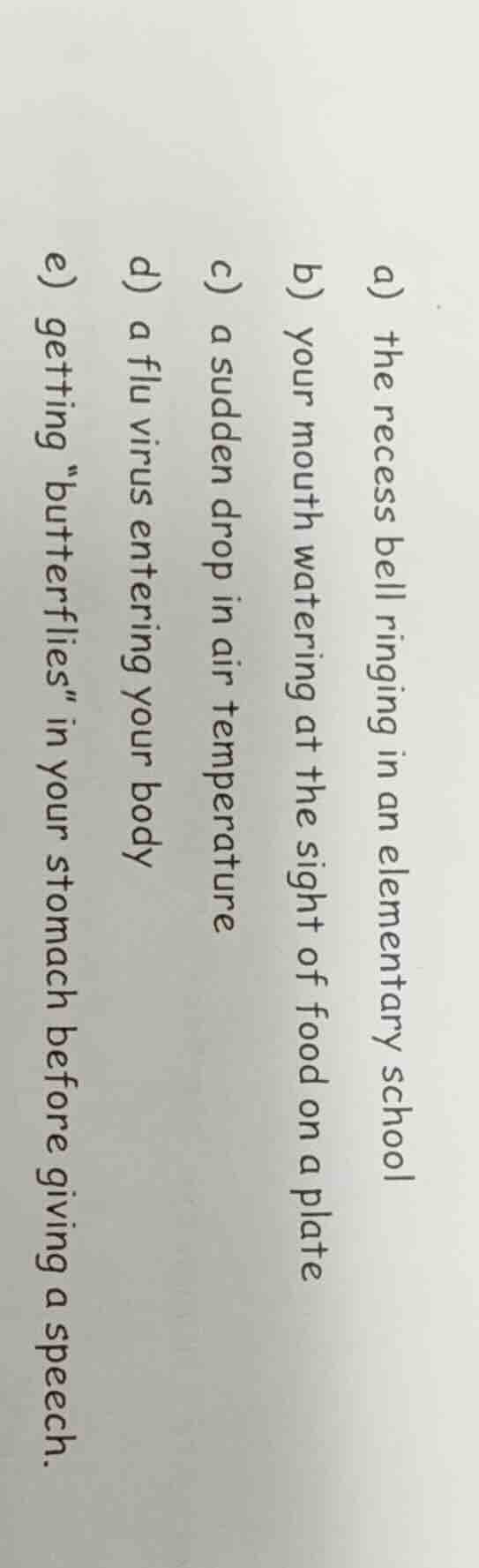
- a) the recess bell ringing in an elementary school: This is an external stimulus. It is an environmental change detected by auditory receptors, which leads to a learned (conditioned) behavioral response in students.
- b) your mouth watering at the sight of food on a plate: This is a response (specifically, a conditioned physiological reflex) triggered by an external visual stimulus (the sight of food).
- c) a sudden drop in air temperature: This is an external stimulus. It is a physical change in the surrounding environment detected by thermoreceptors in the skin.
- d) a flu virus entering your body: This is an internal stimulus (or an internal trigger). Once inside, the virus is detected by the immune system, triggering physiological responses like a fever.
- e) getting "butterflies" in your stomach before giving a speech: This is a physiological response (triggered by the nervous system in anticipation of a stressful event, which is the cognitive stimulus).
Determine the most common question matches
Depending on what your specific worksheet asks, here are the direct classifications:
- If the question asks to identify a learned/conditioned response: Option b (mouth watering at the sight of food) is a classic example of a conditioned response (Pavlovian response).
- If the question asks to identify an internal stimulus: Option d (a flu virus entering the body) represents an internal change that triggers an immune response.
- If the question asks to identify external stimuli: Options a and c represent physical changes in the external environment.

Snap & solve any problem in the app
Get step-by-step solutions on Sovi AI
Photo-based solutions with guided steps
Explore more problems and detailed explanations
Because the question stem is cut off, here is the classification for each option so you can match it to your specific question:
- (a) External Stimulus (Auditory cue triggering a learned behavior)
- (b) Conditioned Response (Physiological reflex triggered by seeing food)
- (c) External Stimulus (Physical environmental change detected by thermoreceptors)
- (d) Internal Stimulus (Pathogen entering the body triggering an immune response)
- (e) Physiological Response (Autonomic nervous system reaction to anxiety)