QUESTION IMAGE
Question
Question was provided via image upload.
Identify the operational challenge of high-volume CO2 welding
Using the Shielding Gas Function knowledge point
Carbon dioxide (\(\text{CO}_2\)) is stored as a liquid under high pressure in cylinders. When high flow rates are required in a production shop, the rapid expansion of \(\text{CO}_2\) gas from high cylinder pressure to low working pressure causes a severe temperature drop due to the Joule-Thomson effect. This rapid cooling can cause moisture in the air or the gas itself to freeze, leading to regulator freeze-up, ice formation, and restricted gas flow.
Determine the appropriate equipment solution
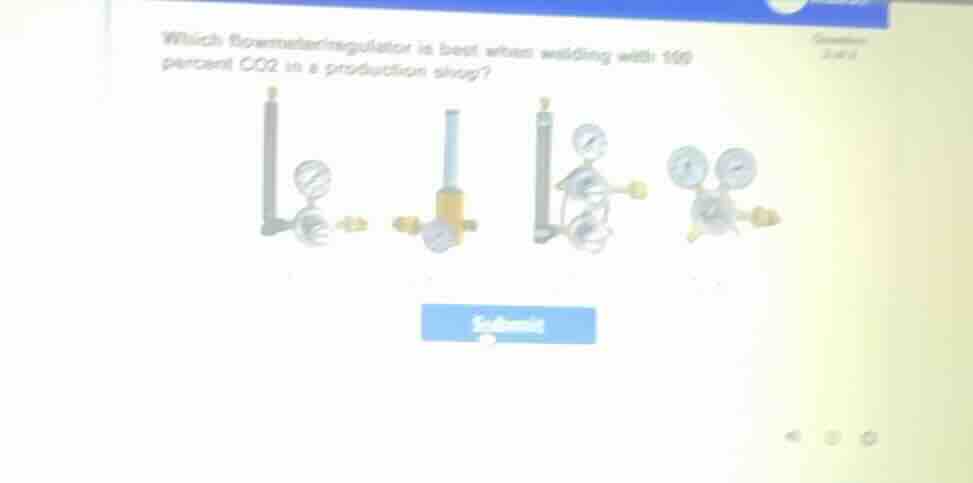
To prevent freezing during continuous high-flow production welding with 100% \(\text{CO}_2\), a specialized flowmeter/regulator equipped with an electric heating element is required. The heater warms the gas as it expands, preventing ice formation and ensuring a constant, uninterrupted flow of shielding gas.
Match the equipment with the visual options
Looking at the four options from left to right:
- Option 1 (A): A standard single-stage flowmeter regulator.
- Option 2 (B): A heated flowmeter regulator, characterized by its thick, cylindrical yellow/gold heated body housing the electrical heating element.
- Option 3 (C): A dual-flowmeter regulator assembly.
- Option 4 (D): A standard dual-gauge pressure regulator.
Therefore, the second option (B) is the best choice for welding with 100% \(\text{CO}_2\) in a production environment.

Snap & solve any problem in the app
Get step-by-step solutions on Sovi AI
Photo-based solutions with guided steps
Explore more problems and detailed explanations
- (A) Standard flowmeter regulator
- (B) Heated flowmeter regulator (Correct answer)
- (C) Dual flowmeter regulator
- (D) Dual-gauge pressure regulator