QUESTION IMAGE
Question
Question was provided via image upload.
Identify the question goal
The question asks to identify which diagram represents an inorganic substance.
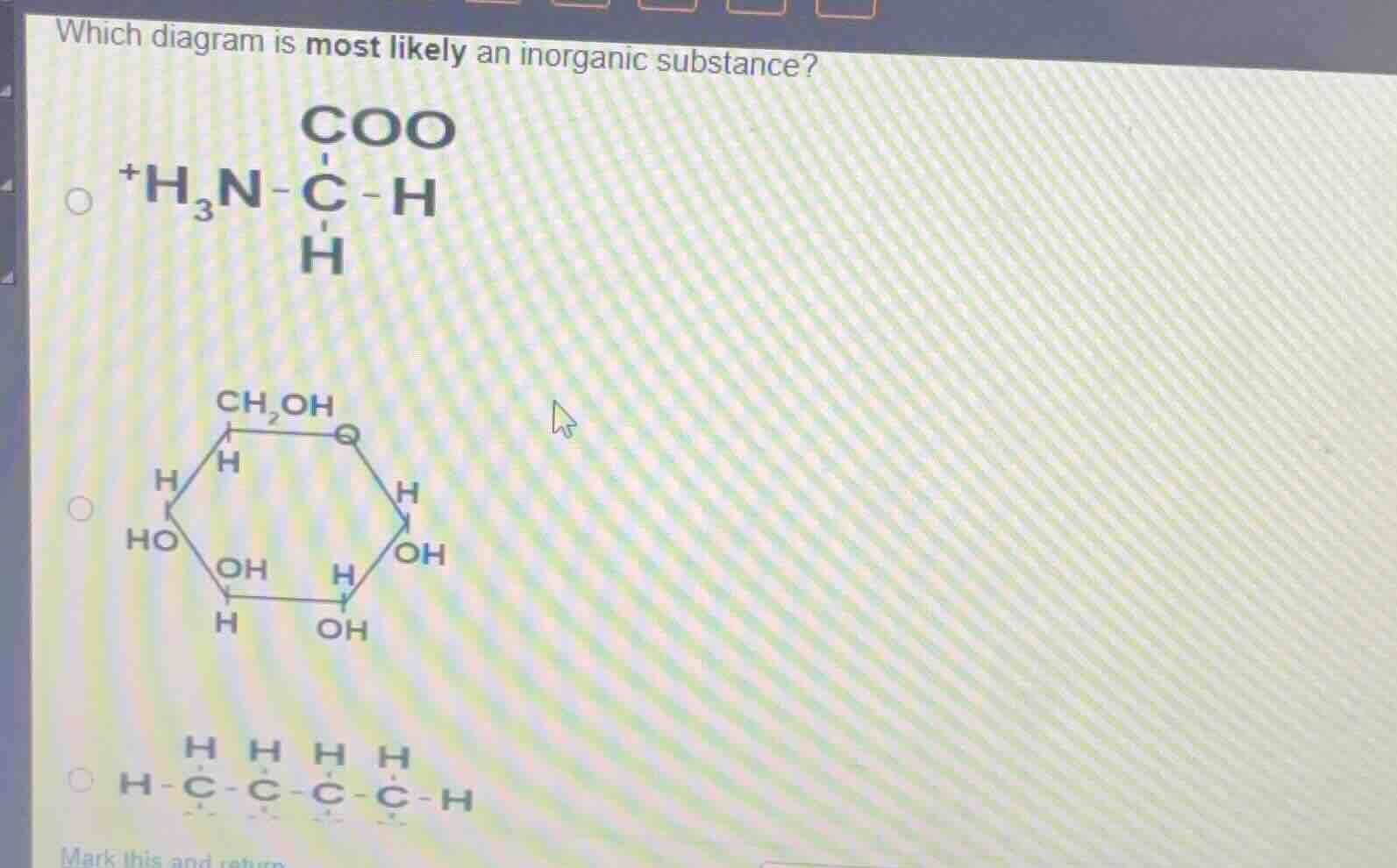
Analyze the first diagram
The first diagram shows an amino acid structure (specifically glycine in its zwitterionic form, with a carboxylate group \(-\text{COO}^-\), an amino group \(-\text{NH}_3^+\), and a central carbon bonded to hydrogen). Since it contains carbon-hydrogen bonds and is a biological molecule, it is classified under Organic Compounds.
Analyze the second diagram
The second diagram shows a ring structure representing a monosaccharide (glucose). This molecule consists of a carbon ring with hydroxyl groups and hydrogen atoms. Because of its carbon-based backbone, it is classified under Organic Compounds.
Analyze the third diagram
The third diagram shows a straight-chain hydrocarbon (butane, \(\text{C}_4\text{H}_{10}\)). Hydrocarbons are classic examples of Organic Compounds.
Determine the missing option
The image is cropped and only shows three organic options (amino acid, glucose, and butane) with their radio buttons. The correct answer must be the fourth option, which is cut off from the bottom of the image. An inorganic substance typically lacks carbon-hydrogen (\(\text{C-H}\)) covalent bonds (such as water \(\text{H}_2\text{O}\), carbon dioxide \(\text{CO}_2\), salts like \(\text{NaCl}\), or mineral acids/bases). Since the fourth option is not visible, we identify that the three visible options are all organic, meaning the missing fourth option is the inorganic substance.

Snap & solve any problem in the app
Get step-by-step solutions on Sovi AI
Photo-based solutions with guided steps
Explore more problems and detailed explanations
Question 1
- (A) First diagram (amino acid)
- (B) Second diagram (glucose)
- (C) Third diagram (butane)
- (D) Fourth diagram (not visible in the image, representing an inorganic substance) (Correct answer)