QUESTION IMAGE
Question
Question was provided via image upload.
Identify the missing question context
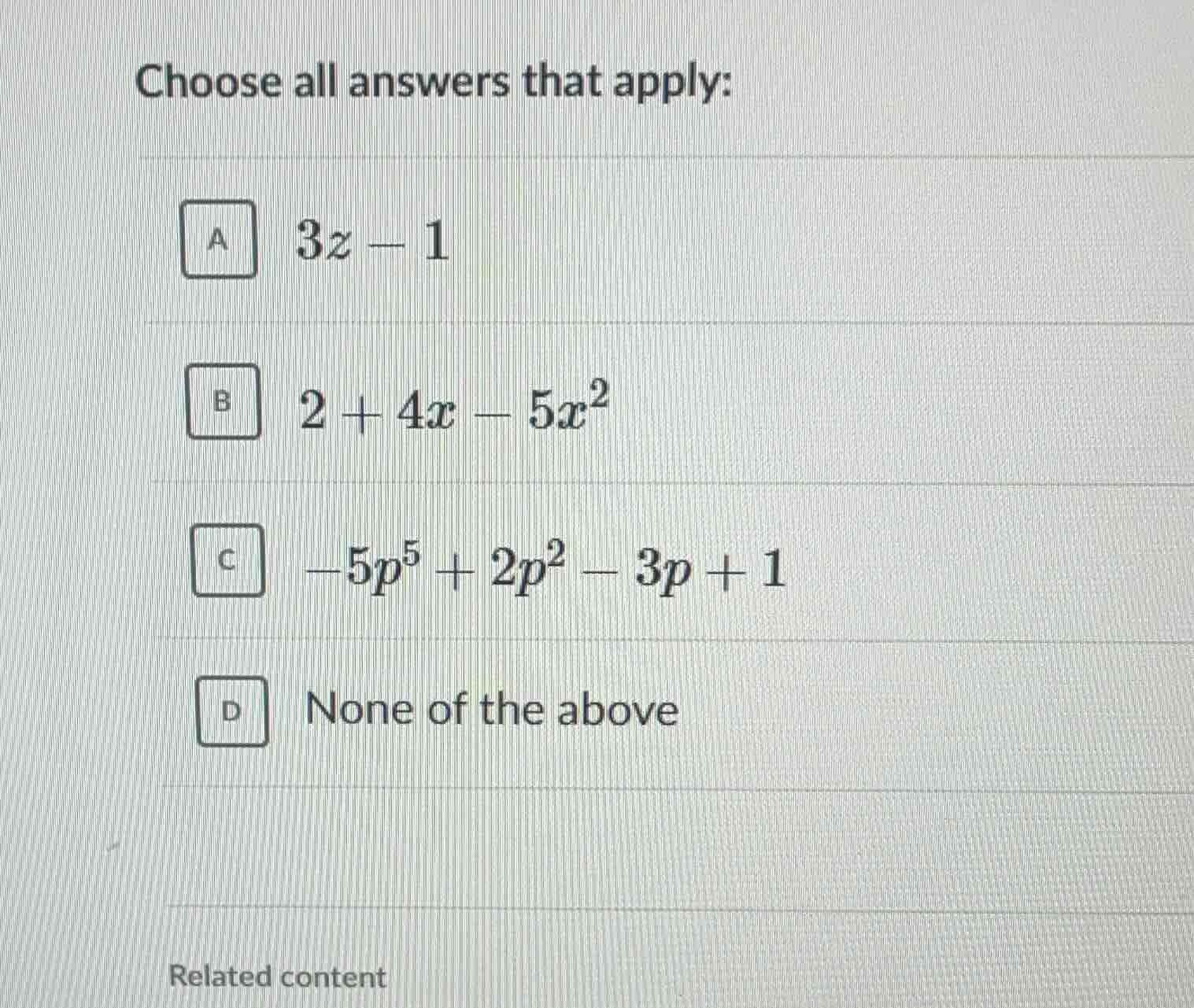
The top of the image is cropped, but the instruction "Choose all answers that apply" and the options suggest a classification task. Based on standard algebra curricula, a common question with these options is to identify which expressions are trinomials, or which have a specific degree (such as quadratic trinomials). Let us analyze the options to determine the most likely question.
- Option A: \(3z - 1\) is a binomial of degree 1.
- Option B: \(2 + 4x - 5x^2\) is a trinomial of degree 2 (quadratic trinomial).
- Option C: \(-5p^5 + 2p^2 - 3p + 1\) is a 4-term polynomial of degree 5.
If the question asks to "Select all trinomials" or "Select all quadratic trinomials", Option B is the unique mathematical trinomial of degree 2. We will analyze the properties of each expression.
Analyze expression terms and degrees
Using the Polynomial Terms and Polynomial Degree knowledge points:
- Option A: \(3z - 1\) has 2 terms. It is a binomial.
- Option B: \(2 + 4x - 5x^2\) has 3 terms. It is a trinomial. Its highest exponent is 2, making it a quadratic trinomial.
- Option C: \(-5p^5 + 2p^2 - 3p + 1\) has 4 terms. It is a polynomial with 4 terms.
Determine the correct choice
Assuming the standard question is "Which of the following are trinomials?" or "Which of the following is a quadratic trinomial?":
- Option B is the only trinomial among the choices (excluding "None of the above").
- Therefore, Option B is the correct choice.

Snap & solve any problem in the app
Get step-by-step solutions on Sovi AI
Photo-based solutions with guided steps
Explore more problems and detailed explanations
- (A) \(3z - 1\)
- (B) \(2 + 4x - 5x^2\) (Correct answer)
- (C) \(-5p^5 + 2p^2 - 3p + 1\)
- (D) None of the above