QUESTION IMAGE
Question
Question was provided via image upload.
Analyze the purpose of the opening question
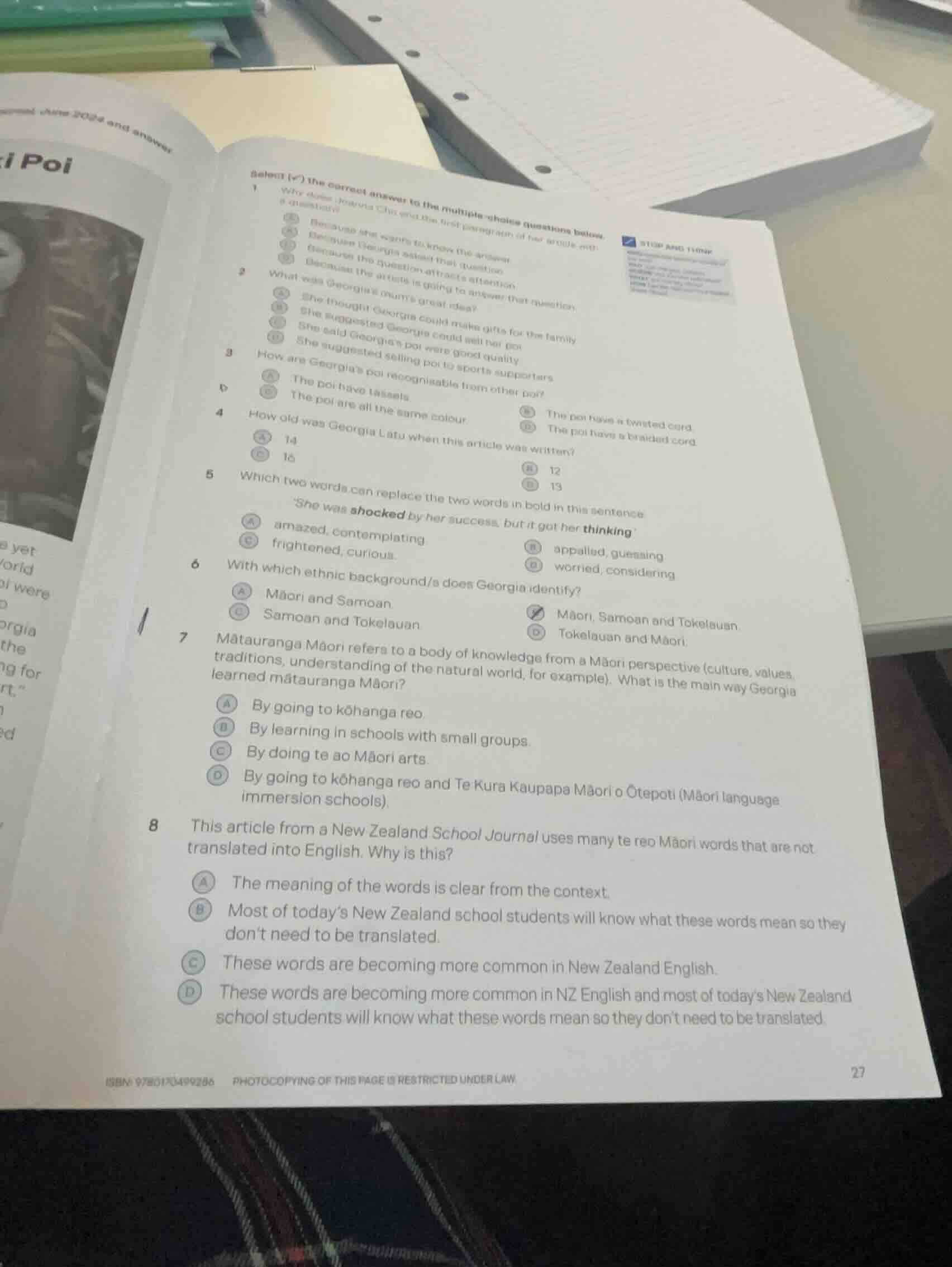
The first question asks why the author, Joanna, ends the first paragraph with a question. In Authors Purpose, rhetorical questions are often used to hook the reader's interest. Looking at the options, the checked option is (C) "Because the question attracts attention." This aligns with standard reading comprehension strategies where opening questions serve to engage and draw in the reader.
Identify Georgia's mum's great idea
The second question asks about the "great idea" proposed by Georgia's mother. Looking closely at the page, option (D) "She suggested selling poi to sports supporters" is checked. This indicates that her mother's idea was a business or fundraising suggestion related to selling poi to sports fans.
Determine how Georgia's poi are recognizable
The third question asks how Georgia's poi are recognizable from other poi. The options describe physical features of the poi (tassels, twisted cord, same colour, braided cord). The checked option is (D) "The poi have a braided cord." This is a specific detail identifying her unique design.
Determine Georgia's age during the article
The fourth question asks how old Georgia Latu was when the article was written. The options are 14, 12, 16, and 13. The checked option is (B) 12, which is a direct factual detail from the biographical context of the article.
Analyze vocabulary in context
The fifth question asks which two words can replace "shocked" and "thinking" in the sentence: "She was shocked by her success, but it got her thinking".
Using Vocabulary in Context:
- "Shocked" can be replaced by "amazed".
- "Thinking" can be replaced by "contemplating".
Thus, option (A) "amazed, contemplating" is the correct choice.
Identify Georgia's ethnic background
The sixth question asks about Georgia's ethnic background. The checked option is (B) "Māori, Samoan and Tokelauan," indicating she identifies with all three Pacific heritages.
Determine the main way Georgia learned mātauranga Māori
The seventh question asks how Georgia learned mātauranga Māori (Māori knowledge). The checked option is (D) "By going to kōhanga reo and Te Kura Kaupapa Māori o Ōtepoti (Māori language immersion schools)." This shows her education was rooted in immersion environments.
Analyze the lack of translation for te reo Māori words
The eighth question asks why the article, from a New Zealand School Journal, does not translate many te reo Māori words. The checked option is (D) "These words are becoming more common in NZ English and most of today's New Zealand school students will know what these words mean so they don't need to be translated." This reflects the modern educational and cultural context of New Zealand.

Snap & solve any problem in the app
Get step-by-step solutions on Sovi AI
Photo-based solutions with guided steps
Explore more problems and detailed explanations
Question 1
- (A) Because she wants to know the answer.
- (B) Because Georgia asked that question.
- (C) Because the question attracts attention. (Correct answer)
- (D) Because the article is going to answer that question.
Question 2
- (A) She thought Georgia could make gifts for the family.
- (B) She suggested Georgia could sell her poi.
- (C) She said Georgia's poi were good quality.
- (D) She suggested selling poi to sports supporters. (Correct answer)
Question 3
- (A) The poi have tassels.
- (B) The poi have a twisted cord.
- (C) The poi are all the same colour.
- (D) The poi have a braided cord. (Correct answer)
Question 4
- (A) 14
- (B) 12 (Correct answer)
- (C) 16
- (D) 13
Question 5
- (A) amazed, contemplating (Correct answer)
- (B) appalled, guessing
- (C) frightened, curious
- (D) worried, considering
Question 6
- (A) Māori and Samoan
- (B) Māori, Samoan and Tokelauan (Correct answer)
- (C) Samoan and Tokelauan
- (D) Tokelauan and Māori
Question 7
- (A) By going to kōhanga reo.
- (B) By learning in schools with small groups.
- (C) By doing te ao Māori arts.
- (D) By going to kōhanga reo and Te Kura Kaupapa Māori o Ōtepoti (Māori language immersion schools). (Correct answer)
Question 8
- (A) The meaning of the words is clear from the context.
- (B) Most of today's New Zealand school students will know what these words mean so they don't need to be translated.
- (C) These words are becoming more common in New Zealand English.
- (D) These words are becoming more common in NZ English and most of today's New Zealand school students will know what these words mean so they don't need to be translated. (Correct answer)