QUESTION IMAGE
Question
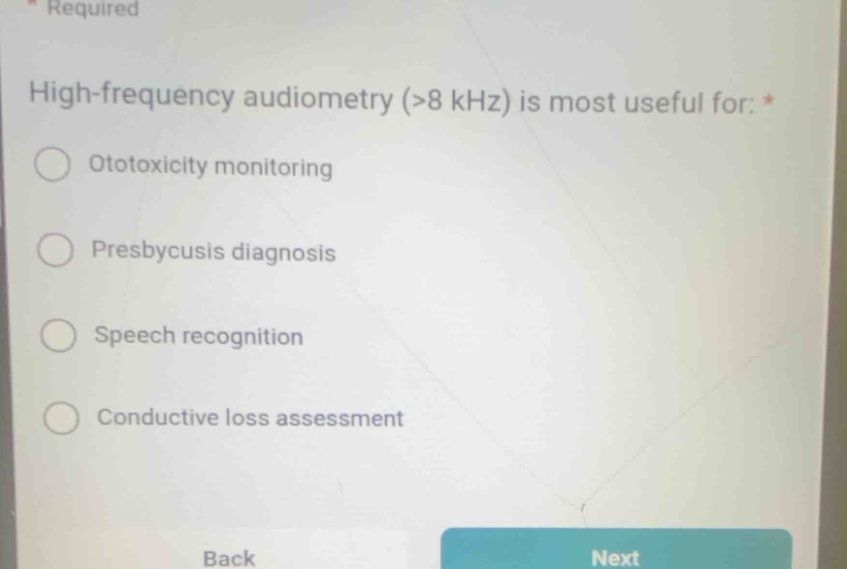
high-frequency audiometry (>8 khz) is most useful for:
- ototoxicity monitoring
- presbycusis diagnosis
- speech recognition
- conductive loss assessment
<pre_analysis>
{
"quality": "clear",
"question_count": 1,
"skills_matched": [
"direct_cot",
"multiple_choice_formatter",
"explain_then_answer",
"tutor"
],
"needs_drawing": false,
"concepts_used": [
"Clinical Audiometry"
],
"new_concepts": [
"High-frequency Audiometry",
"Ototoxicity Monitoring"
],
"current_concepts": [
"Clinical Audiometry",
"High-frequency Audiometry",
"Ototoxicity Monitoring"
]
}
</pre_analysis>
<reasoning>
Analyze high-frequency audiometry
Using the Clinical Audiometry knowledge point, high-frequency audiometry tests hearing thresholds above \(8\text{ kHz}\) (typically up to \(16\text{–}20\text{ kHz}\)). The base of the cochlea, which processes these ultra-high frequencies, is highly susceptible to early damage from ototoxic medications (such as cisplatin or aminoglycosides) before the damage progresses to lower frequencies critical for speech.
Evaluate the options
- Ototoxicity monitoring: This is the primary clinical application, as high-frequency hearing loss serves as an early warning sign of cochlear damage.
- Presbycusis diagnosis: While age-related hearing loss affects high frequencies, standard audiometry up to \(8\text{ kHz}\) is sufficient for diagnosis.
- Speech recognition: Speech sounds primarily fall within the \(250\text{ Hz}\) to \(8\text{ kHz}\) range.
- Conductive loss assessment: Conductive hearing loss typically affects low-to-mid frequencies and is assessed using standard air and bone conduction testing.
</reasoning>
<answer>
<mcq-correct>(A) Ototoxicity monitoring</mcq-correct>
<mcq-option>(B) Presbycusis diagnosis</mcq-option>
<mcq-option>(C) Speech recognition</mcq-option>
<mcq-option>(D) Conductive loss assessment</mcq-option>
</answer>
<post_analysis>
{
"subject": "Natural Science",
"question_type": "Multiple Choice",
"knowledge_point": [
"Natural Science",
"Medicine",
"Audiology"
]
}
</post_analysis>
Snap & solve any problem in the app
Get step-by-step solutions on Sovi AI
Photo-based solutions with guided steps
Explore more problems and detailed explanations
<pre_analysis>
{
"quality": "clear",
"question_count": 1,
"skills_matched": [
"direct_cot",
"multiple_choice_formatter",
"explain_then_answer",
"tutor"
],
"needs_drawing": false,
"concepts_used": [
"Clinical Audiometry"
],
"new_concepts": [
"High-frequency Audiometry",
"Ototoxicity Monitoring"
],
"current_concepts": [
"Clinical Audiometry",
"High-frequency Audiometry",
"Ototoxicity Monitoring"
]
}
</pre_analysis>
<reasoning>
Analyze high-frequency audiometry
Using the Clinical Audiometry knowledge point, high-frequency audiometry tests hearing thresholds above \(8\text{ kHz}\) (typically up to \(16\text{–}20\text{ kHz}\)). The base of the cochlea, which processes these ultra-high frequencies, is highly susceptible to early damage from ototoxic medications (such as cisplatin or aminoglycosides) before the damage progresses to lower frequencies critical for speech.
Evaluate the options
- Ototoxicity monitoring: This is the primary clinical application, as high-frequency hearing loss serves as an early warning sign of cochlear damage.
- Presbycusis diagnosis: While age-related hearing loss affects high frequencies, standard audiometry up to \(8\text{ kHz}\) is sufficient for diagnosis.
- Speech recognition: Speech sounds primarily fall within the \(250\text{ Hz}\) to \(8\text{ kHz}\) range.
- Conductive loss assessment: Conductive hearing loss typically affects low-to-mid frequencies and is assessed using standard air and bone conduction testing.
</reasoning>
<answer>
<mcq-correct>(A) Ototoxicity monitoring</mcq-correct>
<mcq-option>(B) Presbycusis diagnosis</mcq-option>
<mcq-option>(C) Speech recognition</mcq-option>
<mcq-option>(D) Conductive loss assessment</mcq-option>
</answer>
<post_analysis>
{
"subject": "Natural Science",
"question_type": "Multiple Choice",
"knowledge_point": [
"Natural Science",
"Medicine",
"Audiology"
]
}
</post_analysis>