QUESTION IMAGE
Question
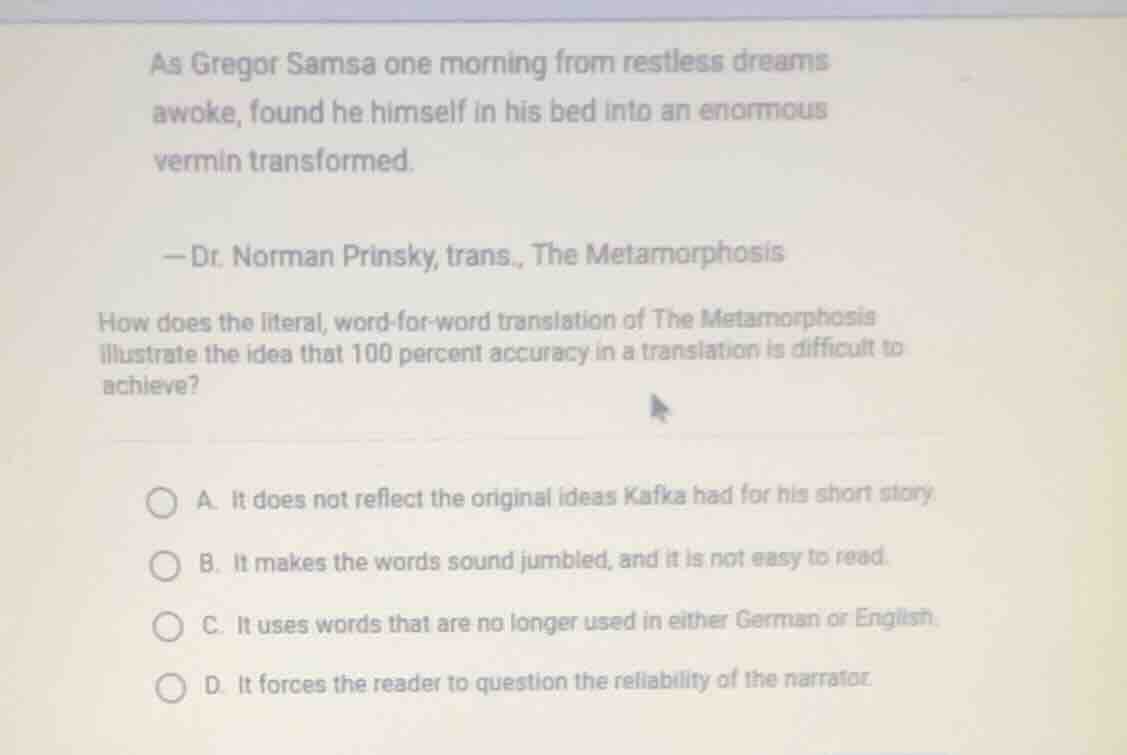
as gregor samsa one morning from restless dreams awoke, found he himself in his bed into an enormous vermin transformed.
—dr. norman prinsky, trans., the metamorphosis
how does the literal, word-for-word translation of the metamorphosis illustrate the idea that 100 percent accuracy in a translation is difficult to achieve?
a. it does not reflect the original ideas kafka had for his short story.
b. it makes the words sound jumbled, and it is not easy to read.
c. it uses words that are no longer used in either german or english.
d. it forces the reader to question the reliability of the narrator.
Analyze the syntax of the literal translation
The provided quote, "As Gregor Samsa one morning from restless dreams awoke, found he himself in his bed into an enormous vermin transformed," follows German word order (syntax) directly. In English, this literal word-for-word structure results in awkward, unnatural phrasing ("found he himself", "into an enormous vermin transformed").
Evaluate the answer choices
- (A) Incorrect. The literal translation still conveys Kafka's core plot point and ideas, but the phrasing is awkward.
- (B) Correct. The word-for-word translation makes the English sentence structure sound jumbled, unnatural, and difficult to read smoothly.
- (C) Incorrect. The words used ("restless", "dreams", "vermin", "transformed") are common, modern English words.
- (D) Incorrect. The awkward syntax is a result of translation mechanics, not a stylistic choice designed to make the reader doubt the narrator's reliability.

Snap & solve any problem in the app
Get step-by-step solutions on Sovi AI
Photo-based solutions with guided steps
Explore more problems and detailed explanations
- (A) It does not reflect the original ideas Kafka had for his short story.
- (B) It makes the words sound jumbled, and it is not easy to read. (Correct answer)
- (C) It uses words that are no longer used in either German or English.
- (D) It forces the reader to question the reliability of the narrator.