QUESTION IMAGE
Question
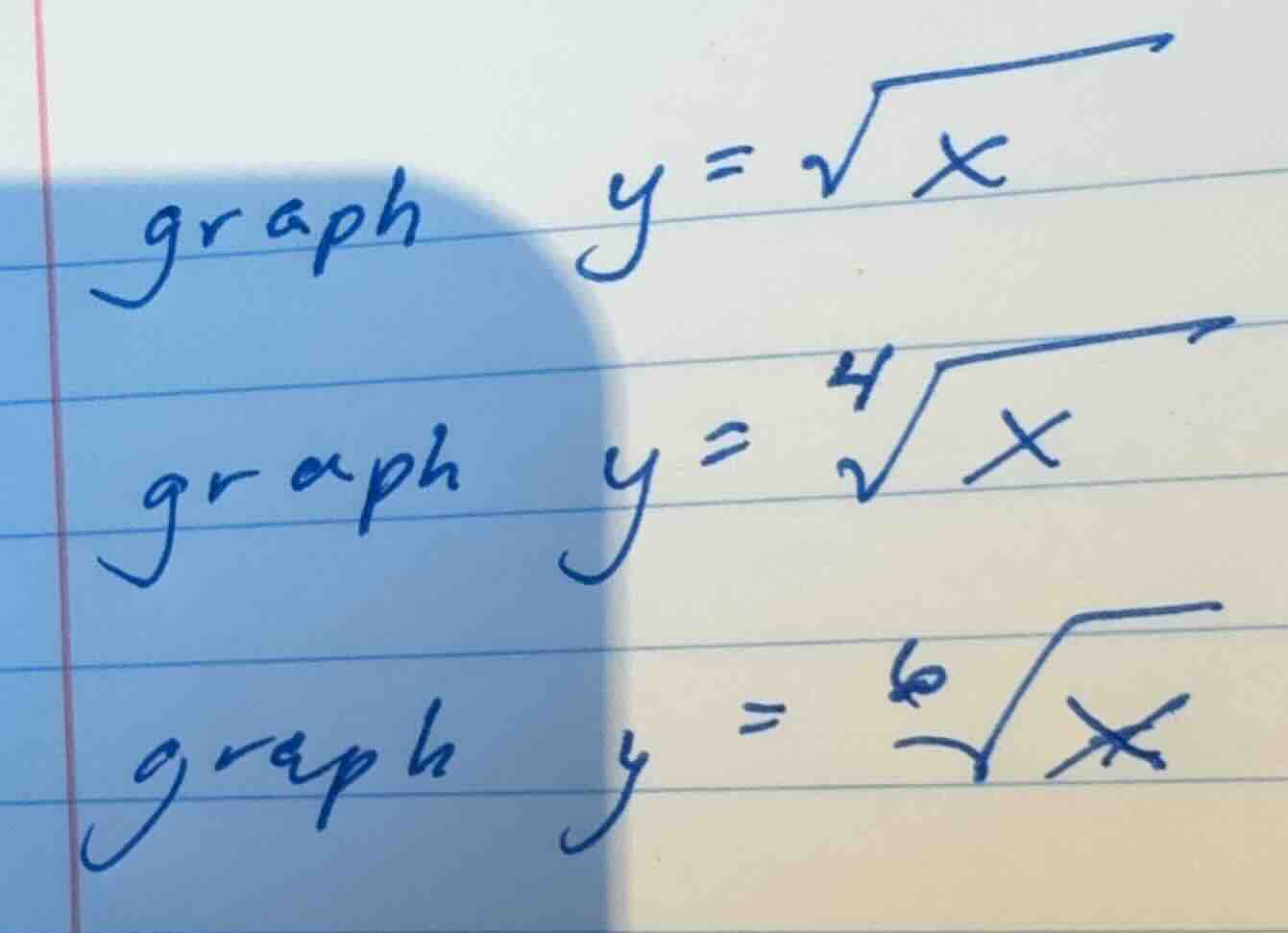
graph \\(y = \sqrt{x}\\)
graph \\(y = \sqrt4{x}\\)
graph \\(y = \sqrt6{x}\\)
🆕 New Concept Discovered: Graphing Radical Functions
How even-index radical curves behave and compare.
Step 1: Identify key characteristics and domain
For any radical function with an even index, \(y = \sqrt[n]{x}\) (where \(n = 2, 4, 6\)):
- Domain: Since we cannot take an even root of a negative number in the real number system, we must have \(x \ge 0\).
- Range: The principal root is always non-negative, so \(y \ge 0\).
- Key Points: All three graphs pass through the points \((0, 0)\) and \((1, 1)\) because:
Step 2: Compare the growth rates
To see how the curves behave relative to each other, we look at two intervals:
- Between \(0\) and \(1\) (\(0 < x < 1\)):
Higher roots of a fraction make it larger. For example, at \(x = 0.01\):
Thus, for \(0 < x < 1\), the graph of \(y = \sqrt[6]{x}\) is the steepest (highest), followed by \(y = \sqrt[4]{x}\), and \(y = \sqrt{x}\) is the lowest.
- Greater than \(1\) (\(x > 1\)):
Higher roots of a number larger than \(1\) make it smaller. For example, at \(x = 64\):
Thus, for \(x > 1\), the graph of \(y = \sqrt{x}\) is the highest, followed by \(y = \sqrt[4]{x}\), and \(y = \sqrt[6]{x}\) is the flattest (lowest).
Step 3: Plot key coordinate points
We can calculate specific points for each function to construct an accurate graph:
- For \(y = \sqrt{x}\):
- For \(y = \sqrt[4]{x}\):
- For \(y = \sqrt[6]{x}\):
Step 4: Sketch the curves
Using the points and comparisons above, we sketch the three curves on the same coordinate plane:
   y ^
     |
   2 +--------------------------------------------------* y = \sqrt{x}
     |                                     *
     |                       *  y = \sqrt[4]{x}
   1 +---------*------------+------------+------------+
     |       *   *
     |     *       *  y = \sqrt[6]{x}
     |   *
   0 +*----------+------------+------------+------------+--> x
     0           1            4            16           64
Snap & solve any problem in the app
Get step-by-step solutions on Sovi AI
Photo-based solutions with guided steps
Explore more problems and detailed explanations
To graph the three functions \(y = \sqrt{x}\), \(y = \sqrt[4]{x}\), and \(y = \sqrt[6]{x}\):
- Start at the origin: All three curves begin at \((0,0)\) and only exist in the first quadrant (\(x \ge 0\), \(y \ge 0\)).
- Intersection point: All three curves intersect exactly at \((1,1)\).
- Between \(0\) and \(1\): The curve with the higher index is higher up.
- For \(x > 1\): The curve with the higher index is flatter and lower down.